
MBA Students Pitch Deeptech Startups at HEC Paris Lab2Biz Grand Jury
MBA Students Pitch Deeptech Startups at HEC Paris Lab2Biz Grand JuryAt the culmination of the MBA Entrepreneurship Specialization at HEC Paris, students step onto a stage where ideas meet scrutiny—and potential meets opportunity. The annual Grand Jury, held in December 2025, brought together MBA students, faculty, entrepreneurs, and industry leaders for an evening dedicated to innovation, ambition, and the future of deeptech entrepreneurship.
During the event, six student teams presented ventures developed through Lab2Biz, a program that challenges participants to transform cutting-edge research into viable business opportunities. Working in teams of three to four and supported by dedicated mentors, students spent months developing strategies as if they were launching real startups—culminating in a high-stakes pitch session before a distinguished panel of judges.
“This is more than a class assignment,” said Brad Harris, Associate Dean of MBA Programs. “It’s a preview of how you might change the world. Entrepreneurship is in the DNA of our school, and moments like this remind us why we do what we do.”
Turning Research into Real Ventures
Each team faced a rigorous pitching format: a one-minute elevator pitch by the CEO, a full team presentation outlining the business concept, followed by nine minutes of intense questioning from the jury. The evaluation simulated conversations with real investors—probing market viability, business models, and technological feasibility.
The projects showcased the breadth of innovation emerging from the intersection of research and entrepreneurship:
- UberSat explored how space debris could be transformed into propulsion for satellites through laser ablation technology—turning orbital waste into a sustainable fuel source.
- ADAMe introduced a real-time decision system designed to help semiconductor manufacturing plants detect anomalies and optimize production efficiency.
- HECEDA proposed AI-powered software capable of dramatically accelerating chip design, reducing complex processes from hours to minutes.
- U-Veil developed a new approach to nanoparticle identification that dramatically shortens laboratory testing time while maintaining reliable accuracy.
- Cryptaris tackled the growing threat of healthcare cyberattacks with encrypted data analytics, allowing hospitals and insurers to run analytics without ever decrypting sensitive patient information.
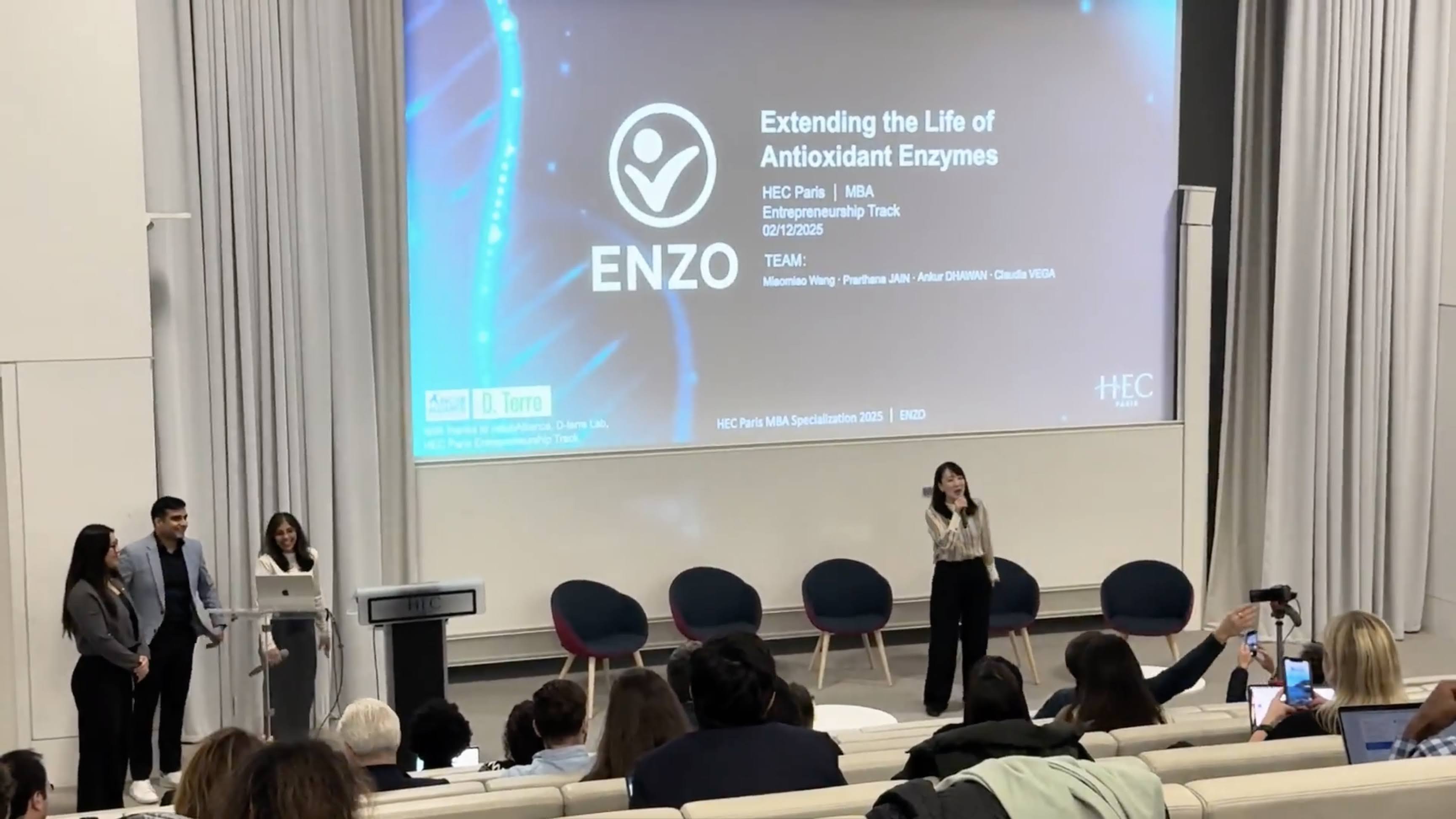
- ENZO focused on biotechnology innovation, extending the activity of antioxidant enzymes used in anti-aging products from two hours to up to 24 hours.
For many participants, the experience provided the closest possible simulation of launching a startup.
“I want to work in a startup eventually,” said Garima Gupta, CMO of Cryptaris. “This was the closest education we’ll get to how a startup works. Even without a technical background, it showed me that I can tackle complex problems if given the opportunity.”
Learning Entrepreneurship Through Practice
The Entrepreneurship Specialization emphasizes hands-on learning—an approach highlighted by Andrea Masini, Dean of Faculty and Research.
“HEC Paris is not only a place where we create knowledge,” he said. “It’s also a platform for solutions. Programs like this give students the chance to turn ideas into reality while learning from mentors who have done it before.”
Students frequently note that the program’s practical nature is what makes it transformative. Throughout the semester, teams meet regularly with mentors, refine their strategies, and explore real market opportunities.
For Bekhzod Khojiakhmedov, CFO of the U-Veil team, the experience revealed what it truly takes to build a venture from scratch.
“When I looked at the profiles of the professors, I saw that they all had practical, hands-on experience in business,” he explained. “Throughout the project we had regular meetings with our mentor and worked together to figure out how to enter the market. It was a very practical experience that I believe I can use in the future to create my own venture.”
Celebrating the Winners
At the end of the evening, Grand Jury Sponsor Thierry Drilhon announced the winning teams: U-Veil and ENZO, two ventures that impressed the jury with both the strength of their ideas and the clarity of their presentations.
Thierry, Senior Advisor, Europe at Francisco Partners and Co-founder of the Women Cardiovascular Foundation, praised the students’ passion and the collaborative spirit behind their projects.
“Your passion will drive your teams and inspire the people who believe in your vision,” he told the students. “Never forget that your most important asset is people. You will succeed because you surround yourselves with talented individuals who share the same vision.”
Thierry shared insights from his experience leading global technology companies such as former CEO of Microsoft France, Cisco Europe and Euromedia Group. He is also former President of the Franco British Chamber of Commerce.
For the U-Veil team, the recognition was the culmination of months of intensive work and collaboration.
“We didn’t know we were going to win,” said Kabia Narvaez, CEO of the team. “But we knew how much effort we had put into the project. The main goal was for people to see the product and experience what it feels like to build something like this.”
The experience, she added, felt remarkably close to launching a real company.
“During the project, we realized it wasn’t just an MBA assignment—it felt like a real business project. When we saw the audience during the presentation, we thought: this is real.”
The ENZO team, whose project aims to extend the lifespan of antioxidant enzymes used in anti-aging products, was equally energized by the experience.
“This setup gives you an early taste of what it’s like to prepare for a pitch in the real world,” said Prarthana Jain, CTO of ENZO. “You don’t often get the chance to test whether entrepreneurship is really for you—and this experience allows you to do that.”
Miaomiao Wang, ENZO CEO, highlighted the importance of collaboration during the journey.
“Our team brought together very different personalities and skill sets,” she said. “Sometimes we had different opinions, but we shared the same purpose. Learning how to move forward together was a very important part of the process.”
The ENZO project was based on technology developed by D.Terre, a startup co-founded by Aida Tadjine, who attended the event and followed the students’ work throughout the term. She was pleasantly surprised by how the team translated the science into a compelling market opportunity.
“It was very impressive to see how well they understood our technology,” she said. “They brought a new vision for the market, especially regarding opportunities in China, which we will take into consideration as we develop the company.”
Aida also praised the team’s ability to clearly communicate the venture’s value proposition.
“They understood the technology very well and added real value,” she said. “They were able to explain how the solution differentiates itself from competitors in the market and present it in a way that made the opportunity very clear.”
ENZO’s mentor, André Pitié, praised the students for approaching the challenge with the mindset of real founders.
“I treated them as if they were the founders of the startup they created,” he said. “They built a credible story with real potential and spoke with industry experts to understand the market. Honestly, they convinced me—I would invest.”
According to Michel Safars, MBA specialization professor and coordinator of the Entrepreneurship Specialization, the winning teams stood out not only for their ideas but also for their cohesion and ability to respond under pressure.
“What we are evaluating goes far beyond the idea itself,” explained Michel. “The winning teams show clarity in their presentation, strong team energy and a shared mindset. You can see how they have worked together — not only in what they say, but in how they say it and how they respond to questions. The exercise is not only about the business concept. It’s about the team’s energy, the clarity of the presentation, and the ability to answer tough questions together.”
Michel noted that the jury takes place during a particularly intense period of the year for MBA students. “Many of them are also searching for jobs at the same time, so it’s a stressful moment,” he said. “But that’s part of the exercise. We deliberately create a bit of pressure, because in real entrepreneurial life there is real pressure. This gives students a taste of what it actually means to be an entrepreneur.”
Preparing the Next Generation of Entrepreneurs
Since its launch in 2014, the Grand Jury has become a defining moment of the MBA Entrepreneurship Specialization, bringing together students, alumni, and entrepreneurs to celebrate innovation and entrepreneurial thinking. For students, the experience represents far more than a final presentation—it is a powerful rehearsal for the entrepreneurial journey ahead.
For Michel, the goal is not necessarily that every student becomes a founder. “What matters to me is when students tell me they learned a lot,” he said. “Some discover that entrepreneurship truly makes sense for them. One student recently told me, ‘Now I’m convinced I have to do it.’ If they leave the class with a clearer understanding of what entrepreneurship means for them, then the course has succeeded.”
As MBA alumna Cécile Villette (MBA’16) reminded students, entrepreneurship rarely begins at the perfect moment.
“It will never be the perfect timing,” she said. “At some point, you simply have to decide to take the leap.”
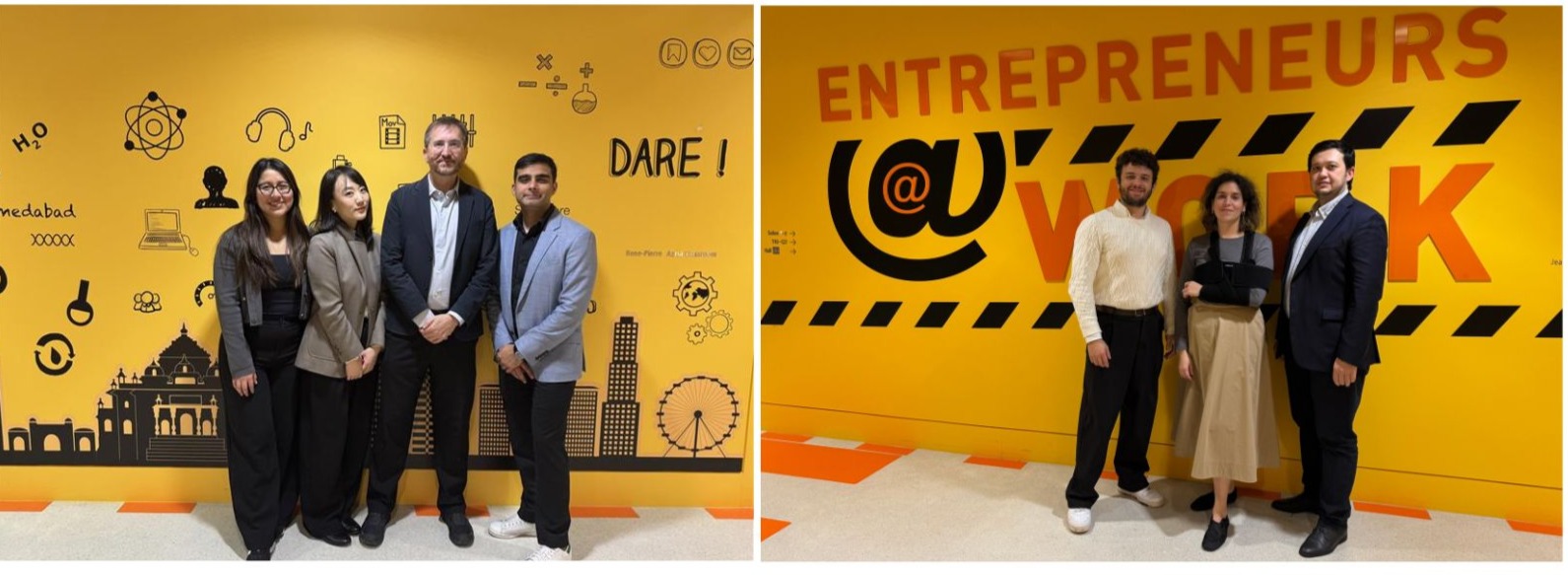
Lab2Biz winning teams (L-R) ENZO and U-Veil