Entrepreneurship and Digital Innovation HEC–TUM
Summer Program
Participants will gain a sound understanding of how digital transformation, Data and AI are impacting industry and the key challenges of digital projects. The skills and mindset acquired will enable you to move from an idea to a startup project.

WHERE & WHEN?
The program will be held at the TUM School of Management, Campus Heilbronn, Germany.
The first week will be taught by TUM faculty and the second week by HEC faculty.
PRE-REGISTER YOUR INTEREST FOR 2027
Information Session
Discover how two of Europe’s leading institutions - HEC Paris and Technical University of Munich (TUM) - have joined forces to create this unique Summer Program. The Recruitment Manager from HEC Paris was joined by the Program Manager from TUM Campus Heilbronn as well as the HEC Academic Director and two former participants of the program for a webinar on Tuesday March 3rd. You can request the REPLAY link by sending an email to admissionsummerschool@hec.fr
About the program
Digital innovation, AI, and immersive technologies are disrupting our way of life, our social relations, and the economy at an ever-increasing pace. It is now at the heart of the dynamics of business creation and industry transformation. Digital technologies are transforming the way a business project is developed. The phases of understanding the market, identifying user problems, ideation, testing a new offer, iteration and launch have been profoundly modified thanks to the new creation methods and digital tools now available.
The objective of this 2-week program is to immerse participants in two essential dimensions of digital innovation: start-up entrepreneurship and digital transformation.
Week 1: taught by TUM Faculty
The first week, taught by TUM faculty (Technische Universität München), lays the theoretical and practical foundation for effective digital transformation at the interface of management and technology. We analyze processes, KPIs, capacity, and bottlenecks, and discuss how digital technologies enable operational improvements. A 'Lean Lego' simulation then illustrates the transition from push to lean pull production and manufacturing cells, highlighting both opportunities and risks of digital transformation. Research-led teaching connects these insights to current developments, examining what operations managers need to know about Augmented Reality in manufacturing and service operations. The week concludes with a two-day hackathon in which students identify real-world problems, develop solution strategies using virtual reality (VR), build rapid VR prototypes (depending on prior coding experience), and present their technological solutions in a concise pitch.
Topics
• Process analysis and KPIs
• Capacity management
• Improvements enabled by digital technologies
• Transition from push production to lean pull production and manufacturing cells
• Opportunities and risks of digital transformation
• Fundamentals Augmented Reality (AR) in manufacturing and service operations
• Problem identification, solution strategy, ideation, implementation
Week 2: taught by HEC Faculty
During the second week, participants will discover the fundamentals of digital entrepreneurship, ranging from the skills needed, methods applied, and tools used, to move from an idea to a startup project. The dynamic learning approach includes a learning-by-doing pedagogy with a conceptual contribution, thanks to class sessions with inspiring examples shared through testimonies and team workshops.
Topics
Digital economy key concepts
• Typology of players in digital industries
• Sustaining vs disruptive innovation
• Productivity gains vs innovation
• Main digital business models (ex. medias & advertising, e-commerce & marketplace, social networks & branding)
• Platform economy and two-sided markets
• Marginal transaction costs
• Network effects
• Hype cycle of digital product
• Impact of Data & AI on digital transformation
Digital entrepreneurship fundamentals
• Ecosystem: incubators, venture capital
• Startup life cycle: explore, experiment, validate / iterate, accelerate
• Agile, lean startup and scrum methodologies
• Design thinking
• Growth "hacking" and AARRR framework
• Product market fit
• Traffic, qualified audience & acquisition strategies
• Data analytics: metrics and Key Performance indicators (KPI)
- Created and taught by leading HEC Paris - TUM professors
- Accessible to students of all backgrounds who wish to learn more about entrepreneurship and digital innovation
- Unparalleled opportunity to collaborate with diverse peers as part of student work groups
- Real life experience: opportunity to present your project to renowned professionals
- Dual certificate from leading partner institutions: HEC Paris and TUM
Why TUM Campus Heilbronn?

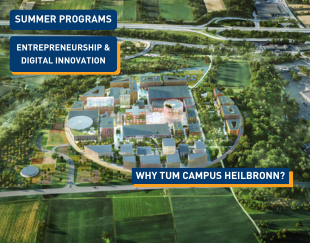
Our partner school for this program, TUM School of Management at TUM Campus Heilbronn, is located in southwest Germany and represents one of the most ambitious higher education projects in the country. The region is rapidly becoming a hub for AI research, development, and commercialization, anchored by the currently built European AI Hub (IPAI). It features a unique innovation ecosystem, with a strong start-up network and close ties to the German Mittelstand and global market leaders in the Heilbronn-Franconia region.
Read more about the vibrant community in Heilbronn at the foot of this page.
The room buzzes with creativity from day one. Professors encourage us not just to generate ideas but to structure them, and the pitching competitions make that real. We learn to present our projects in a way that is compelling, clear, and persuasive, skills that extend far beyond entrepreneurship itself.
Tiffany Bascle, Summer 2025
Upon successful completion of this summer program, participants will be able to do the following:
First week with TUM:
- Analyze and evaluate manufacturing and service processes, identify bottlenecks, and suggest improvements.
- Assess the usefulness of digital technologies for economic problems and identify the optimal technologies.
- Conceptualize and develop VR solutions to real-world problems and present them concisely
Second week with HEC Paris:
- Understand the digital and Data-AI revolution and why it promotes start-up entrepreneurship
- Assimilate the fundamentals of the entrepreneurial approach and its mindset
- Understand the successive steps of any entrepreneurial project: market, ideation, resolution of a user problem etc.
- Identify and use the right tools to design and test an innovative project
- Mobilize skills through an agile approach
Grading is based on project work prepared in groups. Several groups will be invited to present their work to the full class. Individual participation throughout the program can lead to a grading bonus.
During the presentation of the first week, students will present their results concisely (exactly within 5 minutes) by:
• Describing the identified economic problem
• Describing their envisoned solution and technical implementation
• Justify their approach and demonstrate feasibility
• Present a VR prototype (if available).
During the presentation of the second week, participants will present the results of their work in groups by:
• Describing the identified problem
• Illustrating it with arguments (market study, interviews, metrics...)
• Presenting the solution, describing the product, its targeted customers and its business model
• Explaining its positioning regarding competitors existing in the market
• Planning first actions to launch the product or service.
Participants who successfully complete the program will earn 5 ECTS credits. Full attendance is required to obtain the Program Certificate. All students who are seeking credit are encouraged to consult their home academic institution to validate credit transfer.
The Entrepreneurship and Digital Innovation Summer Program is designed for participants who have:
- A curiosity for new business models and solving real-world problems;
- An aspiration to work in a group to imagine the value proposition of a digital project;
- The desire to experiment and challenge themselves.
{"preview_thumbnail":"/sites/default/files/styles/video_embed_wysiwyg_preview/public/video_thumbnails/VN8FpPmmz_c.jpg?itok=2Z6IimhP","video_url":"https://youtu.be/VN8FpPmmz_c?feature=shared","settings":{"responsive":true,"width":"854","height":"480","autoplay":true},"settings_summary":["Embedded Video (Responsive, autoplaying)."]}


The Summer School Experience