Family Business Research and Knowledge
THINK THINKResearch and publications on family businesses
We deepen the understanding of family businesses through interdisciplinary research — governance, succession, and societal impact. Our academic publications are made accessible to all, fostering reflection and informing public debate.
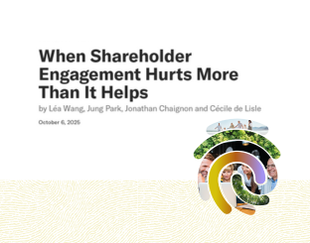
Our latest publication – Harvard Business Review
“When Shareholder Engagement Hurts More Than It Helps”
Read the full article on Harvard Business ReviewPractitioner Insights from Academic Research
The HEC Paris Family Business Center provides executive summaries of academic research conducted by professors during their tenure at HEC Paris. These booklets translate scientific findings into practical insights for entrepreneurial families, offering both an overview of the studies and actionable takeaways.

Our Studies and Barometers
Doctoral research projects
Our Alumni Contributions
Published by Valérie Baschet (H99) and Didier Sensey, co-founders of meaneo, this white paper explores business transmission as a fully-fledged entrepreneurial act—at the intersection of governance, culture, and the human factor. It introduces the Carnet de Transmission Durable, a practical methodological framework designed to support both outgoing leaders and successors across all dimensions of the handover process. Prefaced by Cécile de Lisle, Executive Director of the Family Business Center at HEC Paris, it forms part of a broader reflection on the long-term sustainability of family businesses and their role within the French economic fabric.
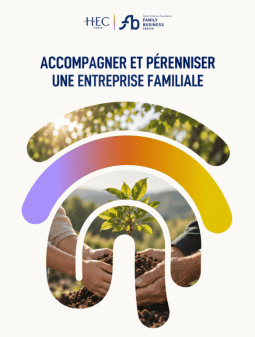
Laurent Allard (H01) and Pierre-Emmanuel Costeux (H01)'s book (2024), Accompagner et pérenniser une entreprise familiale, shows that family business longevity is not inherited — it is built, generation after generation, through deliberate work on shareholder collective identity, governance, and succession. Angèle Marinelli and Cécile de Lisle, PhD Fellow and Executive Director at the HEC Paris Family Business Center respectively, distil the key insights from this work and offer questions for reflection within your own firm.
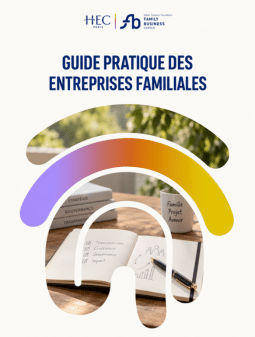
Valérie Tandeau de Marsac (H82)'s book (2011), Guide pratique des entreprises familiales, shows that family business longevity rests on aligning two forms of commitment: affectio familiae, the will to remain united as a family, and affectio societatis, the will to operate a business together. Explicit governance, structured capital, anticipated succession: longevity is not something that happens to a family firm — it is something it builds. Angèle Marinelli and Cécile de Lisle, PhD Fellow and Executive Director at the HEC Paris Family Business Center respectively, distil the key insights from this work and offer questions for reflection within your own firm.
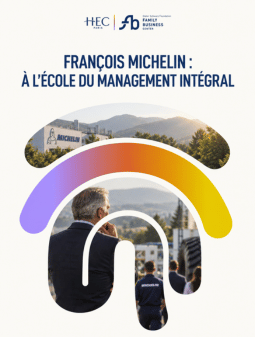
Sara Mandray (H19)'s book (2019), François Michelin : À l'école du management intégral, shows how François Michelin's management philosophy — grounded in a sense of the concrete, a profound respect for persons, and an integral view of the human being — offers a coherent response to contemporary leadership challenges, particularly within family firms. Angèle Marinelli and Cécile de Lisle, PhD Fellow and Executive Director at the HEC Paris Family Business Center respectively, distil the key insights from this work and offer questions for reflection within your own firm.
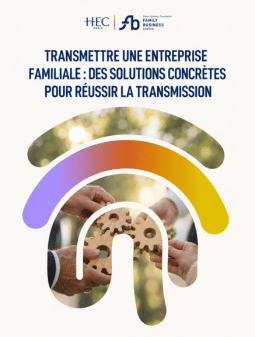
Olivier Mellerio's book (2011), Transmettre une entreprise familiale : des solutions concrètes pour réussir la transmission, shows that family business succession is a demanding process, frequently undermined by fiscal, financial, and legal constraints as much as by a lack of anticipation. Succeeding requires early preparation, structured governance, and intergenerational alignment. Angèle Marinelli and Cécile de Lisle, PhD Fellow and Executive Director at the HEC Paris Family Business Center respectively, distil the key insights from this work and offer questions for reflection within your own firm.
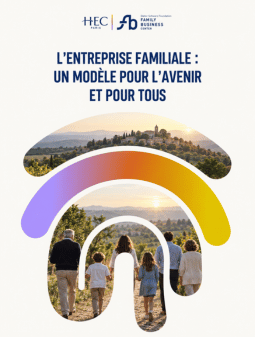
Valérie Tandeau de Marsac (H82)'s book (2014), L'entreprise familiale : Un modèle pour l'avenir et pour tous, shows that the family business is not an outdated, nepotism-prone model but a structurally distinct and resilient form of organization. Across five key dimensions — conflict, capital control, long-term orientation, familiness, and succession — the book reveals that the very features that expose family firms to risk are also those that underpin their advantages: resilience, strategic autonomy, trust, and continuity. Angèle Marinelli and Cécile de Lisle, PhD Fellow and Executive Director at the HEC Paris Family Business Center respectively, distil the key insights from this work and offer questions for reflection within your own firm.