
Women in Leadership Spotlight: Shreya Pal
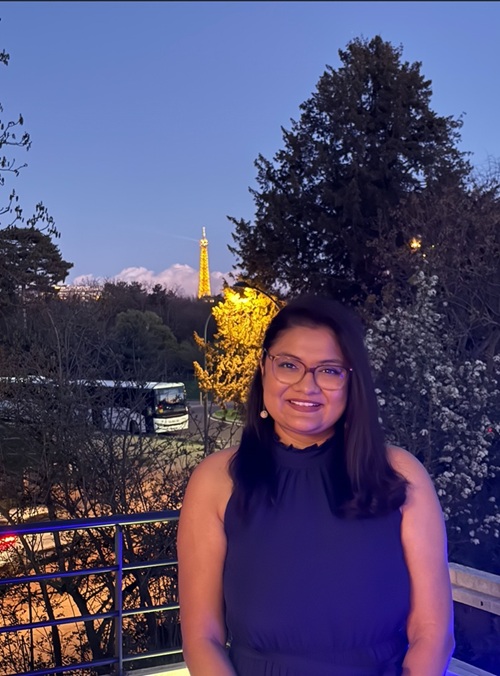
For Shreya Pal (MBA ’27), President of the Healthcare Club, leadership took shape not through a title, but through a moment of realization. During her time at HEC Paris, she came to see that leadership wasn’t something to grow into someday—it was something she was already practicing. Through shaping the club’s vision, fostering collaboration, and creating spaces for meaningful connection, she embodies a thoughtful, authentic approach to leadership grounded in self-awareness, initiative, and impact.
What moment in your career - or during your MBA at HEC Paris - has most shaped the leader you are today?
I believe it was during a leadership class at HEC Paris when realized I already am the leader I associated my future self with. I always associated myself to be a leader as someone with the right title, managing a large team, in a high-impact role, but in that moment, I recognized that I was already practicing leadership, just without calling it that.
Through my work with the HEC MBA Healthcare Club, I've been shaping its goals and culture. I've taken initiatives to launch projects that are aligned with the long-term strategy of the club, taken and influenced important decisions that would directly affect its future. I've been leading and facilitating discussions in my working group or other group projects. I've been carving out time to still do the things I love by integrating work and life.
This realization was important to me because it helped me lead with clarity, take ownership earlier and trust my instincts more.
How has your time at HEC Paris influenced or reshaped what leadership means to you?
Meeting emerging leaders from all around the world in my MBA cohort and other leading European business schools, visiting companies and meeting their leadership teams, seeing CEOs of startups to mid-sized companies, all gave glimpses of what effective leadership looks like but more importantly, these experiences gave my time to reflect on what it means to me.
Of course, we learned several frameworks and do's and don'ts of leadership from case studies, but my biggest shift has been personal rather than theoretical which came from doing what I was learning. Inclusive leadership has always been important to me; I saw ways of implementing psychological safety and building trust in groups that actually enriched our discussions for projects. Second, I've understood the importance of leading with authenticity is to lead in a way that is aligned with my values and personality rather than trying to fit into a pre-defined mold.
Who is a woman who has inspired you during your career or MBA experience, and why?
A woman who has deeply inspired me is Kiran Mazumdar-Shaw.
What stands out to me is how she built Biocon at a time when India’s pharmaceutical landscape was largely dominated by generics. She didn’t follow the existing path but rather, she saw a gap in the original biotech innovation and had the conviction to pursue it, despite limited infrastructure, funding challenges, and skepticism about whether India could compete in that space. In many ways, she helped lay the foundation for India’s biotech ecosystem as we know it today. As someone building a career in healthcare, that ability to identify an untapped opportunity and systematically build toward it really resonates with me.
What also spoke to me is how she navigated leadership as a woman in a field and geography where that path was far from straightforward. She has spoken openly about the importance of credibility and resilience, once saying, “I think the biggest challenge for women is to believe in themselves.” That line stayed with me because it captures something I’ve seen and experienced regarding how much leadership is not just external, but internal.
Her journey reinforces the kind of leader I aspire to be: someone who combines scientific ambition with strategic vision, and who is willing to challenge the status quo to create something meaningful.
What do you wish more people understood about women’s experiences in business school today?
On the surface, everything looks equal, but in reality, many women are navigating an internal dialogue that often goes unnoticed. I’ve seen it in myself and in others that in group settings, there’s this constant second-guessing: “Maybe someone else can say this better,” “Is this the right moment?” “Will my point even add value in a room full of louder voices?” So sometimes, we hold back.
What’s interesting is in rooms with only women, the dynamic often feels different, people are more intentional about making space for each other, encouraging quieter voices, and ensuring all ideas are heard, not just the loudest ones.
That contrast says a lot.
And beyond that, the journey itself isn’t straightforward. Women here are deeply ambitious and absolutely deserve to be in these spaces, and, at the same time, many are balancing multiple pressures from academic, professional, personal fronts. There’s often an internal layer too, a quiet drive to prove something, not just to the world, but to ourselves. It's not just about access or opportunity but also about understanding the nuance of how women experience these environments and how much potential is unlocked when they’re in spaces that allow them to show up fully.
If you were mentoring the next cohort of women arriving at HEC, what’s the one thing you’d want them to know?
At a place like HEC Paris, it’s very easy to look around and assume everyone else is more prepared, more confident, more “meant” to be there. They’re not. Everyone is going through their own inhibitions and biases so don't be afraid to be you. Ask questions, go for opportunities before you feel 100% ready, reach out to people who you think might be out of reach. And lastly, be intentional about the rooms you choose to be in. There will be so many events and opportunities and an incredible ecosystem to be a part of but make sure to step out of comfortable circles.
What hobby, passion, or personal interest has helped keep you grounded during your MBA at HEC, and why is it important to you?
Cooking has always been my reset. Coming home after a long day and making a simple meal I grew up eating instantly grounds me. I had always wanted to start a supper club, and the MBA felt like the right moment to finally act on it. I began by hosting my Leadership Fellows group, and from there, it organically grew into a monthly experience for my cohort.
Each dinner is curated. I design a three-course menu around a theme, set up the space, and bring together around 10 people at the table. Beyond food, what I care about most is what happens around it. I’ve seen conversations unfold in ways that don’t usually happen in structured settings with people opening up about everything from geopolitics to personal passions, even helping each other with opportunities.
That’s exactly what I had envisioned: creating a space where people can connect more authentically. It’s important to me because it reflects a different side of leadership, one that’s about bringing people together, creating environments where others feel comfortable, and building meaningful connections. In the middle of a fast-paced MBA, it’s been both grounding and energizing, a reminder that impact doesn’t always come from formal roles but also from the spaces you create.