
Doris Moreno Maldonado
Summer Student Story
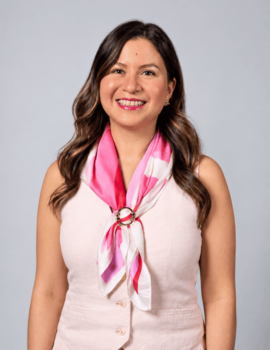
This program gave me the vocabulary and showed me the frameworks for what actually moves the needle in capital investment decisions — how ESG scoring integrates into corporate sustainability reporting and portfolio risk management.
I was born and raised in Mexico, a developing country, and for the past eight years I've lived and worked in a developed one, the United States. That contrast has shaped how I see the world — and it's exactly why HEC Paris caught my attention. Beyond its reputation as the top business school in Europe, I speak French, and I wanted an excuse to spend my summer immersed in a French-speaking country. What I didn't fully anticipate was how transformative the classroom itself would be.
The multiculturality of the cohort was unmatched. I wasn't just learning the European Union's perspective on sustainable finance — I was learning from classmates across the UK, South America, and Asia, including Singapore, China, and India. That mix mattered, because it drove home a lesson no textbook could: the EU's Sustainable Finance Disclosure Regulation (SFDR) doesn't stay within EU borders. It shapes how companies across the world, including the Americas and beyond, raise and allocate capital, whether they realize it or not.
As an engineer by training, this program complemented my technical background in a way I didn't expect. I came in believing I had already mapped out every possible engineering career path: R&D, procurement, manufacturing, operations, project management, even sales. HEC showed me the map was bigger than I thought and now I see banking, NGOs, AI, investing, and beyond on it. I am now convinced that engineers belong in financial institutions too because today, more than ever, the world needs technical knowledge to advance the UN Sustainable Development Goals (SDGs).
What stayed with me most is how directly applicable the content was. One of the real strengths of the program is the range of guest speakers, each bringing a different industry lens — which makes it easy to connect, for example, a farming project to AI data centers and agricultural supply chain resiliency, all into one sustainable strategy. These connections have been a baseline for me as I look forward this fall into bridging Extended Producer Responsibility (EPR) regulations globally, to new product development, ingredients supply, and capital allocation; as part of my project within the United Nations Global Compact Industry Accelerator.
The Sustainable Finance & Investment program has also expanded my creativity into new business models comprising carbon credits, and guaranteed food supply. This program gave me the tools to think about how a cacao-belt agriculture project can be structured to secure not just its own success, but carbon credits and capital allocation for the corporations backing it. ESG isn't a nice-to-have or a purely environmental concern — it's how businesses in any sector mitigate financial risk, everywhere in the world.
I now understand ESG frameworks and market scoring well enough to shape how a project — or an entirely new business model — gets funded. That's the full-circle moment: sustainable finance and investment are the engine behind how we fund the UN SDGs, net-zero targets, and Science Based Targets initiative (SBTi) commitments companies are racing toward.
I came to HEC looking for a global, cross-industry perspective on sustainable finance, and I left with the confidence to move across careers and industries — proof that engineers belong in financial institutions just as much as anywhere else. If you want to understand ESG investment decision-making, risk and impact assessments, capital allocation for sustainability projects across regulatory frameworks like the EU SFDR, in both developed and emerging markets, I can't think of a better way to spend your summer.