


 Innovation & Entrepreneurship
 Tech & AI
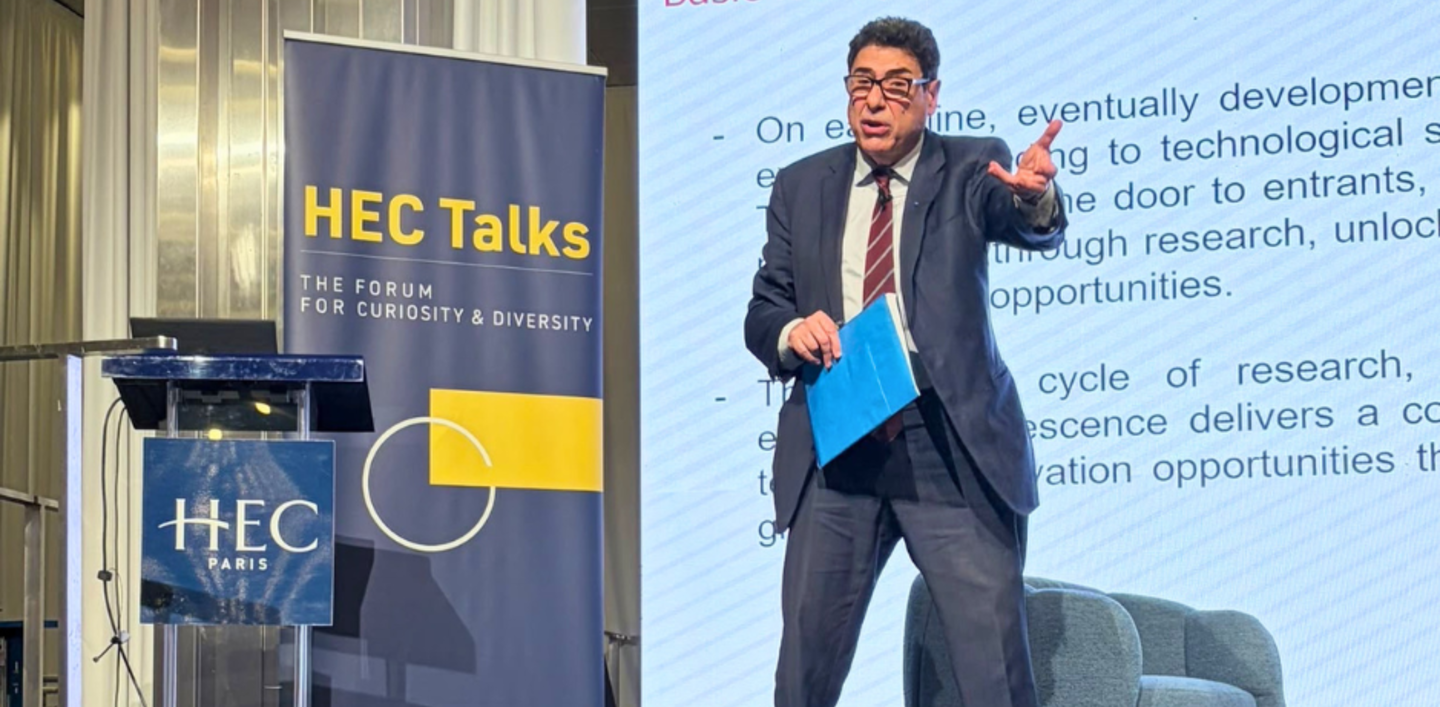
Following the OpenAI–Hugging Face cyberattack in July and Anthropic CEO Dario Amodei’s recent call to slow down the pace of frontier AI development, much of the tech industry is warning about rogue AI agents that could threaten humanity. But Philippe Aghion is looking elsewhere.
Speaking at HEC Paris on September 14, on the occasion of the ceremony at which he was awarded an honorary doctorate, the economist, whose work focuses on the long-run forces shaping economic growth, is more concerned with whether societies have the right conditions in place to sustain innovation over time and turn technological progress into lasting prosperity.
- AI could accelerate both productivity and idea generation.
- The main constraints on innovation are institutional, not technological.
- To address Europe’s competitiveness challenge, Aghion argues for a “coalition of the willing” rather than waiting for consensus among all 27 EU member states.
- Degrowth advocates make legitimate points, but innovation remains necessary to address the climate crisis.
- Innovation progresses through continuous renewal.
AI as a Catalyst for Growth and Innovation
For Aghion, AI is first and foremost a new engine of growth. It can automate tasks in the production of goods and services, but its potentially deeper effect lies in innovation itself. “New ideas are often recombination of old ideas,” he told the audience. “And with AI, you can recombine much more.”
AI does not simply make existing activities more productive; it could also accelerate the production of new ideas.
For decades, economists have debated whether humanity’s best ideas are becoming progressively harder to discover. That question provided the backbone of Aghion’s talk.
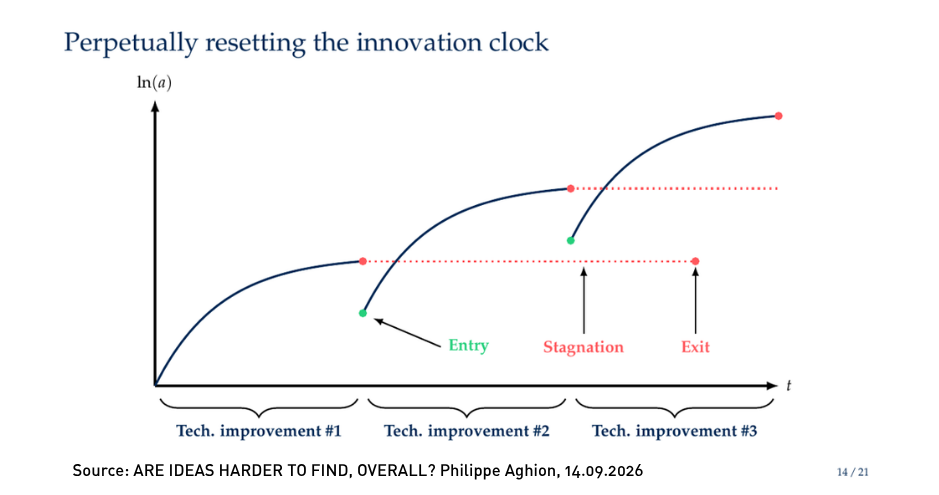
A particular technology can eventually reach a point where further improvements become harder to achieve. But innovation keeps “resetting” as new products, technologies and combinations of ideas create fresh avenues for progress.
“Already without AI, ideas were not harder to find overall,” he said. “But with AI, even less so.”
He pointed to ongoing research by HEC Paris professor Antonin Bergeaud on US patents granted between 2010 and 2025. Looking across technological classes outside computing and data processing, the research measures how exposed each field is to AI. As Aghion summarized the result, greater exposure to AI is associated with increased patenting: “Whenever you become exposed to AI, it boosts your production of patents.”
However, his optimism is tempered by a political warning: technology alone is not enough. Whether societies can harness innovation’s potential depends on the institutions surrounding it, from education and competition policy to the role of the state.
Education under strain: declining academic standards, social media and barriers to social mobility
Aghion identifies education as one of the central bottlenecks to innovation. He points to the phenomenon of “lost Einsteins” and “lost Marie Curies” - a term popularized by researcher Xavier Jaravel - referring to smart children from low-income backgrounds who may lack the knowledge or aspirations that could lead them towards research or entrepreneurship.
“If you have a good schooling system,” he argued, children from poor backgrounds “can get very far.” If the education system fails, the economy does not simply produce worse educational outcomes: it also loses researchers, entrepreneurs and ideas.
A strong public education system can help compensate for those inequalities. But Aghion believes schools - especially in France - have become less able to perform that function.
While the results of the latest OECD PISA survey, released on September 8, 2026, show a troubling decline in student performance in France and across OECD countries - with the lowest scores recorded in twenty years, particularly in mathematics and reading - Aghion advocates for “no-excuse” schools.
This educational model, generally associated with high academic expectations, strict discipline, and intensive teacher support, was developed largely to improve outcomes for disadvantaged students.
In Aghion’s telling, its appeal lies particularly in its focus on foundational skills: reading, writing, grammar, basic calculation and theorem demonstration, without digital distractions such as social networks and screens. That also requires the right learning environment, he argues, with smaller classes and well-trained teachers.
Crucially, Aghion argues that homework must be done at school.
As fewer parents provide sustained help at home (while also being distracted by their own devices) he sees school as the place that must compensate for those differences, ensuring every child has the support needed to progress.
Competition policy: keeping the door open to new innovators
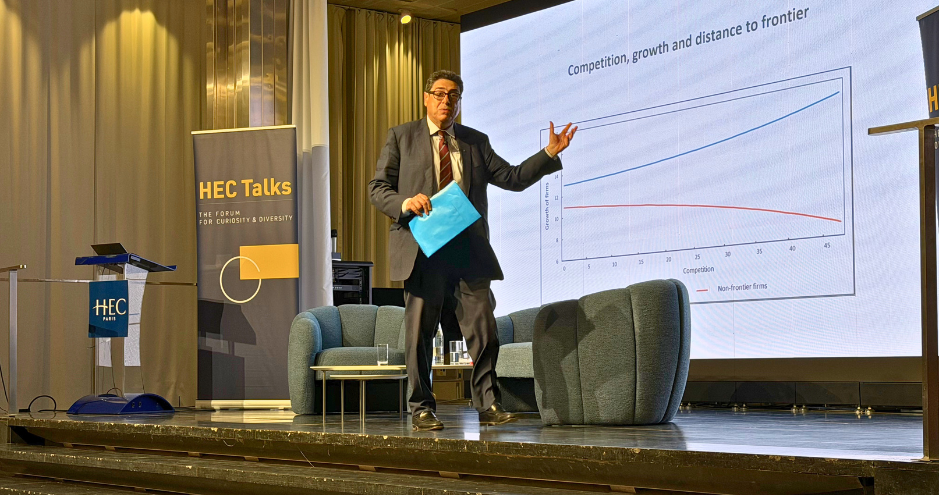
Competition policy is another major bottleneck Aghion identifies. It is central to what he calls creative destruction: the process through which new firms and technologies replace older ones and push the technological frontier forward.
The tension is built into innovation itself. Entrepreneurs need the prospect of profits to justify taking risks and investing in new ideas. But once successful, yesterday’s innovators may use their market power to protect their position and prevent new competitors from entering. “You need the innovation rents,” Aghion explained, “but you want to make sure that yesterday’s innovators will not use their rents to prevent subsequent innovations.”
That is why competition matters. It is not simply about keeping prices low; it is about ensuring that new talent and new firms can continue to challenge incumbents.
For Aghion, the experience of the digital economy offers a warning. He argues that the IT revolution initially boosted US growth, but also helped create “superstar firms” whose expansion increased market concentration and eventually discouraged the entry of new firms. AI could reproduce the same dynamic. Upstream parts of the AI value chain, he noted, are already concentrated among a small number of players in cloud computing and processors.
The challenge is therefore to allow innovative firms to grow without letting success turn into a barrier to the next generation of innovators. In Aghion’s words: “You want to make sure that once they’ve grown up, they won’t use their power to prevent entry.”
That requires competition policy, but also an ecosystem in which new firms can scale. Aghion pointed to Europe’s difficulty in turning startups into large companies, citing limited venture capital and a fragmented market as factors pushing some firms to grow elsewhere.
His answer is not to choose between competition and industrial policy. On the contrary, he argues that the two can reinforce each other. In AI, that could mean more open source, greater data sharing to facilitate entry, and public investment in computing capacity. “I believe you can have a competition-friendly industrial policy,” he said.
EU competitiveness and innovation: from 27-country consensus to a “coalition of the willing”
The challenge is particularly acute for Europe. Aghion was among the economists and experts whose contributions informed the analysis and policy advice of Mario Draghi’s 2024 The Future of European Competitiveness report. Its diagnosis of Europe’s innovation gap strongly echoes Aghion’s work on innovation-led growth and creative destruction.
At HEC Paris, however, Aghion expressed doubts about Europe’s ability to move quickly enough when agreement among all 27 EU member states is required. “I’m very pessimistic about what we can do in 27 countries,” he said, pointing in particular to fragmented regulation and the incomplete single market.
His alternative is what he calls a “coalition of the willing”: countries ready to move ahead together without waiting for EU-wide consensus. He suggested that France, Germany, the UK and other willing partners could jointly develop a European equivalent of the US DARPA (Defense Advanced Research Projects Agency), combining industrial and competition policy to finance high-risk, long-term innovation in areas such as AI, defence and the energy transition.
That effort would also require a stronger financing ecosystem. Aghion argues that Europe has plenty of savings but too little venture capital and too few institutional investors directing those resources towards European innovation. Alongside longer-term research funding, he called for joint institutional investment that could help promising firms scale in Europe rather than seek financing and growth elsewhere.
Is degrowth at odds with innovation?
Asked about arguments for degrowth in response to a question invoking Jean-Marc Jancovici, who will also be speaking on the HEC campus in a few days, Aghion did not dismiss them.
On the contrary, he said advocates of greater sobriety are right when they argue that economic progress should shift “from quantity to quality” or that measured GDP does not capture every dimension of improvements in living standards.
Where he parts company with a strictly degrowth-oriented view is on the role of technological progress. “I believe societies will need still innovation,” he said.
That means, notably, finding cleaner sources of energy and technologies that help societies adapt to climate change. During the discussion, he cited possibilities ranging from hydrogen and nuclear fusion to more energy-efficient cooling and infrastructure protecting communities from rising sea levels.
His broader point is that environmental constraints do not remove the need to innovate. They make the direction of innovation more important.
“If you don’t believe in innovation, you become Malthusian,” he told the audience.
For Aghion, believing in innovation means refusing to see today’s technological and resource constraints as necessarily permanent.
If societies continue to innovate, he argued, the world is “not finite” in the sense that new technologies, materials and solutions can expand what is possible. The challenge is to steer innovation toward adaptation and more sustainable forms of progress.
That distinction also shapes his view of climate policy. A carbon tax can encourage people and businesses to move away from polluting technologies, he argued, but only when viable alternatives exist. Without those alternatives, higher prices can fall on people who have little ability to change their behavior. He used France’s Yellow Vest movement as an example.
Innovation as the driving force of growth: the theory behind Aghion’s Nobel Prize
Aghion’s confidence in innovation is rooted in the economic theory he has spent nearly four decades developing and which earned him the 2025 Nobel Prize in Economic Science.
When he began his career, dominant theories of economic growth could explain how investment in machines and capital increased production. But technological progress itself largely remained a “black box”: economists knew it was essential to long-term growth, without fully explaining where it came from.
Aghion became, in his own words, “obsessed” with opening that black box.
As a young economist at MIT, he found himself working next door to Peter Howitt. One day, he recalled, he walked into Howitt’s office with an idea inspired by Joseph Schumpeter: “Why don’t we try from scratch to write a model that would encompass Schumpeter’s idea of creative destruction?”
The model they developed placed innovation at the heart of economic growth.
Entrepreneurs invest in new technologies because successful innovation can give them an advantage, and profits. A new product or production process can replace an older one. In doing so, the innovator also pushes the technological frontier forward, creating a higher starting point for those who come next.
Innovation is therefore both cumulative and disruptive: each generation builds on what came before, while making some existing firms and technologies obsolete.
The model also changed the way economists could think about policy. Innovation was no longer an unexplained force operating in the background.
If the incentives to innovate depend on the economic environment, then public policy can influence the conditions under which new ideas emerge, develop and replace old ones.
The model itself came quickly. Aghion joked that he and Howitt had its basic equations within roughly three months, between late 1987 and early 1988. Recognition required rather more patience.
“It took 38 years to get the prize,” he quipped.
The “continuous reset”
The “reset” hypothesis allows Aghion to reconcile two apparently opposing accounts of progress.
Within a specific field or technological line, ideas may indeed become harder to find as the most accessible opportunities are exhausted. But this does not mean innovation as a whole runs out of steam: new technologies, fields and combinations of ideas continually open fresh avenues for development.
Aghion sees evidence of this dynamic in research itself. In the economics literature, the research he presented at HEC shows individual topics rising and declining in importance, while new combinations of topics continue to appear over time. There is a “continual” and “unending reset.”
It captures the central message running through Aghion’s lecture. Innovation is not an endlessly rising straight line. Technologies mature. Research agendas peak. Firms become obsolete. New ones enter. Ideas are recombined. New fields appear.
Progress comes from the capacity to begin again, at a higher level than before.
AI may accelerate that process but whether societies can take advantage of it depends on something technology cannot supply by itself: schools that reveal talent, markets that remain open to challengers, funding that allows ideas to scale, and public policies capable of directing innovation toward collective priorities.
The innovation clock may keep resetting. The institutions around it determine how much of that possibility becomes progress.