


 Innovation & Entrepreneurship
 Sustainability & Society
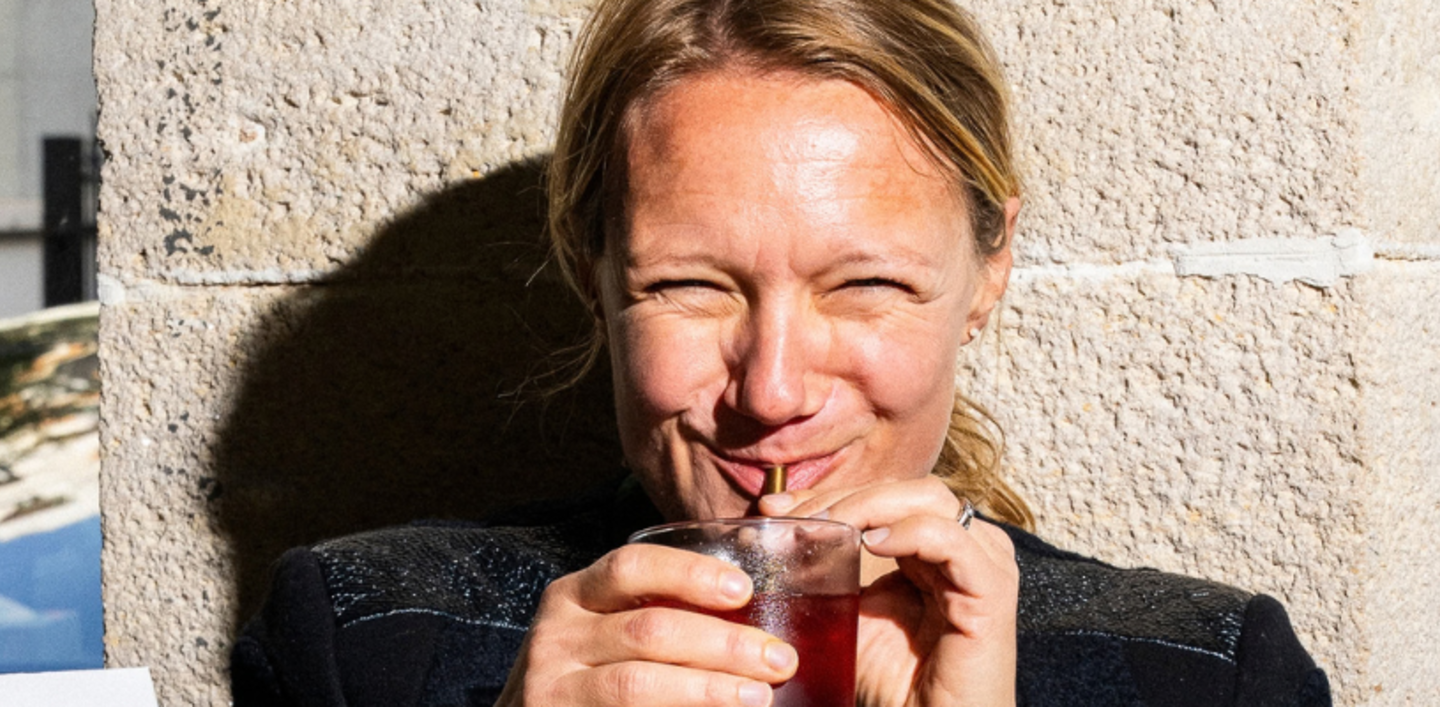
From farming roots to an ecological wake-up call in New York
Charlotte Figarede grew up around a kitchen table where food came with conversation. Her parents were farmers turned entrepreneurs, "big workers, often absent because they were busy working," as she puts it, and she grew up somewhere where labour was the highest virtue. Around that table, though, she picked up something else early on: people sitting down to actually listen to one other. She still quotes a line from chef Guillaume Gomez, who talks about gastronomy as a kind of soft power. It stuck with her. Her early career became an attempt to rebuild that table elsewhere, in the chocolate business at Valrhona, then at Café Joyeux, supporting its social mission.
The real shift happened during a year and a half in New York, right as Covid hit. Every evening she’d watch the sidewalks pile up with cardboard and packaging, thrown out overnight. And then, in the middle of all that waste, she was offered a job running a US import subsidiary, shipping pastries and chocolate made in France across the Atlantic, frozen. She didn’t need much time to see the problem with that.
The birth of Necense
Back in France, meeting Chef Damien (Damien Duquesne), the French chef and co-founder of the food site 750g, tipped her into entrepreneurship. They landed on the same idea from different angles: while the transition is already taking place on our plates, nobody had touched soda yet. It’s an 8-billion-euro market in France, and the average person drinks 52 litres of soda a year. Damien and Charlotte wanted the same fix: cut the bottle, put something real back in the glass. That also meant changing an established drinking habit.
Damien had actually started already, on his own, at the end of the pandemic. He pulled every industrial drink off his restaurant's menu, Coca-Cola included, because none of them was matching what he was cooking. The sodas on the market were badly made and full of chemicals, so he shut himself in his kitchen and began infusing wild plants, fruit, and dried bark himself. Customers loved it right away. Sales doubled, costs halved. His son, a student back then, told him the obvious thing: "If it works in your restaurant, it should work in others too."
Charlotte joined Damien in 2023, just as R&D wrapped up and the first sachets came off the line. The result was Necense, a range of infusion sachets used to prepare a concentrate that is then diluted with sparkling water. Three minutes, and your homemade soda is ready.
From day one, Charlotte took charge of the brand, the messaging, the commercial rollout, and hiring the team, work she handled with a confidence built on everything she'd learned before.
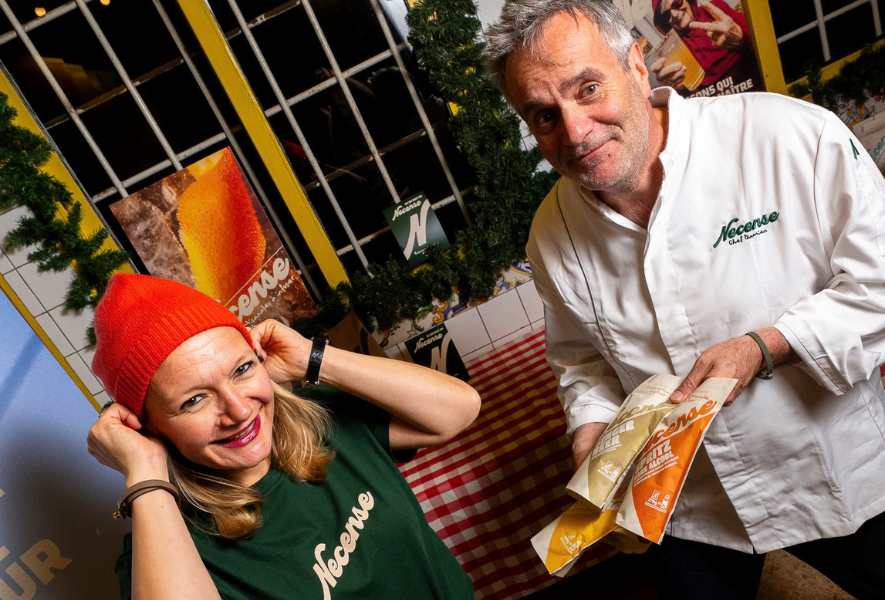
Charlotte Figarede and Chef Damien
A detour through HEC Paris to build her backbone
Charlotte comes from a family of entrepreneurs. She always knew she'd start something herself one day, she just needed the moment, and she wasn't going to sit waiting for it. Her commercial instincts were already sharp, honed at Valrhona. Running a company, however, would require skills she had not yet had reason to develop.
She believes in lifelong learning, so she went to HEC for theory that could organise what she already sensed. Finance came first, the subject she knew least, and the one every entrepreneur runs into eventually: fundraising, loans, growth decisions that can spiral fast. Then came managing people through change, something she calls an "ocean". She wanted to get better at handling it, not just riding it out.
A company, a family, a society: they're all systems. They have their own players and forces, their own rules, and a sequence you have to move through in order. "Change isn't won through conviction," she says. "It's driven."
Armed with these tools, when the opportunity to build Necense came along, Charlotte approached the launch methodically. But the road wouldn't be easy. The hardest part, it turned out, was changing behaviour.

 Executive MSc in Change Leadership
Making sustainable beverages desirable
On paper, the proposition is straightforward: raw, organic, French ingredients, hand-picked by a renowned chef. Nobody on the team argued with the logic. Changing a decade-old habit turned out to be the hard part. A ready-to-drink bottle asks nothing of you. A sachet you infuse yourself asks you to plan ahead for your own pleasure. Against the ingrained instant gratification of a can you grab and go, Necense was asking people to slow down. The ritual itself is simple: boil the plants and dried bark Chef Damien selected for two minutes, strain to get a concentrate, something like a syrup that keeps for three months in the fridge, then top it up with sparkling water whenever you're ready to drink.
Their first communication reflected the urgency they themselves felt about the environmental problem. Charlotte and Damien sounded like angry activists. They soon realized the limits of the "existential crisis" approach: environmental guilt only moves the already converted, and it exhausts everyone else. "People hate feeling like they're being deprived of something," she says. "Everyone wants the wildfires to stop, and yet nobody's giving up red meat, or a weekend flight." Guilt doesn't scale.
That's where the real lesson landed.
Winning an argument wasn’t the point, setting a new norm was. That meant giving up and finding a way to make people actually want this. Pleasure became the pitch. Necense dropped the angry revolution and became a brand people actually wanted, inviting them to "become the bartender of their own aperitif," mixing drinks with friends and family just for the fun of it. To push that idea further, she co-founded MUVE (Mouvement Sans Eau), alongside other water-free pioneers in cosmetics and home care, including 900.care, Pimpant, and Supe, proving that shipping water around the country is an industrial dead end we can collectively move past.
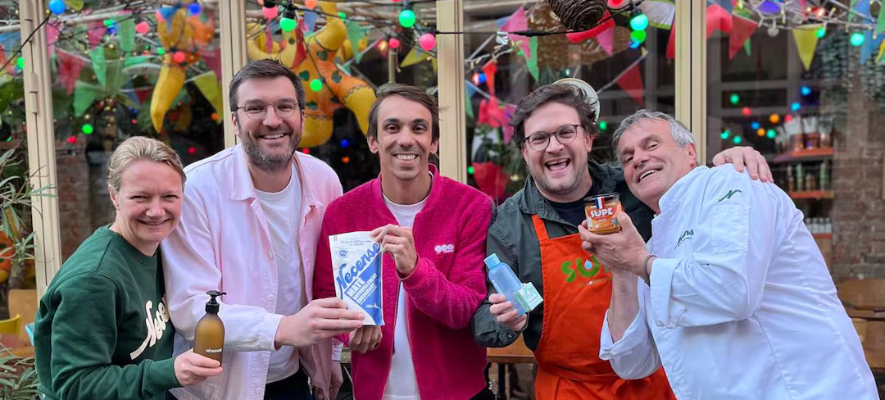
From left to right: Charlotte Figarède (Necense), Baptiste Hamain (Pimpant), Thomas Arnaudo (900.care), Gregory Gicquel (Supe), and Chef Damien (Necense). Photo credit: MUVE
A path of truth and impact
Three years in, the model has held up. Necense has already prevented the production of more than 3 million bottles, saving over 1,000 tonnes of CO2. The strategy was deliberate: go heavy on B2B. More than 1,000 partner hotels, restaurants, and cafés now make up 90% of the business.
A 3-kilo sachet of dry mix replaces five 20-kilo crates of bottles, one less crate for kitchen staff to carry.
With around a dozen innovation awards and a spot in Challenges' Top 100 startups, Necense has built solid footing in France and is now scoping international markets, including Denmark, the Middle East, and the UK.
For Charlotte, this has also been a personal and managerial education. Leading a team of ten, she describes entrepreneurship as "a path of truth, one where you can't fake it in front of reality." It's not rational, she adds, it's emotional, and you put a lot of yourself into it. "The team already builds that shared sense of purpose in the moments we get together, and we’re good at valuing collective performance. We just don’t yet have that same energy running through the regions."
More than anything, she’d had to learn patience. Real norm change takes a generation, she says: "It's anthropology, not marketing." You move forward with whoever’s ready. The rest catch up eventually, at whatever pace the system allows. "It's a dance," she says.
Charlotte wants the ecological transition to move faster across the restaurant industry, and Necense changed her sense of how that happens. Asking people to give up something rarely works. A different drink sticks around because people genuinely prefer it: better taste, a moment worth sharing at a table.
Sustainability spreads faster when it doesn't feel like sustainability at all, just the thing people would pick anyway. The ecological transition can run on desire instead of restriction. Necense, three years and a few million bottles saved later, is proof that Charlotte's bet paid off.