


 Sustainability & Society
 Economics & Finance
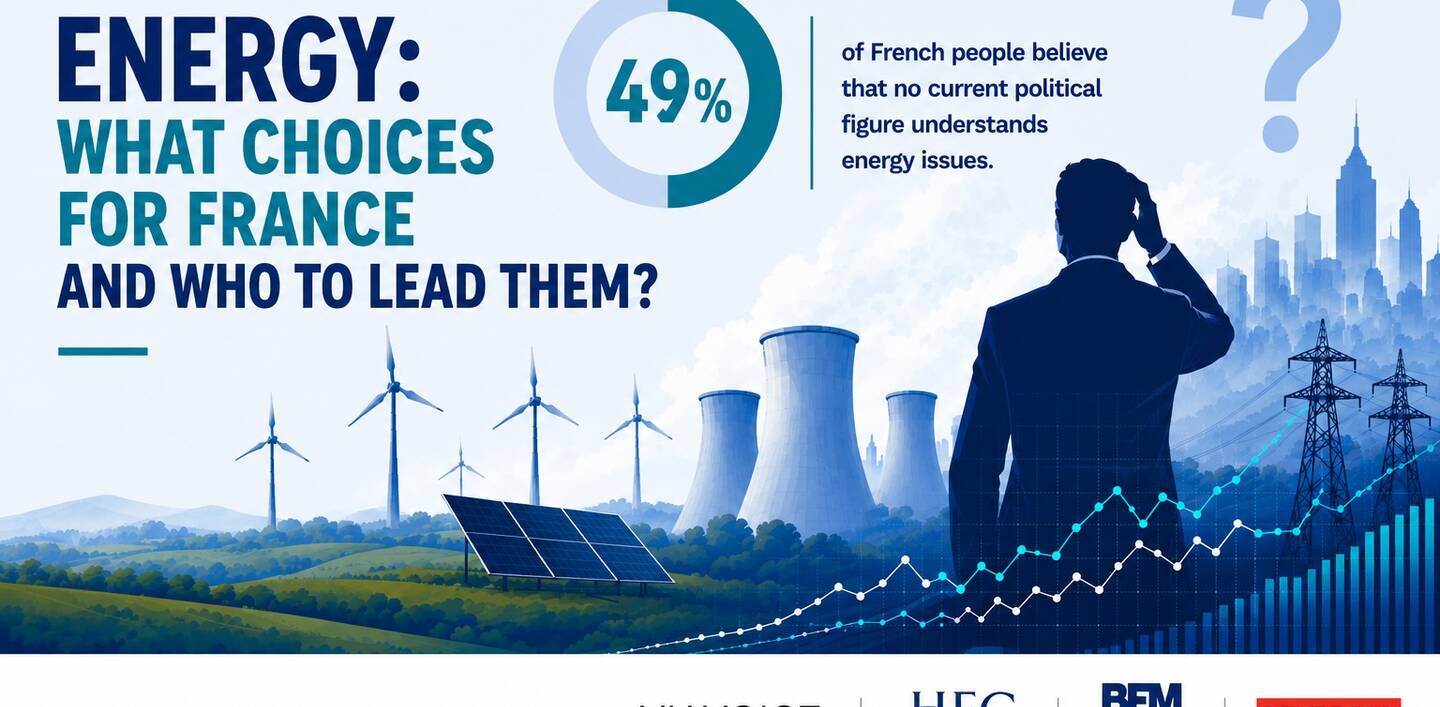
As the summer of 2026 combines record-breaking heat with persistent tensions on oil markets since the war in Iran, energy is already emerging as a defining issue in the 2027 presidential election. Yet the latest Baromètre des Décideurs by Viavoice for HEC Paris, BFM Business and L’Express reveals a troubling lack of confidence among the French in the political class’s ability to understand and address these challenges.
When asked about the energy choices ahead, both the general public and decision-makers favour renewable energy without abandoning nuclear power, while taking a pragmatic view of divisive issues such as air conditioning.
Between heat waves and rising oil prices, the summer of 2026 marks a period of warnings
Heatwaves, droughts and wildfires: the summer of 2026 has been marked by a succession of records, making climate adaptation and energy policy both immediate concerns and long-term challenges.
In France, July 2026 was the hottest month recorded since measurements began in 1900, with an average temperature of 24.9°C, 3.8°C above normal. It followed the hottest June ever recorded, marked by a 14-day heatwave whose intensity exceeded that of August 2003. A third heatwave, which began on 28 July, was still being felt in mid-August.
Drought has accompanied these exceptional temperatures. A quarter of medium-sized and small rivers are already dry, an unprecedented situation since monitoring began in 2012.
The phenomenon extends far beyond France. In Western Europe, the June-July period was the hottest ever recorded, with an average land temperature of 21.62°C, 2.79°C above the 1991-2020 average.
At the same time, the effects of the spring 2026 energy shock, triggered by the outbreak of conflict in the Middle East, are still being felt. The conflict pushed oil prices up by more than 60% in euros in May 2026 compared with the end of 2025, according to INSEE, despite the agreement reached between the United States and Iran in June. The International Energy Agency reported that benchmark oil prices reached as much as $105 a barrel on 23 July before falling back, in a market that remains extremely volatile because of continuing disruptions in the Strait of Hormuz.
It is against this backdrop that Viavoice asked French people about the energy choices ahead.
A Political Vacuum on Energy
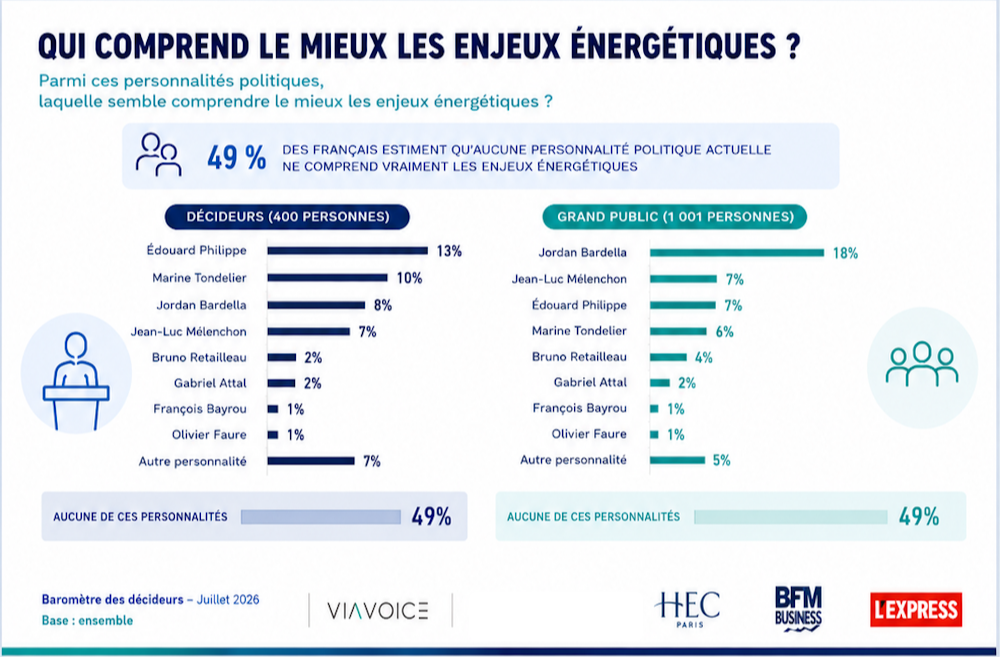
Asked, “Among these political figures, which one seems to understand energy issues best?”, 49% of French respondents answer: none of them. The figure is exactly the same among decision-makers and the general public.
The survey does not measure these politicians’ actual ability to resolve the energy crisis, but rather their perceived credibility in understanding its underlying issues. From that perspective, the verdict is severe just a few months before the presidential election, with respondents rejecting the entire field of choices offered to them.
"Rassemblement national" President Seen as More Competent on Energy than the Leader of the Greens
Among the general public, Jordan Bardella clearly comes first among the political figures named, with 18%, ahead of Jean-Luc Mélenchon and Édouard Philippe, both on 7%. Meanwhile, Marine Tondelier, national secretary of The Ecologists and a candidate in the 2027 presidential election, receives just 6%, three times less than the president of the "Rassemblement national".
The ranking is different among decision-makers: Édouard Philippe comes first with 13%, ahead of Marine Tondelier on 10% and Jordan Bardella on 8%. Political preferences differ, but the underlying diagnosis of distrust is shared.
The result is all the more striking because French respondents express relatively clear views on what should actually be done.
The French Put Renewables Ahead of Nuclear Power
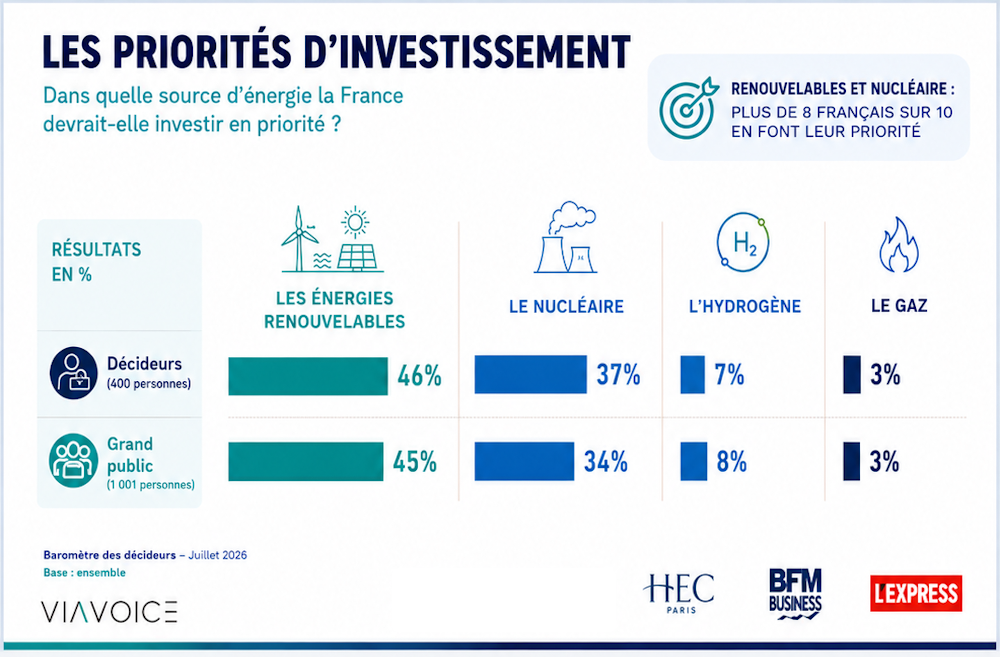
Asked which energy source France should prioritise for investment, decision-makers and the general public place renewable energy first, at 46% among decision-makers and 45% among the population as a whole. Nuclear power follows, at 37% and 34% respectively — almost ten points behind renewables. Far behind come hydrogen, at 7% and 8%, followed by gas, selected by only 3% of both samples.
With tensions surrounding hydrocarbons making the question of energy sovereignty more pressing, the two leading responses are both energy sources that are largely domestic in terms of their production.
The strong preference for nuclear power does not, however, eliminate the issue of its adaptation to climate change, in addition to the question of nuclear waste. On 12 August, more than one-fifth of France’s nuclear generating capacity was unavailable for environmental reasons, a record level. The causes were varied: high temperatures and low river flows led several reactors to shut down or reduce output, while a massive influx of jellyfish disrupted operations at the Gravelines nuclear power plant.
The episode is a reminder that energy policy will have to meet two challenges simultaneously: decarbonising production and adapting energy infrastructure itself to a warmer climate.
Energy Prices Are Already Becoming a Presidential Election Issue
For 65% of decision-makers, energy prices should be a priority issue in the next presidential election; another 23% consider them an important issue among others. That brings the total to 88%.
Among the general public, the demand is even stronger: 62% say energy prices should be a priority and 30% say they should be an important issue, meaning 92% of French people see the subject as significant. Only 5% consider it a secondary issue.
The Barometer results suggest that energy is not perceived simply as an environmental or geopolitical issue. It directly affects purchasing power, transport, business competitiveness and national sovereignty. It is precisely this cross-cutting nature that makes the political vacuum identified elsewhere in the survey so problematic.
Air Conditioning: The Choice of an “Acceptable Compromise”
With severe heatwaves intensifying, air conditioning has become a focal point in the debate over sustainable adaptation solutions.
On the one hand, it can protect older people, the sick, young children, exposed workers and residents of homes that become uninhabitable during extreme heat. On the other, air conditioning increases electricity demand and units release heat outdoors, contributing locally to urban overheating. While it may provide an answer to a public-health emergency, it can also appear at odds with energy-conservation objectives. ADEME therefore recommends incorporating its use into a broader strategy that also prioritises building renovation, solar protection and passive cooling solutions.
It also raises a social question: who has access to cool indoor spaces? Those living in highly built-up, poorly vegetated neighbourhoods, in small apartments or under rooftops, and who have neither effective shutters nor the means to pay for cooling equipment, are the most exposed. A policy focused solely on the individual purchase of air conditioners risks widening the divide between houses and apartments, and between leafy neighbourhoods and highly urbanised areas.
Against this backdrop, 56% of decision-makers and 49% of French people describe air conditioning as an “acceptable compromise”, rather than an “ecological disaster”, the latter response being chosen by 26% of decision-makers and 24% of the general public.
These figures should not, however, be interpreted as unreserved support for air conditioning: only 13% of decision-makers and 20% of French people regard it as an “obvious solution”.
After several summers marked by episodes of extreme heat, a significant share of the public now appears to be thinking in terms of trade-offs between health, energy and environmental imperatives.
It is also a sign that the climate debate is entering a new phase: alongside reducing emissions, the question of adaptation is now becoming very concrete.
Political Distrust Is Compounded by Economic Pessimism
Scepticism about political leaders’ ability to address energy challenges echoes a broader lack of confidence in the future. While the French may appear increasingly prepared to adapt to successive crises, they remain deeply pessimistic about the country’s economic outlook.
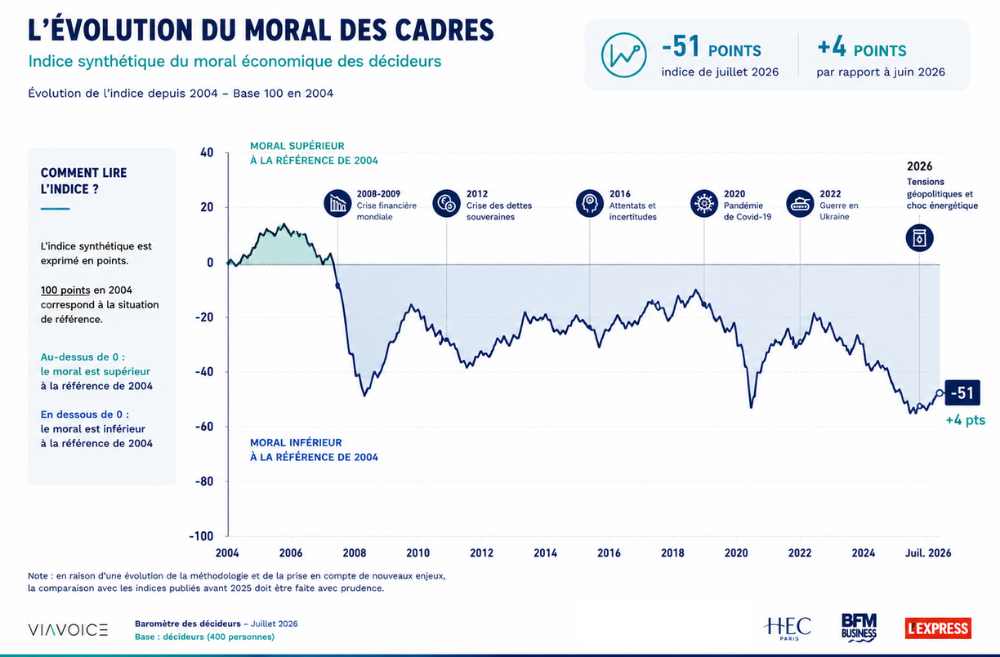
The synthetic index measuring decision-makers’ confidence did rise by four points in July, to -51, after falling to -55 in the previous wave. Viavoice had pointed out that this level was close to the low recorded following the 2008 financial crisis, at -56. Comparisons should nevertheless be treated with caution because the methodology used to calculate the index changed at the beginning of 2025.
Behind this modest rebound, expectations remain extremely bleak. 74% of decision-makers believe living standards in France will deteriorate over the coming year, compared with only 9% who expect an improvement. The general public gives an almost identical assessment: 73% expect living standards to deteriorate and 10% anticipate an improvement.
Views of personal circumstances are somewhat less gloomy, but still predominantly negative: 51% of decision-makers expect their own financial situation to deteriorate, compared with 16% who expect it to improve**. Among the French public as a whole, the figures are 50% and 18% respectively.
This gloom did not begin with the heatwaves or the war in Iran. As early as November 2024, 77% of decision-makers were already expecting living standards in France to decline, while 56% feared a deterioration in their own financial situation. Almost two years later, the figures remain of a similar order: more than a temporary bout of pessimism triggered by a particular crisis, they point to the emergence of a lasting sense of concern.
This is the central paradox of the latest Baromètre des Décideurs. French people and executives appear to be gradually learning to live with crises: they weigh up renewables against nuclear power, accept air conditioning as a compromise and place energy prices at the top of their priorities. Yet they still do not clearly see who, in the political arena, is capable of embodying those choice
Less than a year before the presidential election, France’s energy challenge may therefore not simply be a question of which solutions to choose. It is also about finding someone capable of convincing the French public that they understand the scale of the challenge.
The Baromètre des Décideurs survey was conducted online by Viavoice from 17 to 21 July 2026 among 400 executives representative of the executive population in metropolitan France and 1,001 people representative of the adult population.