
 Tech & AI
 Strategy & Leadership

- According to Olivier Sibony and Eric Hazan, AI can outperform experts in bounded decisions where objectives are clear and relevant data are abundant.
- In their book Faut-il encore décider ?, the academics argue that giving humans the final word can erase that advantage when they override AI at moments of disagreement.
- Some decisions require a legitimate human process, regardless of algorithmic performance.
- Independent testing and democratic control are needed before organizations delegate consequential decisions.
In July 2026, 26 Meta employees asked a U.S. federal court to halt their dismissals, alleging that AI-assisted systems had scored, ranked and selected workers for a layoff of about 8,000 people. Meta told the court that human business leaders made the choices using documented criteria and that no selection decision was made by AI. The judge found “serious questions” around the claims, denied the immediate request and called for more evidence. The dispute remains unresolved. But this case provides concrete form to a question which is moving into the public arena worldwide: when an algorithm influences a consequential choice, who is actually deciding - machines or humans?
That question runs through Do We Still Need to Decide? Human Decision-Making in the Age of Artificial Intelligence (only available in French), published in February 2026 by Eric Hazan and Olivier Sibony. The authors examine decisions in medicine, recruitment, justice, credit, investment and public policy. Their starting point is that machines already make better choices than humans in some bounded settings. Their central problem begins when the machine and the expert disagree.
For Sibony, decision-making is tied to autonomy and professional identity. “Deciding is a prerogative we associate with our autonomy, our dignity and our role, particularly at work,” he said in an interview shortly after the book’s publication in 2026. A manager’s responsibilities are often defined by the decisions that person is allowed to make. Delegating them can therefore alter professional identity as well as performance.
When AI and human judgment diverge
The usual answer to disagreement is to keep a human in control. Sibony says that when he asks managers who should have the last word, 99% answer that they should. The logic appears straightforward: consult the machine, then apply experience and judgment to make the final call in each individual case.
Hazan and Sibony identify a problem with that arrangement. If an algorithm is demonstrably more accurate on average than a human judge, disagreements between the algorithm and its human supervisor are more often caused by the algorithm being correct and the human being wrong. In other words, the calls a human feels most tempted to overrule are those in which he or she is wrong.
The authors cite a study of diagnostic accuracy in which physicians were correct in 74% of cases and an AI system in 90%. Giving the doctor the AI diagnosis and letting her make the final decision produced virtually no improvement (76% accuracy). Why? Because doctors often rejected the algorithm when it contradicted them. “If AI is genuinely better, we must accept delegating the decision to it, rather than simply consulting it,” Sibony says. “That is not an abdication of your responsibility, but a change in when you exercise it. Responsibility lies in choosing the AI system you will use and verifying that it does perform better. It is because you are responsible for the decisions, and you want them to be as accurate as possible, that you must trust the AI.”
Which decisions require a human process
The book’s map of artificial decisions places clear limits on delegation. One limit is technical. AI learns from comparable examples, so decisions without meaningful precedent sit in what the authors call the “no-go zone”. A nuclear launch, a response to an unprecedented terrorist attack or the use of geoengineering during a climate emergency offers little or no relevant history from which a system can learn.
A second limit concerns the value of the human act itself. The authors include autonomous weapons, criminal verdicts and decisions such as electing partners in a law firm. In these cases, legitimacy comes from visible responsibility, formal procedure, debate, precedent and the opportunity for those affected to be heard.
An algorithm might accelerate a verdict or even reduce the number of errors. Regardless, the legitimacy of the decision still comes from the hearing, the procedure and the visible assumption of responsibility. “Getting the answer directly from the AI would be like being dropped by helicopter at the summit of a mountain instead of climbing it,” Sibony noted. “In these cases, the journey matters as much as the destination.”
These decisions are rare in the authors’ framework, but they are consequential. Their defining feature is that human responsibility or human procedure forms part of the decision’s value, independently of the quality of the predicted outcome.
Where co-decision adds value
Full delegation works best when two conditions are present: enough relevant data and an objective that can be stated clearly. Many management decisions lack one of them. Private equity investors have clear financial aims but limited, scattered and uneven data on unlisted companies. Recruiters have extensive information but often cannot specify how they will trade experience, qualifications, potential and team fit against one another.
Training a recruitment system on past choices converts that ambiguity into a pattern drawn from earlier decisions. The system reproduces those choices, including systemic bias, accidental errors and missed opportunities. Sibony points to a vendor that promises to help employers recruit “clones” of successful staff. Past success gives no evidence about whether rejected applicants might have performed better.
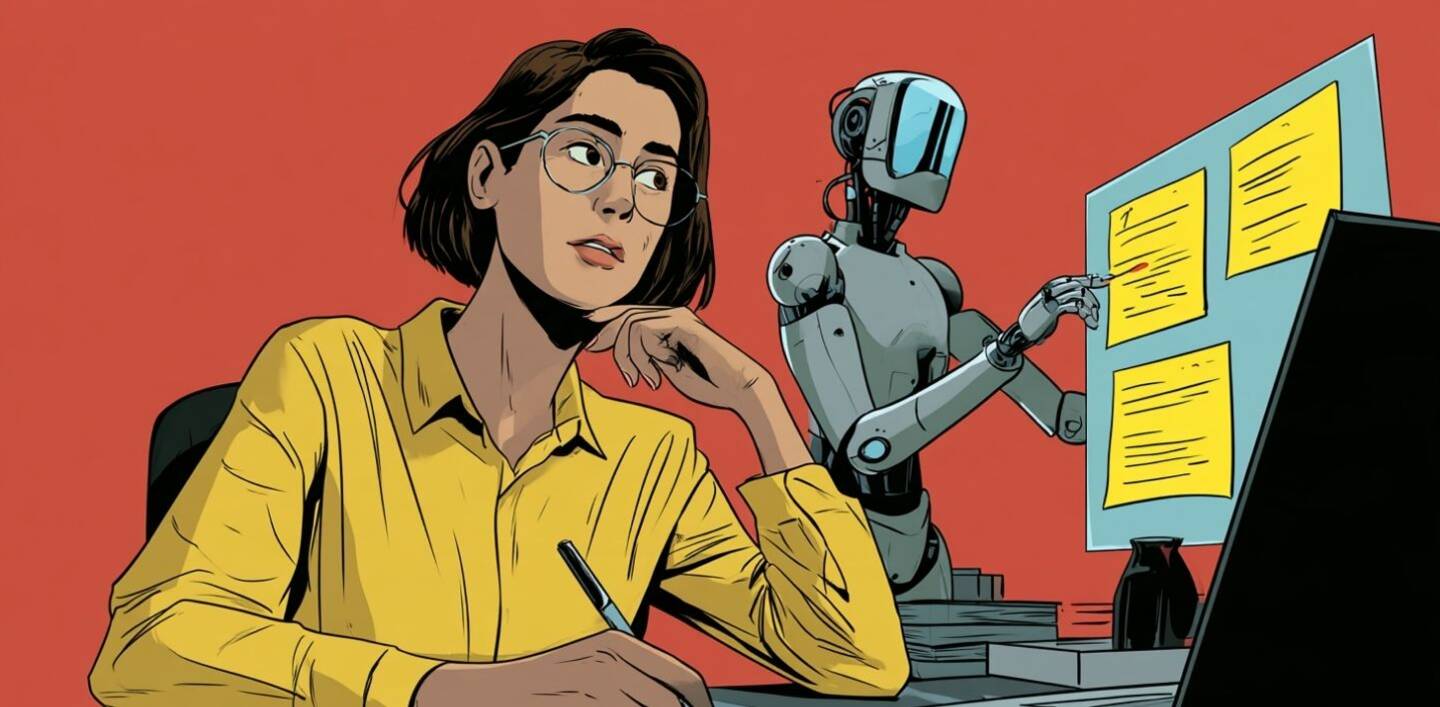
The authors place these situations in a “field of co-decision”. The person retains authority while AI acts as a demanding challenger. A language model can ask questions, expose neglected information, test assumptions and force the decision-maker to state criteria more precisely. Sibony compares the role to a sparring partner: a participant that strengthens the process without receiving the final authority to choose.
Who sets the goals behind the algorithm
The hardest decisions often contain several legitimate objectives. The book uses organ allocation as an example. More than 20,000 people in France are waiting for transplants, and algorithms help determine who receives a scarce organ. The system must balance utility, which favors those most likely to benefit, with equity, waiting time, medical urgency, age and geographic proximity.
An algorithm applies those priorities consistently; society defines what should be prioritized. The political decision lies in setting the objective, choosing the trade-offs and deciding who has authority to change them. Hazan and Sibony therefore treat AI decision-making as a question of power and democratic governance: who decides, on whose behalf and under which rules?
The authors describe several scenarios for the future, including one in which AI is massively rejected, and one in which it acquires an uncomfortable degree of unsupervised control over decisions that affect humans. The scenario they favor, however, combines broad adoption with citizen control. It includes democratic definition of algorithmic objectives, public or cooperative data infrastructure and independent supervision of critical systems.
Who can make machine decisions trustworthy?
Delegation also depends on proof that the system is better. A recruiter processing one million applications may need automated screening but has little capacity to test the vendor’s claims. Sibony compares self-certification by the supplier to asking a butcher whether the meat is good. The authors call for an independent AI audit authority with powers to investigate, test and sanction. They compare it with the institutions that certify aircraft or medicines. Users trust those systems without understanding every mechanism because an independent body has verified them.
Europe’s regulatory framework now sets several of those requirements. The European Commission says the AI Act’s transparency duties start to apply on August 2, 2026. Under the agreed AI Omnibus timeline, rules for high-risk systems in employment, education, migration and other consequential areas are scheduled for December 2, 2027. Those rules include risk management, documentation, monitoring and human oversight.
Effective oversight depends on how the person uses the system. Hazan and Sibony ask whether the human overseer has enough information, independence and authority to follow or challenge the recommendation for valid reasons. They also return to the objective itself. “No AI can do what we want if we do not know ourselves what we want,” both conclude.
Sources
Faut-il encore décider ? La décision humaine à l’ère de l’intelligence artificielle is published by Flammarion.


 Economics & Finance