
Youssef Yammine on Pursuing a New Direction through the EMBA
“The EMBA helped me develop a broader business perspective. It gave me more confidence to challenge my own assumptions and consider opportunities outside the path I had followed for many years.”
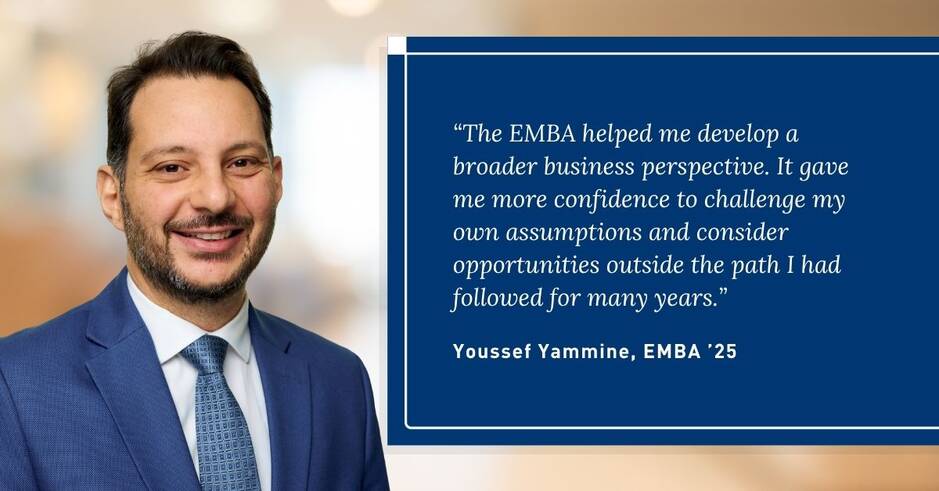
Youssef Yammine spent 15 years in Ericsson, beginning as a radio frequency engineer before progressing through network engineering, solution architecture and business development. Along the way, he took on significant international responsibilities and moved toward the strategic side of the business, eventually becoming a Regional Sales Manager.
As he considered the next 15 to 20 years of his career however, he realized that technical and commercial experience alone would not be enough.
“I wanted to strengthen my understanding of strategy, finance, leadership, operations and entrepreneurship,” he says. “I wasn’t just thinking about my next position, I wanted to prepare for a broader leadership role where I could contribute to business decisions at an executive level.”
The decision to pursue an Executive MBA was entirely his own. Although his employer offered to sponsor him, Yammine chose to finance the program independently so that he could retain complete freedom over the next stage of his career.
“The EMBA was an investment in my own development and in the kind of leader I wanted to become.”
Why HEC?
Youssef considered a few European business schools before selecting HEC. The school’s international reputation with a focus on leadership and strategy was an important reason for him, as was the quality and diversity of its Executive MBA cohort.
“For me, the objective was not simply to earn another degree,” he explains. “I wanted to learn alongside people who were already operating at a senior level and who came from different industries, countries and professional backgrounds.”
Already based in Paris, he appreciated the accessibility of the campus. Having a globally recognized program close to home made it possible for him to combine his studies with a growing career and his family responsibilities.
“HEC offered something that was difficult to replicate elsewhere: academic rigor, senior-level peer learning and an extremely international network,” he says. “It was also the strongest option geographically. I asked myself why I should travel farther when one of the world’s best programs was so close to me.”
A transformative leadership experience
One of the program’s greatest strengths was the immediate relevance of the modules. Classes in strategy, negotiation, finance and leadership gave Youssef frameworks he could apply directly to customer discussions, internal challenges and business decisions.
“I naturally tended to focus deeply on the details,” he says. “The EMBA pushed me to step back, look at the bigger picture, understand the strategic and financial implications, and ask better questions before moving toward a solution.”
For him, the leadership course was particularly transformative. It challenged some of his long-held assumptions about management and prompted him to reconsider both his leadership style and his professional direction.
“The leadership class disrupted my usual reflex,” he says. “It made me reflect on where I was in my career and whether I was still in the right environment for the leader I wanted to become.”
His understanding of leadership shifted from solving problems alone to creating the conditions in which other people could succeed.
“As you move into more senior positions, you cannot be the person who solves every problem,” he explains. “You need to build strong teams, empower people and focus your energy on the decisions where you can have the greatest impact.”
The program also made him more aware of the need to adapt his leadership style to different people, circumstances and stakeholders. Delegation, in particular, became an increasingly important part of his approach.
Preparing for a new career
Youssef customized the EMBA to support his long-term objective of becoming a more well-rounded business leader. “The Board Governance specialization was particularly interesting for me because it allowed me to explore governance, strategic decision-making and the responsibilities of senior leaders from a different perspective,” he shares.
Rather than viewing the EMBA simply as a certificate to complete, he saw it as a way to develop a wider executive toolkit—and for reflecting honestly on the direction of his career. That reflection played an important role when he decided to leave Ericsson during the program.
“I had spent many years at Ericsson and built a strong foundation there,” he says. “But during the EMBA, I began thinking more actively about what I wanted the next chapter of my career to look like. The program gave me the opportunity to step back from the day-to-day and reflect on my longer-term ambitions.”
He realized that he wanted to move beyond his previous environment, take on new commercial challenges and assume greater responsibility for strategic accounts, business development and growth.
“The EMBA did not directly cause the move, but it influenced how I thought about my career,” he says. “It gave me the confidence to challenge my own assumptions and consider opportunities outside the path I had followed for many years.”
Learning from his classmates
For Youssef, the most memorable aspect of the Executive MBA was the combination of people and international exposure.
“Being in a room with senior executives from different industries and cultures, discussing a business case or a real-world challenge, and realizing that everyone approaches the same problem differently was incredibly valuable,” he says.
The international modules extended that experience beyond the classroom, encouraging participants to examine leadership and business in unfamiliar environments. But some of the most useful insights came from talking to classmates.
“Sometimes a 20-minute conversation with someone from another industry could completely change the way I looked at a problem,” he recalls.
The diversity of the cohort ultimately became one of its greatest strengths. The group called itself 'La Bande'—a fun name reflecting both its members’ close bond and the idea of distinct individuals coming together in harmony.
“In music, different contributions need to be synchronized to create something powerful,” Youssef explains. “That was our cohort. Its diversity was the key to making the experience so successful.”
A network that stays in touch
The relationships created during the EMBA have continued well beyond the classroom. Members of ‘La Bande’ stay connected through regular conversations and reunions, including a recent gathering in Lisbon that combined time together with a leadership seminars and talks from senior corporate speakers.
“Our cohort came from different countries, industries and professional backgrounds, but we went through an intense experience together,” Youssef says. “That really created a strong bond.”
For him, this enduring community demonstrates that the value of the HEC network lies not simply in its size but in the quality of the relationships it creates.
“The EMBA does not end when you graduate,” he says. “It becomes part of your long-term professional network.”
The HEC Paris Executive MBA ultimately helped Youssef rethink his path, change his approach to leadership and pursue the new role with greater confidence.
“It helped me move from being an experienced commercial and telecom professional to thinking like a broader business leader,” he concludes.