The Biological Fracture: Mapping the Next Wave of Medical Biotech Commercialisation
Biotech is no longer one industry with one investment logic. In this analysis, Livia Kalossaka maps more than 1,000 deep tech startups to reveal how AI drug discovery, TechBio platforms and biomanufacturing are reshaping biotech commercialisation. Discover where the real bottlenecks lie, and where the next opportunities are hiding.
Biotech no longer follows a single investment logic
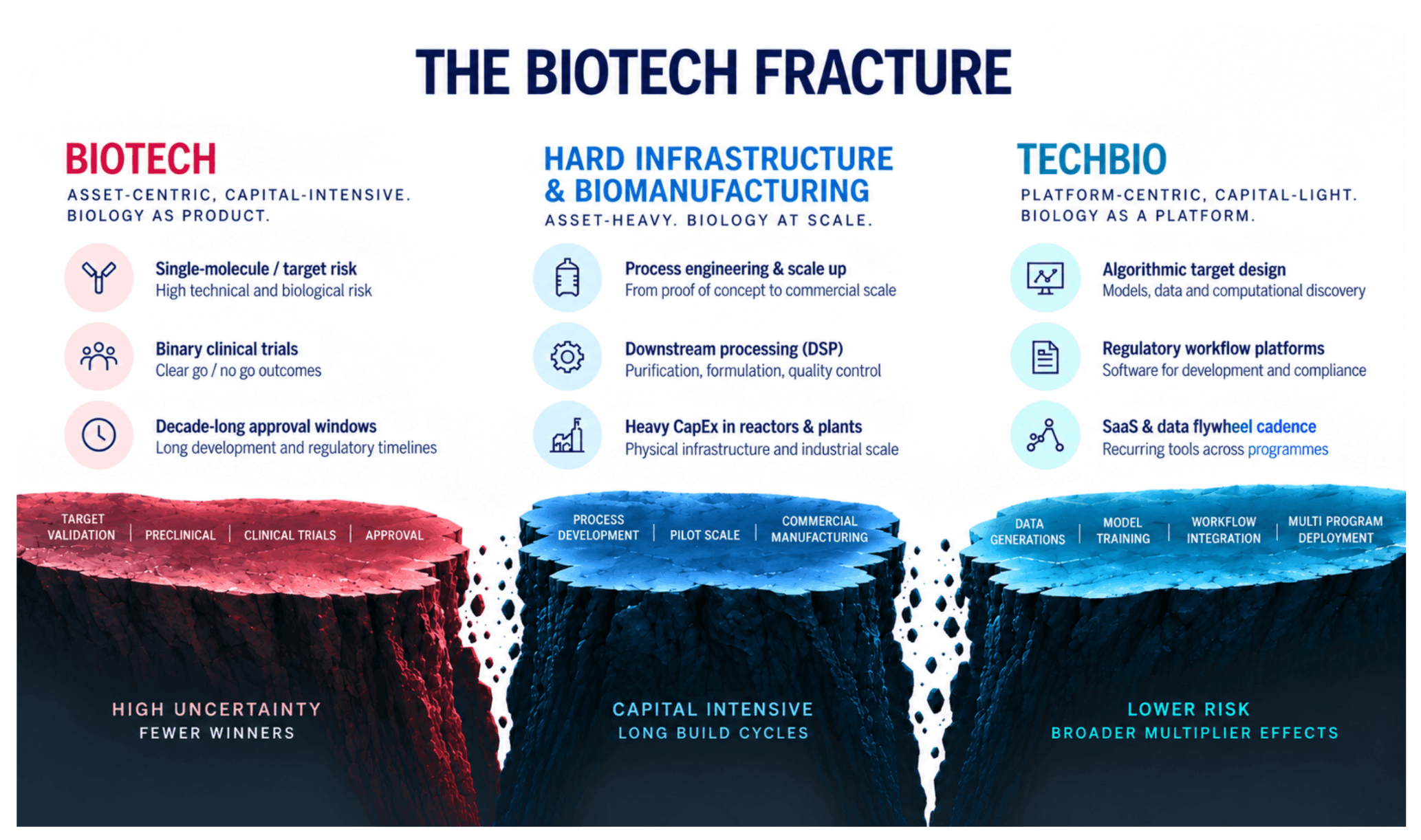
Biotech has two words in its name: biology and technology. However, behind that single label sit two constituent operating paradigms: traditional BioTech and TechBio.
BioTech represents an asset-centric, capital-intensive model built on what we’ve been used to, multi-year research horizons. It rewards whoever gets there first, but forces capital markets to absorb extreme attrition rates during clinical translation.
TechBio represents a platform-centric, capital-light layer that operates on SaaS timelines. It rewards workflows and data infrastructure. In this space, being the first mover is often a drawback because there is no established market, no comparable benchmark, and no clear pricing model. What matters instead in this world is control: recurring software tools, algorithmic target design, automated regulatory workflows, and feedback loops that make every new project cheaper and more predictable than the last.
Between these two worlds sits a third reality: hard infrastructure and biomanufacturing. This area runs on heavy physical capital, complex downstream processing, and long facility build cycles. Moving the question from "will it work?" to "can we manufacture it safely and predictably, nth times over?"
Everyone still tells the same story about biotech: a new molecule, a new modality, a new cure. However, as biological discovery becomes faster and cheaper with AI, the scarce resource is shifting. On the one hand, it is the high-quality data needed to make better predictions, what Science Exchange calls a “data moat”; on the other hand, it is the clinical capacity, regulatory review and biomanufacturing needed to validate and manufacture at scale.
Where Disruption Concentrates
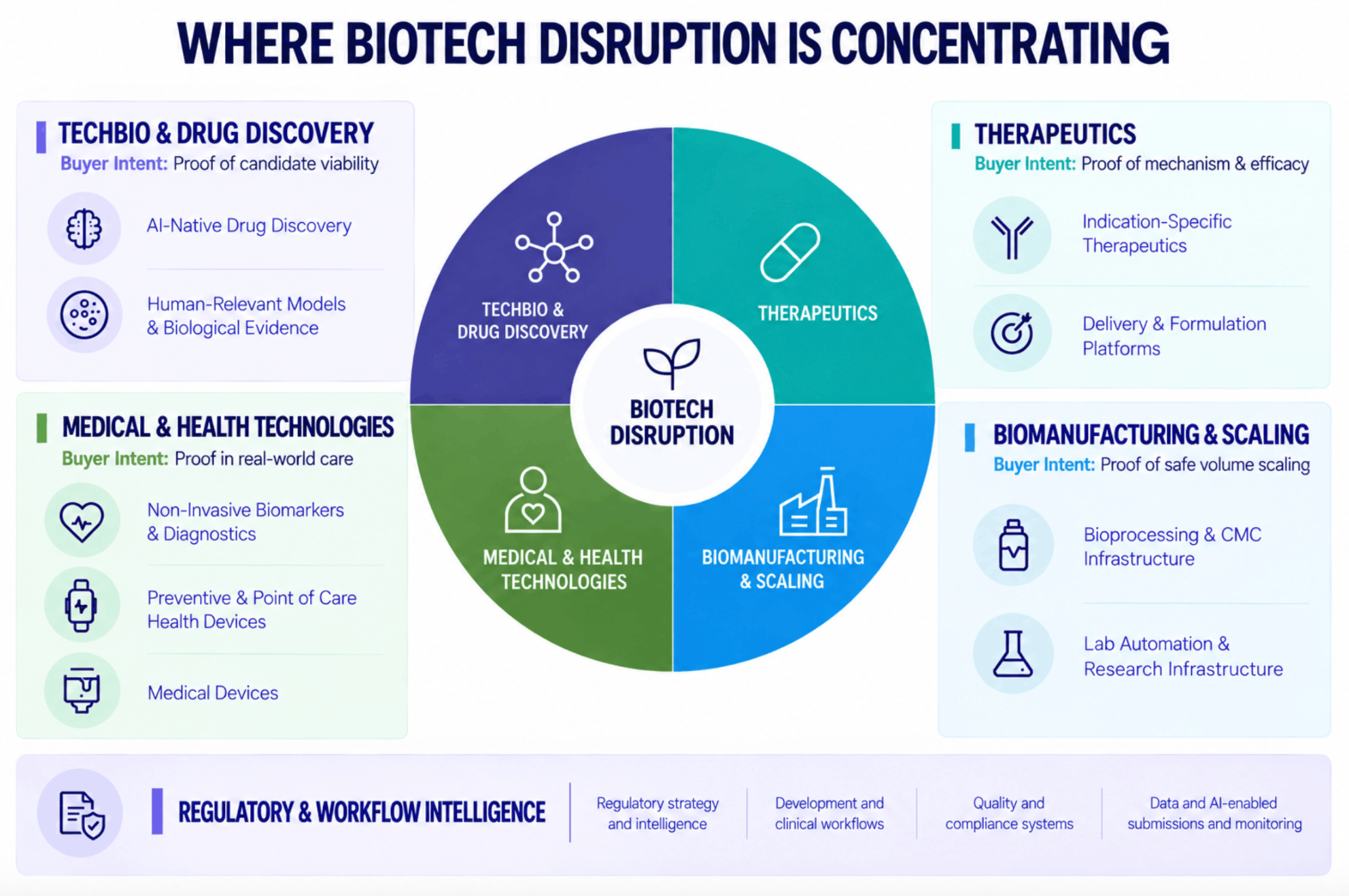
To visualize where biotech disruption, economic value, and capacity bottlenecks accumulate across the life sciences value chain, we mapped the Creative Destruction Lab (CDL) Paris and Hello Tomorrow startup pools into four core environments and one horizontal layer.
Within this framework, Therapeutics and Medical & Health Technologies sit on the asset-centric BioTech side, TechBio & Drug Discovery is the platform-centric TechBio side, and Biomanufacturing & Scaling is the hard infrastructure layer anchoring the entire ecosystem. Regulatory & Workflow Intelligence cuts across all four, supporting the evidence, quality and operational systems that connect them.
If proof is the scarce resource, the market breaks down by who buys proof and how it is used:
- TechBio & Drug Discovery: Buyers pay for proof that a candidate is worth advancing through predictive biology models, AI-native platforms, and human-relevant preclinical evidence.
- Biomanufacturing & Scaling: Buyers pay for proof that a process can run safely at volume through continuous bioprocessing, single-use systems, and manufacturing analytics.
- Therapeutics: Buyers pay for proof that one mechanism works in a named indication through targeted assets, disease franchises, and precision platforms.
- Medical & Health Technologies: Buyers pay for proof that a measurement or intervention works in real care pathways through non-invasive biomarkers, point-of-care devices, and preventive health systems.
Patterns across the pipeline
On the supply side, we compared applications to two early-stage programmes, the Hello Tomorrow Challenge (HTC) and CDL-Paris, which together offer a partial but useful view of where founders are focusing.
Deep Tech Pioneers, the Hello Tomorrow startup network, brings together some of the most promising deep tech startups worldwide. Each year, they are selected from more than 4,800 applications to the Hello Tomorrow Challenge by an expert jury of investors, executives and researchers from each track’s industry, assessed on technological innovation, economic viability, impact and team.
On the other hand, CDL Paris takes a thesis-driven approach to venture selection. Recruitment begins with the formulation of a Portfolio Thesis around the most pressing challenges in each domain, using scientific frameworks to identify opportunities where frontier technologies could have significant impact. CDL’s philanthropic model also allows it to explore and de-risks moonshot technologies that may be less suited to conventional investment criteria. Following an initial scouting funnel of more than 2,000 startups, ventures are assessed and interviewed by panels of subject-matter experts, academics and the CDL team. This process has shown strong traction in internally identified opportunities, with 81% of the final cohort coming from the ventures initially identified through CDL’s own scouting process.
In TechBio & Drug Discovery, computation becomes the baseline, emerging as one of the two clearest common anchors across both datasets. Within the CDL cohort, AI-native drug discovery represents more than half of all drug discovery platforms (roughly 12% of the entire applicant pool), while predictive biology leads the computational tag at nearly 9% of the total pool. In Hello Tomorrow’s mapping, these exact capabilities shifted from fringe, outer-ring signals in 2021 to become the default operating baseline by 2026.
Finally, in Biomanufacturing & Scaling, specialist programmes are positioning themselves ahead of the market. Biomanufacturing and CMC is a core part of CDL-Paris's thesis, and the programme actively recruits startups in this space, which now account for roughly 15% of its cohort. In Hello Tomorrow's open call, by contrast, biomanufacturing still appears as an outer "future signal". The difference reflects thesis-driven selection on one side and organic founder demand on the other. Conviction around the question "can it be made at scale?" is currently stronger among specialist investors than in the wider founder pool.
Signals from the Frontier
Beyond the aggregate numbers, a few companies from our startup networks show how founders are tackling three specific bottlenecks where proof is the scarce resource: generating evidence, manufacturing at scale, and delivering and discovering therapies.
On the evidence and validation side, platforms are replacing slow physical assays with scalable data systems. Virtonomy (HTC'21, Germany) runs in silico clinical trials on digital twin patient populations built from real-world data, enabling medical device teams to generate statistically robust regulatory evidence in weeks. Preclinically, mo:re (HTC'24, Germany) and FluoSphera (HTC'22, Switzerland) tackle the same bottleneck through patient-derived tumour organoids and chip-free microphysiological systems that produce human-relevant, regulatory-acceptable data without animal testing. DoMore Diagnostics (HTC'23, Norway) extends this logic into diagnostics, deploying deep learning over standard pathology slides to predict chemotherapy efficacy in colorectal cancer without requiring new tissue biopsies. Each company is building a business model that monetises proof instead of molecules.
On the biomanufacturing side, the operational question has shifted from biological validity ("does it work?") to industrial execution ("can it be manufactured predictably at scale?"). Ispiron (HTC'25, France) applies real-time process control analytics to navigate the scale-up cliff between lab bioreactors and commercial production. HypeSound (HTC'24, Italy) addresses the same wall physically, deploying calibrated acoustic stimulation to increase fermentation yield and stability without chemical or genetic modification. Both are trying to demonstrate that biological production can be transformed into reliable equipment addressing the operational bottleneck that 63% of investors now look at before investing. They are turning unpredictable biological recipes into predictable industrial equipment.
On the delivery and discovery side, platforms are converting biological barriers into programmable infrastructure. TheraSonic (HTC'24, France) uses focused ultrasound to temporarily open the blood–brain barrier, operating as a licensable delivery chassis for third-party therapeutics targeting the central nervous system. Simultaneously, computational platforms like Whitelab Genomics (HTC'23, France) and Kyan Therapeutics (HTC'21, Singapore) deploy foundation models and AI engines as evidence filters, enabling pharma buyers to pressure-test pipeline candidates prior to clinical entry. Instead of betting on individual therapeutic assets, these companies build the underlying structure that de-risk portfolio development across the industry.
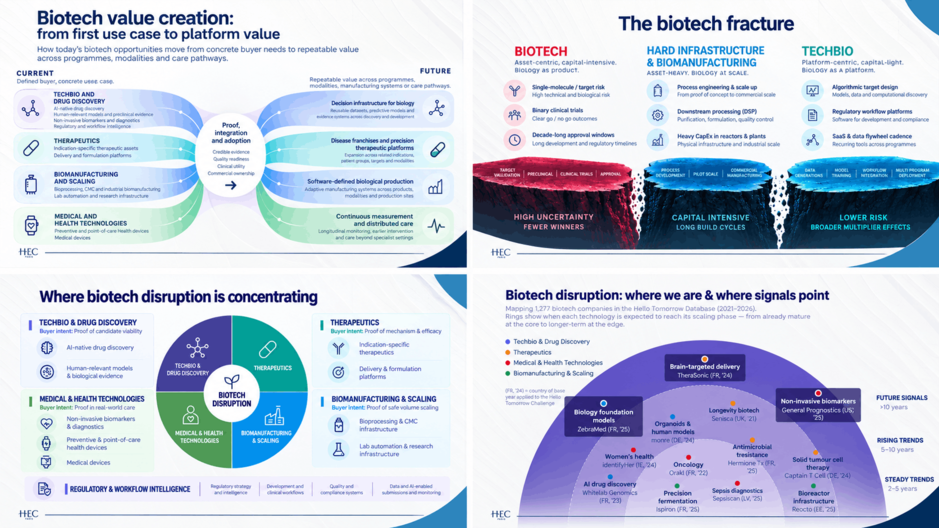
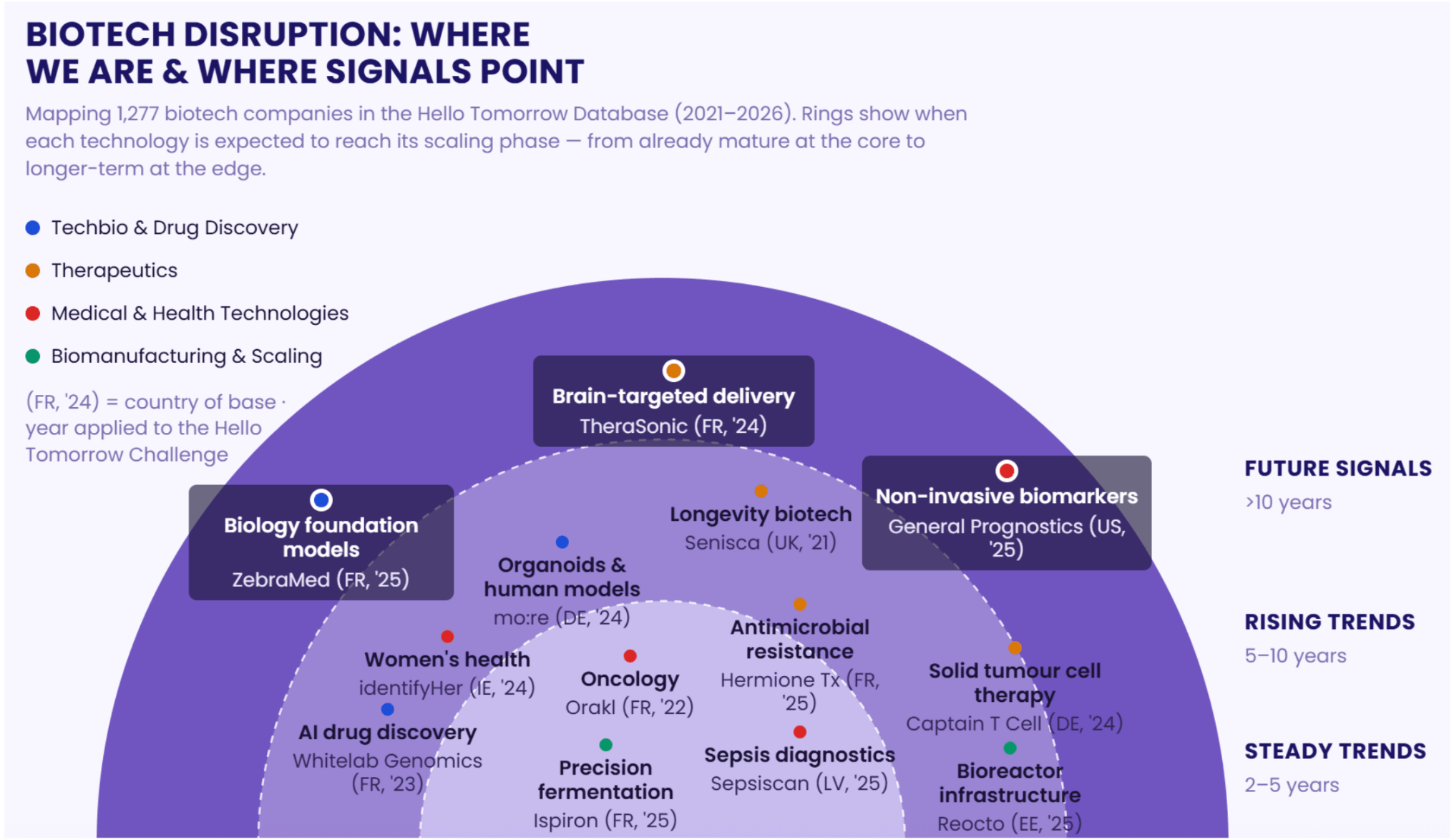
Looking across more than 1,000 companies tracked between 2021 and 2026, a startup map emerges that functions like a market clock. What moves to the outer edge represents what capital markets have not fully priced yet.
The inner ring of steady trends still holds classic therapeutic areas like oncology or sepsis diagnostics. The outer ring of future signals is dominated by computational tools and biomanufacturing infrastructure, with companies like ZebraMed (HTC'25, biology foundation models), Whitelab Genomics (HTC'23, AI drug discovery), General Prognostics (HTC'25, non-invasive biomarkers), and NitroDuck (HTC'25, biomanufacturing).
The commercialisation pathway
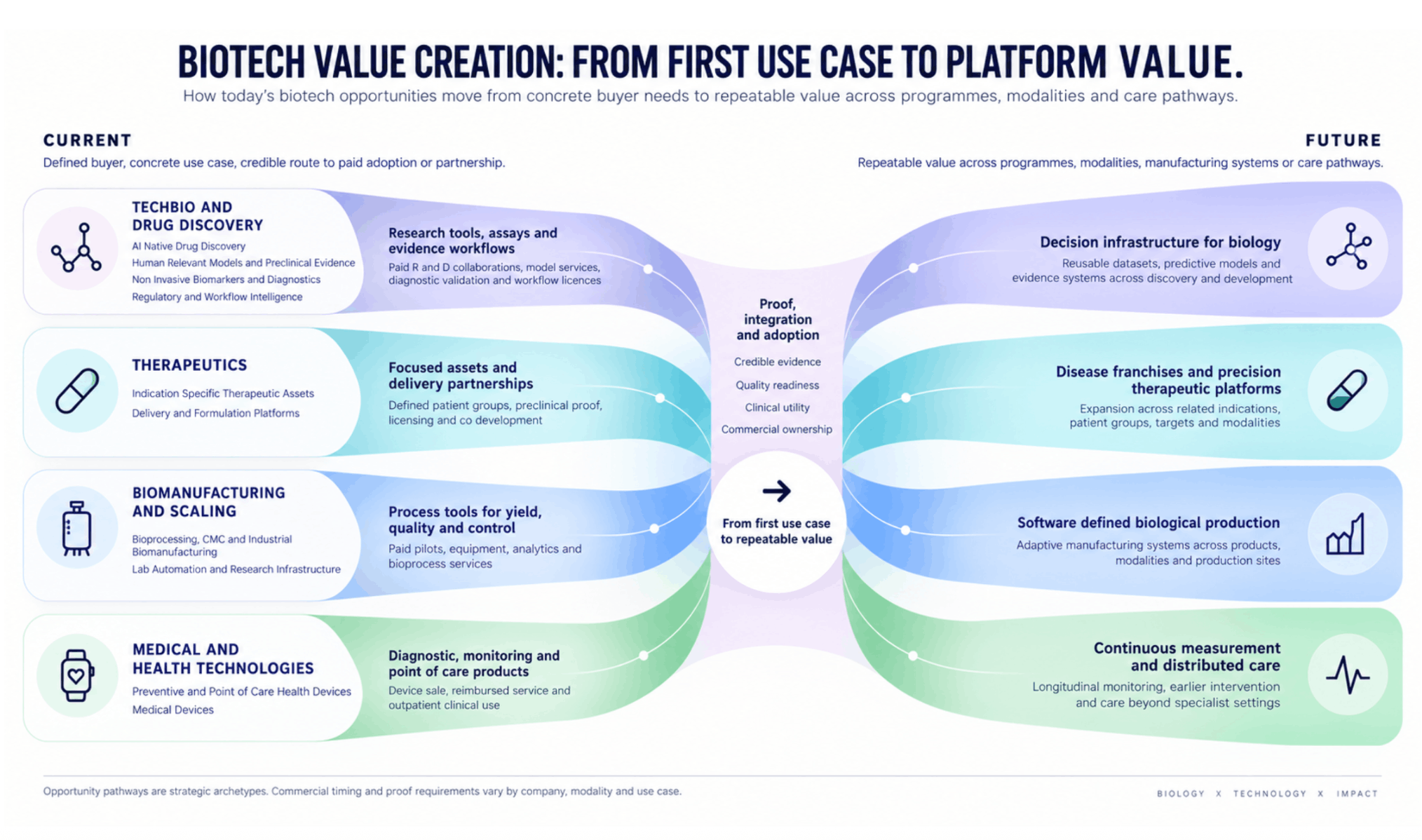
Tagging the cohort data by category over time reveals a clear gap between industry expectations and current reality. Looking back to five years ago, biotech accelerators were mostly operating on the assumption that therapeutics and delivery platforms would continue to expand their share of startup pipelines.
The dataset trends we have today show a different story. Across the 2021–2025 Hello Tomorrow cohorts, Biology Measurement & Omics combined with Bioinformatics & AI Biology expanded from a third of all tags to more than half the pool. Meanwhile, Therapeutics and Medical Devices both declined as a proportion of total applications. Which means that Bioinformatics & AI Biology experienced the sharpest shift, moving from a minor category in 2021 to nearly a quarter of all tags by 2025. This does not imply fewer therapeutics companies are forming, but rather that measurement, data, and computational platforms grew rapidly enough to redefine what constitutes a typical biotech startup.
Industrialising a biological capability into scalable platform infrastructure represents the primary driver of productivity. As highlighted in global competitiveness diagnostics, market value is no longer created through point-solution approaches to drug discovery, but is found when systemic frictions across the industrial value chain are removed.
When platforms convert operational bottlenecks such as fragmented, manual validation into automated regulatory workflows and licensable delivery mechanisms, they reduce compliance costs and accelerate time to market. The markets around them are substantial: biopharmaceutical contract manufacturing is forecast to reach $75.8B by 2030, continuous bioprocessing $911M by 2030, digital biomarkers $12.77B by 2031, and healthcare digital twins $33.4B by 2035. While these figures capture total addressable market volume across incumbent and emerging channels, the commercial capture for startups lies in having strong value propositions that displace high-friction manual services with repeatable, high-margin software and operational tools.
For institutional investors and public policy makers alike, capturing these value pools means securing long-term technological sovereignty, manufacturing resilience, and sustainable economic competitiveness.
To capitalise on this structural realignment, we think that institutional stakeholders must update their operating models:
- For Venture Capital & Private Equity: Re-calibrate valuation models to distinguish between clinical asset risk and workflow bottleneck risk. Underpricing infrastructure platforms with enterprise-SaaS dynamics creates market misallocations.
- For Corporate R&D & Open Innovation: Pivot corporate strategy from acquiring early-stage single-molecule assets toward securing long-term access to proprietary datasets, continuous bioprocessing architectures, and automated CMC nodes.
- For Accelerators & Policy Makers: Update public funding instruments and evaluation criteria. Traditional Biotech is asset-centric and measured against multi-year clinical trial milestones. Evaluating TechBio infrastructure engines against those same clinical benchmarks misjudges their value proposition, failing to support platforms designed around throughput, data integration, and enterprise workflow adoption.