
From North America to the HEC Paris MBA: Rethinking What’s Next
They left careers in aerospace, luxury retail and data science to study in France. The move has changed not only where they might work, but what they imagine doing next.
Saneena Anzalone (MBA '27) was sitting outside Napoleon’s tomb when she decided to change her life. She had come to Paris alone with one week off from her job at a luxury consignment boutique in Naples, Fla. At Les Invalides, after walking through the monument and thinking about leadership, she took out her phone and searched for an English-language MBA in France.

HEC Paris appeared in the results. “I said, ‘I’m going to apply there,’” she recalled. “It’s one thing to be a tourist, but it’s another to change your life.”
Anzalone arrived at the HEC Paris MBA alongside North Americans whose careers had little in common with hers. Marc Nasr (MBA '27) worked in aerospace strategy in Montreal. Mark Dillemuth (MBA '27) was an actuary and data scientist in Philadelphia. Each had begun to see professional change as geographic change, too.
Nasr, a Canadian who was born and raised in Lebanon, studied mechanical engineering and specialized in aerospace and propulsion. His work gradually carried him away from aircraft design and into business development, contract negotiations and strategy. By the time he joined Mitsubishi Aerospace, an MBA had begun to make sense, as had a move closer to his family.
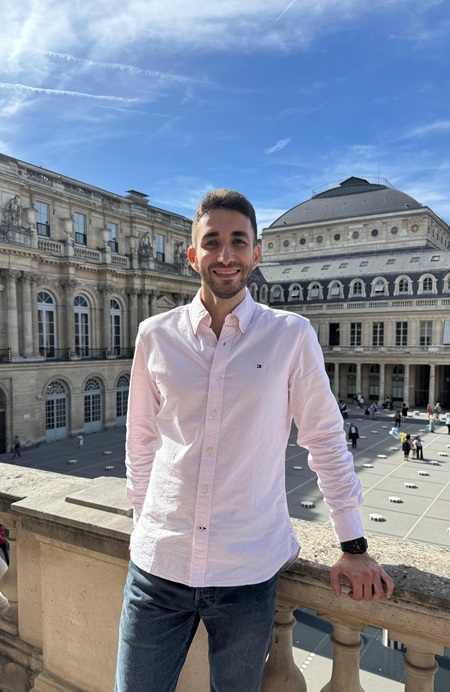
Canada would have been cheaper. It also would have been safer. But Nasr wanted to build a career in the EMEA region, and he believed the degree should place him in the market where he hoped to work. “You should do your MBA where you plan to build your long-term career” he said. At HEC Paris, the longer program and finance specialization gave him room to consider a transition into banking, management consulting or private equity, with a particular interest in mergers and acquisitions.
Anzalone was seeking a different kind of transition. Raised in Boston and later based in Hawaii and Florida, she had built a career around high-end fashion and jewelry. She was interested in why people buy luxury goods, how brands tell stories and how technology is changing the relationship between retailers and their customers. She wanted more than a conventional strategy curriculum. At HEC Paris, she has turned toward fintech and digital innovation, joined the Future of Money and Payments Certificate and helped create the MBA Retail and E-commerce Club.
When her acceptance call came, Anzalone had already left her job, given up her apartment and begun selling her car. The caller had a French number. “What are you doing in September?” the recruitment manager asked. Anzalone knew then that her old life in Naples was over.
Dillemuth’s decision was more methodical. A mathematics graduate from the University of Texas, he had worked at Cigna, first as an actuary and later as an internal data consultant. His team built machine-learning models to forecast claims, expenses and health outcomes. He liked explaining technical work to decision makers, but wanted to do it across industries and eventually invest in technology companies.
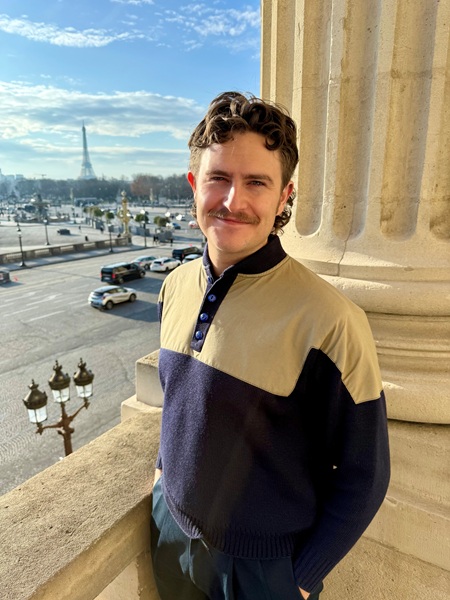
What drew him to HEC Paris was not Europe in the abstract, but the scale of the school’s international population and the range of industries represented there. In one study group, he worked with classmates from Japan, China, India and Chile. “Had I stayed domestically, my question was, do I want to work in New York or Los Angeles?” he said. “Now my question is, do I want to work in Singapore or Paris?”
The move has not been frictionless. All three mentioned visas and French bureaucracy; Dillemuth also worried about spending his savings on a school less familiar in the United States. His advice is blunt: decide where and in which sector you want to work, then judge the degree accordingly.
Anzalone has had to learn something less technical. Accustomed to managing on her own, she found that independence was not always useful while establishing residency in a new country. “Get comfortable with being uncomfortable,” she said, “and don’t be afraid to ask for help.” Nasr recommends speaking with alumni who have already made the same move.
None of them came to France simply to collect a credential abroad. They crossed an ocean in pursuit of the opportunities they envisioned on the other side.