HEC Paris partners with Sami for the first Global Carbon Footprint Radar
HEC Paris, through its Sustainability & Organizations (S&O) Center, has joined forces with climate platform Sami for the first edition of the Carbon Footprint Radar, a new global barometer examining how companies measure and manage their carbon footprint.
Developed by Sami in collaboration with SGS, HEC Paris, EDF and the Sustainability & ESG Professionals Association (SEPA), the first Carbon Footprint Radar draws on responses from 556 companies across 62 countries to provide a snapshot of corporate carbon accounting practices in 2026.
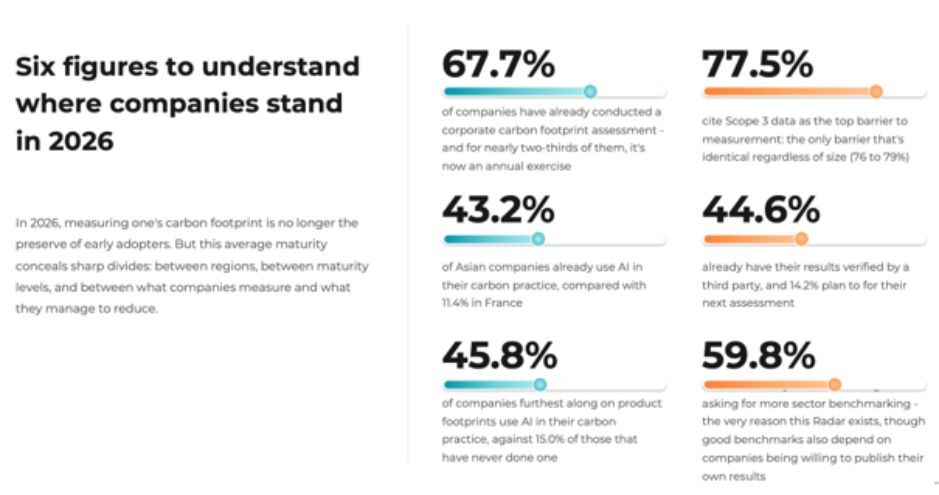
The study comes at a pivotal moment for corporate climate action. While regulatory pressure is easing in Europe, notably with the narrowing of the scope of the Corporate Sustainability Reporting Directive (CSRD), carbon accounting continues to gain ground among companies. 67.7% of respondents have already completed a carbon footprint assessment, and for around two-thirds of them, it has become an annual exercise.
As François Gemenne, Professor at HEC Paris and Academic Director of the Sustainability & Organizations Center, underlines:
“While regulators hesitate and step back, the majority of companies are moving forward. In the future, carbon accounting will become as important as financial accounting in measuring a company’s performance.”
Bringing academic insight to corporate carbon practices
As academic partner, the HEC Paris Sustainability & Organizations Center contributed to the analysis of the findings through the expertise of Brian Hill, whose research explores decision-making, uncertainty and the mechanisms that can encourage greater environmental transparency.
One of the key questions explored is what drives companies to measure their carbon footprint when regulation is no longer the primary incentive. The Radar points to the growing role of market pressure from clients and competitors, identified as the most consistent driver across regions. It also highlights significant differences in leadership engagement: while 62.9% of French respondents cite it as a driver, this figure falls to around 33–34% in Asia and the rest of the world.
« The Radar shows that carbon reporting is no longer driven by regulation alone: customers and competitors are now the most powerful forces for transparency, with a significant role remaining for voluntary leadership, especially in Europe. This can create a market dynamic of its own - companies disclose because stakeholders value the information and because, once others are transparent, staying silent becomes harder. This is precisely the kind of bottom-up dynamic highlighted and studied in our ongoing work at the HEC Paris Sustainability and Organizations Center on creating the conditions for smarter sustainability disclosure. » says Brian Hill, CNRS Research Professor in Economics and Decision Sciences at HEC Paris. [Read the Policy Paper : Squaring disclosure regulations and competitiveness]
The barometer also sheds light on some of the challenges companies still face. Scope 3 data remains the leading obstacle to carbon measurement, cited by 77.5% of respondents, while more than half of companies surveyed have never assessed the economic return of their carbon initiatives.
Through this academic contribution, the S&O Center aim to help deepen understanding of how carbon accounting practices are evolving beyond regulatory requirements, and of the organizational and market dynamics that can encourage companies to move from measurement towards action.
Discover the full 2026 Carbon Footprint Radar and its findings by country and sector.