

 Strategy & Leadership

- Conflicts involving “critical members” have an outsized impact on team creativity, showing it’s not just about the disagreement but who’s at the center of it that counts.
- Task conflicts involving critical members can drive creativity, but only if the team is reflective and aligned on shared goals. These disputes push the team to rethink and innovate.
- Personal conflicts involving critical members tend to chip away at team unity, unless critical members possess the emotional intelligence to diffuse harmful tensions.
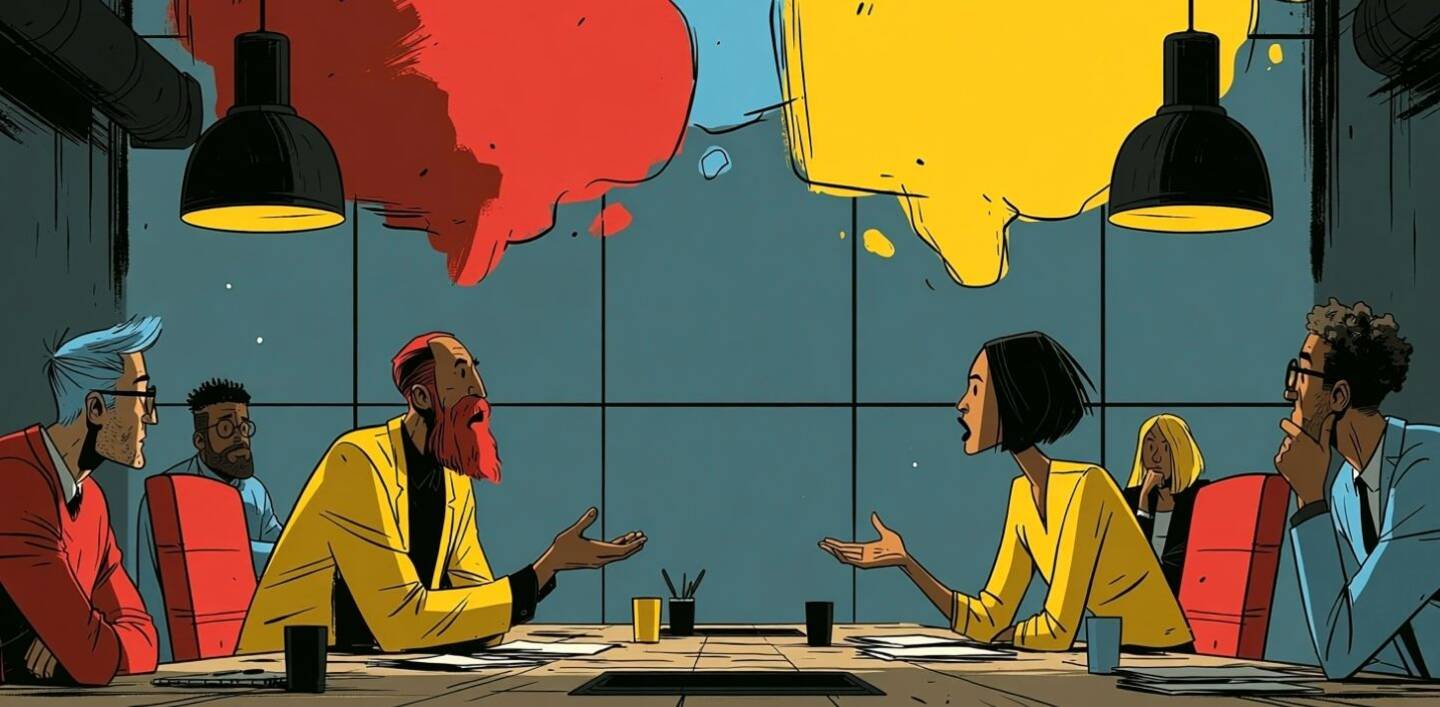
Companies often try to eliminate conflict in the hope of improving team performance. Yet our research suggests that conflict is not always the enemy of creativity. What matters most is not the conflict itself, but who is involved. Drawing on data from 70 new product development teams, we show that disagreements involving the team's central members can either become a powerful catalyst for innovation—or, conversely, seriously undermine team dynamics and creative performance.
The (sometimes) bright side of conflict
In any team, disagreements about the task at hand — like how to distribute resources, make decisions, or handle workflow — are bound to happen. These are known as “task conflicts”. And traditional research has often considered such disputes as potentially helpful, arguing that they can bring in new perspectives, spur discussion and, if managed properly, enhance team creativity. That said, data often tell a different, more complicated story. We started our research as an attempt to reconcile some of the inconclusive results.
Using network analysis in 70 new product development teams, we found that task conflicts involving critical members of a team can indeed spark creativity by pushing the team to reflect on their work, albeit only under certain conditions. Specifically, critical members’ task-related disagreements seem to only have creative potential when they occur in teams that report higher levels of shared goals. These results hold even when accounting for all other task conflicts in the team.
Here’s how it works: when a critical member — the one others depend on for essential information — engages in task conflict, teams are forced to take a step back, reassess what’s happening, and consider new approaches. It pushes the team out of autopilot mode and, so long as the team is aligned toward a shared goal, it encourages a mindset of flexibility and fresh ideas, which is the lifeblood of creativity. Absent shared goals, we don’t really see much creative benefit from critical members’ task conflict, which is not surprising—why do the hard work of questioning the status quo if you don’t agree on the outcome you want? So, as it turns out, much of what we have traditionally captured in overall team conflict is not conducive to creativity; what happens in the “core” is where the fruits can emerge.
The Dark Side of Conflict
On the flip side, personal spats — known as “relationship conflicts” — have a different effect. These are conflicts that aren’t really about the work itself, but rather stem from personality clashes or interpersonal issues.
Past work has been pretty clear about the negative role of team relationship conflict and creativity, but our work shows that when these conflicts involve critical members, the effects are even more deleterious. Namely, critical members’ interpersonal conflicts erode the team’s cohesion, i.e., the “glue” of the group, which destroys the trust and safety needed to try new, creative things.
When critical members possess high levels of emotional intelligence, the worst of these negative effects can be mitigated. In short, emotional intelligence helps these key players handle personal tensions in a way that keeps the team together, even when conflicts pop up. So, chalk up another victory for those talented stars who can also manage the people side of their work.
Practical Takeaways
So, what can leaders do to harness the creative potential of conflict while minimizing its downsides? Here are a few actionable steps:
Set shared goals: By establishing common goals, leaders create an environment where task conflicts are more likely to be constructive. When team members are all pulling in the same direction, disagreements about how to get there can be resolved more productively, driving the team to reflect and adapt.
Coach for emotional intelligence: Because relationship conflicts involving critical members can harm cohesion, it’s essential to equip these key players with the emotional skills needed to manage personal tensions. Selecting for or coaching on emotional intelligence can help critical members handle conflicts in ways that don’t damage team unity, preserving the group’s creative potential.
Reconsider conflict: Recognize that not all conflicts are equally disruptive — or equally beneficial. A well-designed team structure will consider both the roles of critical members and how conflicts involving them can shape team dynamics. Leaders can look at conflict not just as a problem, but as a potential driver of creativity, depending on who is involved and how it’s handled.
Overall, traditional research on team conflict has often assumed a one-size-fits-all approach, treating task and relationship conflicts as if they affect everyone equally. Thanks to advances in how we explore team data, our study reveals that conflict involving central network members disproportionately affects team dynamics and creativity.
Conflicts with these key players can’t be brushed aside; they have ripple effects that influence the whole team.
Sources
Article based on the paper, “Team conflict at the core: Exploring the influence of critical team member conflict on team creative functioning”, by Brad Harris (HEC Paris), Huiyao Liao of the Chinese University of Hong Kong, Ning Li of the University of Iowa, and Yuqing Han of Shanghai Jiao Tong University, published in the Journal of Occupational and Organizational Psychology in November 2023.
Find the original article in The Conversation Europe, here.


 Innovation & Entrepreneurship

 Tech & AI