
 Innovation & Entrepreneurship
 Strategy & Leadership

Cement is the kind of industry that rarely makes its way into investor pitch decks or magazine covers, and that may be precisely the problem. Because the world pours more than four billion tonnes of it every year and pays for the convenience with roughly 8% of all human carbon emissions. A footprint larger than the entire aviation industry and second only, among industrial processes, to steel. That makes cement one of the highest-stakes sectors to decarbonize, and one of the hardest to tackle.
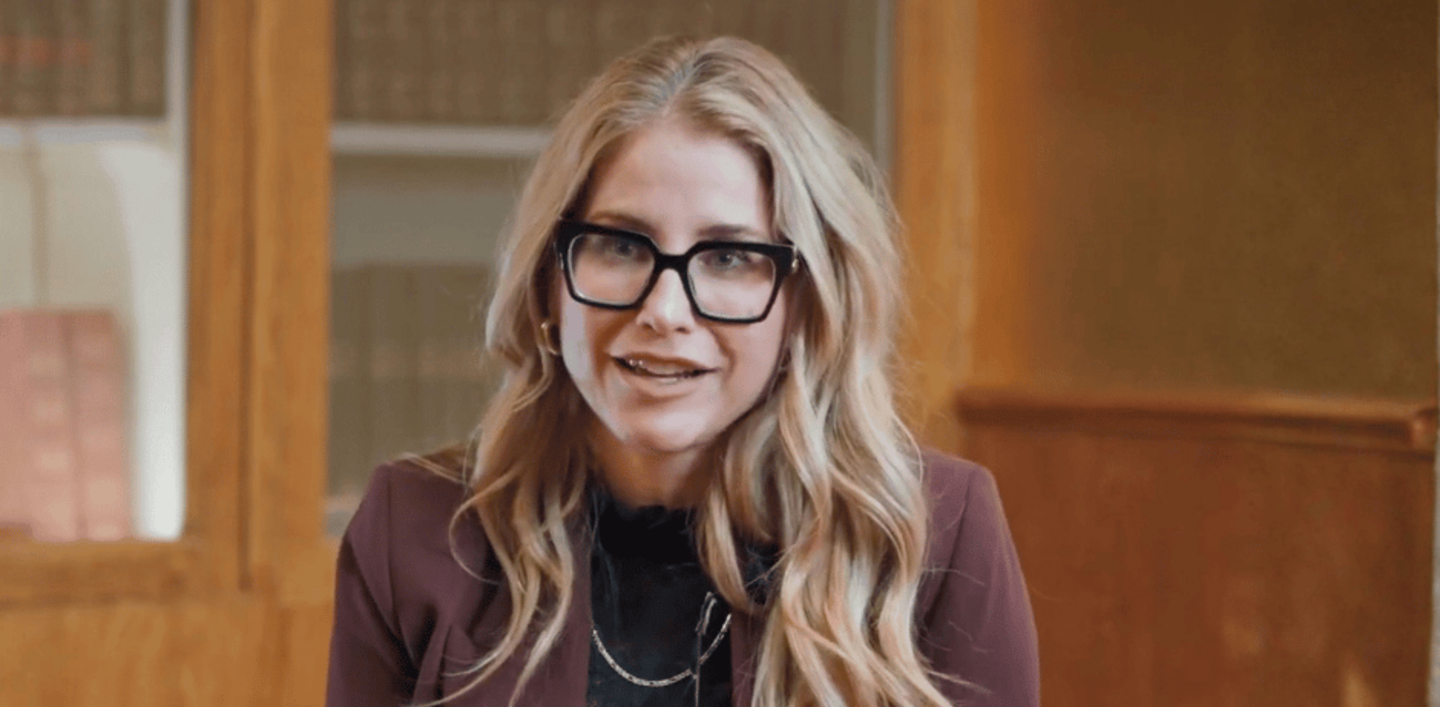
For Erin Bobicki, this challenge has become the central organizing fact of her professional life, the reason she now runs a climate technology company called Cura Climate, and the reason she eventually agreed to lead it despite she once believed she was “not the good person” for the job.
 Find out more
The geometry of doubt
A career in academia teaches a particular kind of caution. As a professor of mining and mineral processing at the University of Toronto, she had spent years calibrating a different sort of authority, one earned through peer review, published in journals, defended at conferences, where the currency was precision and the cardinal sin was claiming expertise one had not yet demonstrated.
When Erin launched her first company out of her own research in 2021 (Aurora Hydrogen), she handed the chief executive role to someone she trusted and quietly retreated into the more comfortable territory of the CTO seat. It is the part of her story she tells most plainly, without embellishment, and perhaps for that reason it is the part that lingers. A senior female scientist, world-class in her domain, looked at the company she had built and decided she was not the one to lead it.
What the data could not measure
The seduction of being a scientist and engineer, as Erin describes it, lies in the stability of the rules: everything resolves, eventually, to data, and the discipline trains you to suppress the kind of intuitive certainty that would, in any other profession, be called confidence.
Business, she discovered almost immediately, runs on entirely different physics. Investors do not weigh the technical merit of a pitch deck the way reviewers weigh a manuscript, and customers, in her experience, do not buy the optimal technical solution. They buy the one whose narrative they can credibly repeat to their own board the following Monday.
In science, the better explanation eventually prevails. In business, it has to win the room first. A scientist trained to keep affect out of her conclusions found herself operating in a domain where affect was effectively the currency of exchange.
She did what scientists do when faced with an unfamiliar system: She studied it. Negotiation came first, then strategy, finance, organizational behaviour, and eventually the HEC Paris Executive MBA, especially for the demography of its classroom. Because it wasn’t simply one more subject to master that she was after, but a shift in perspective: rubbing shoulders with executives from other countries, other markets, other business traditions, and discovering that what she had taken for granted was nothing of the sort.
The Friction Between Different Ways of Thinking
She draws on a simple image from everyday life. In Canada, the days grow longer and shorter dramatically with the changing seasons, it’s a reality so constant that we eventually stop noticing it. But traveling to other latitudes, where day and night are balanced throughout the year, comes as a bit of a shock. This stability seems strange, almost artificial, until you realize the feeling comes only from never having known anything else.
The same, she came to think, is true of business culture. What we take for granted is simply what we are used to. Appetite for risk, fundraising etiquette, the role of family capital, the velocity at which decisions are made and unmade: none of these is universal. But surround yourself with people from different backgrounds (other cultures, other markets, other ways of thinking) and those differences become impossible to ignore. A sufficiently international cohort, sitting together long enough, will demonstrate this to anyone paying attention. And it's often there, in that friction between radically different ways of doing things, that innovation is born.
She came away with a network spanning several continents, knowing more than ever that every company demands its own playbook, and that the right approach is simply whatever works for the organization in your hands.
Choosing to Lead
By the time Cura Climate began to take shape, the question of leadership no longer looked the same: the technology had matured, and the market had shifted.
For years, cement makers had treated decarbonization as a constraint to be put off. Now, squeezed between regulatory pressure on their emissions and the need to keep their plants running, they were actively seeking it out. On a visit to a plant in Exshaw, Alberta, Erin met producers who were no longer resisting change but looking hard for a third way. “Cement producers are at risk of closing because of their carbon emissions,” she explains, “but there’s also pressure in the opposite direction to keep the plants open and protect jobs in the region.” The Exshaw community didn’t want amine-based capture systems on its site. As for the producers, they didn’t much care which company solved the problem, as long as someone did. She realized a window had opened, and this time, she didn’t hand the top job to someone else.
This is probably the stage scientists underestimate most, because it doesn’t look like a victory: it looks like ordinary work. People often search for the precise moment when legitimacy is earned, but no such moment arrives. The shift builds up quietly, in the conversations you can now hold with confidence and in the decisions you know how to defend.
You don’t lead because you feel ready. You discover you’re ready by leading.
A Different Relationship to Uncertainty
Her work hasn’t gotten any easier. Climate funding has cooled markedly since its 2021 peak; investors, burned by how slowly cement startups have moved, now ask tougher questions about timelines and capital efficiency; the company is running on sheer grit; and Erin is managing all of it with six children at home. It’s an equation she neither sugarcoats nor makes a secret of.
What has changed isn’t the level of uncertainty, but the way she inhabits it. Doubt, after all, has never left her daily life: it is the raw material of research as much as of entrepreneurship. A researcher spends a career formulating hypotheses they know to be provisional, accepting that a single experiment can undo months of work, holding as true whatever has not yet been disproven. Where she once saw the business world as a source of stress (the absence of clear rules, the impossibility of proving everything before acting), she now recognizes familiar ground.
Uncertainty isn’t a problem to be solved, but a material to be worked.
She talks about the fundraising climate, the risks of scaling up, and the different business models the team is weighing with the same measured precision she once reserved for journal articles. The approach, at heart, is very much the same: “We go out into the field and proceed exactly as we would with a scientific experiment: we run the business experiment, we talk to people, we see where we’re gaining traction, and in the end, that’s what drives the decision.” Where the lab measured reactions, the market measures signals. In both cases, the method is to test rather than assume, and to let the data settle what intuition can only sketch.
In short, Erin has found a bridge between the two worlds. That bridge is the scientific method itself, applied to a field that once seemed governed by an entirely different physics, and which, the further she explores it, turns out to obey the same laws she has always known: hypothesize, test, observe, adjust.
The Myth of Feeling Ready
Asked what Erin would tell a scientist standing today where she stood four years ago, she answers with a piece of advice she has clearly given herself many times and would gladly hand to anyone willing to take it. "You can do it. You may not have the confidence, you may not know all the things, but most founders don't, particularly in climate tech."
The lesson to draw from her journey isn’t that scientists make good founders, though many do. It’s that the moment of feeling “finally ready” is almost always a fiction. The entrepreneurs around you who seem so sure of themselves are, for the most part, feeling their way forward and learning as they go. Erin didn’t become a business expert before deciding to run a company. She decided to run a company and let the expertise build up behind that decision, in the only way expertise ever really builds up: through proximity to the problem.

 Sustainability & Society