


 Strategy & Leadership

On August 16, 2026, France closed the European Swimming Championships in Paris fourth in the pool swimming medal table, with eleven medals, including four golds. Leon Marchand delivered the final French title in the 400m freestyle before helping the men's 4 x 100m medley relay to bronze. A few days earlier, France's first gold had come in the mixed medley relay, launched by Mary-Ambre Moluh with a European record in the 100m backstroke.
Those results do not, by themselves, prove the persistence of a management model developed three decades ago. But they make one question explored by Thomas Paris, a CNRS researcher and associate professor at HEC Paris, especially relevant: how can a national team, made up of athletes and coaches who work together only intermittently, build a collective culture of performance?
The historical contrast is striking. At the Atlanta Olympics in 1996, France selected 24 swimmers. Only three reached a final and none won a medal. Twelve years later, after a transformation led around Claude Fauquet, first as head of the French teams and later as national technical director, French swimming had collected 31 medals, seven of them gold, across eight major world competitions. The momentum continued after his departure: over the following two Olympiads, France added another 40 world-level pool medals, including 14 golds.
The problem was not only sporting
Paris's research covers the period from 1996 to 2008 and draws in particular on 13 interviews with central actors in the transformation: swimmers, coaches and federation officials. It starts from a finding that matters as much to organisations as to sport: repeated poor results can be a symptom of a cultural problem, not simply a shortage of talent.
After Atlanta, the accounts collected describe a team in which people largely trained in their own silos, coaches rarely exchanged methods and qualification for a major competition could sometimes be treated as the destination rather than the start of the real demand. Beneath those behaviours sat deeper assumptions: swimming is an individual sport; the fastest swimmers at a given moment are necessarily the ones best equipped to succeed internationally; once the best individuals have been selected, the organization has done most of its job.
That is precisely what the transformation challenged. Culture was treated as a system of rules, routines, working relationships and shared ideas about what performance actually means.
Make the rules credible
The first break was dramatic. From September 1996, Fauquet sharply raised the qualifying standards for international competitions. The times were so demanding that one coach recalled thinking, 'well, we'll be going by minibus'. The signal was unmistakable: being among the best in France was no longer enough; swimmers had to demonstrate a level compatible with world competition.
The criteria then evolved: successive qualifying standards in heats, semi-finals and finals to develop the ability to repeat performance, followed by quota systems in events where France already had world-class swimmers. Most importantly, the rules were enforced. In 2001, Roxana Maracineanu, France's first swimming world champion three years earlier and an Olympic medalist in Sydney, missed the qualifying time by three hundredths of a second. Despite her status and pressure from within the federation, she was not selected.
The organizational lesson goes well beyond sport. Stated values become cultural only when they are embedded in credible decisions. If excellence is proclaimed but exceptions multiply whenever the consequences become uncomfortable, the real message sent to the organization is the opposite. Consistency between rhetoric, criteria and consequences is one of the strongest levers for changing behavior.
Build a collective without destroying autonomy
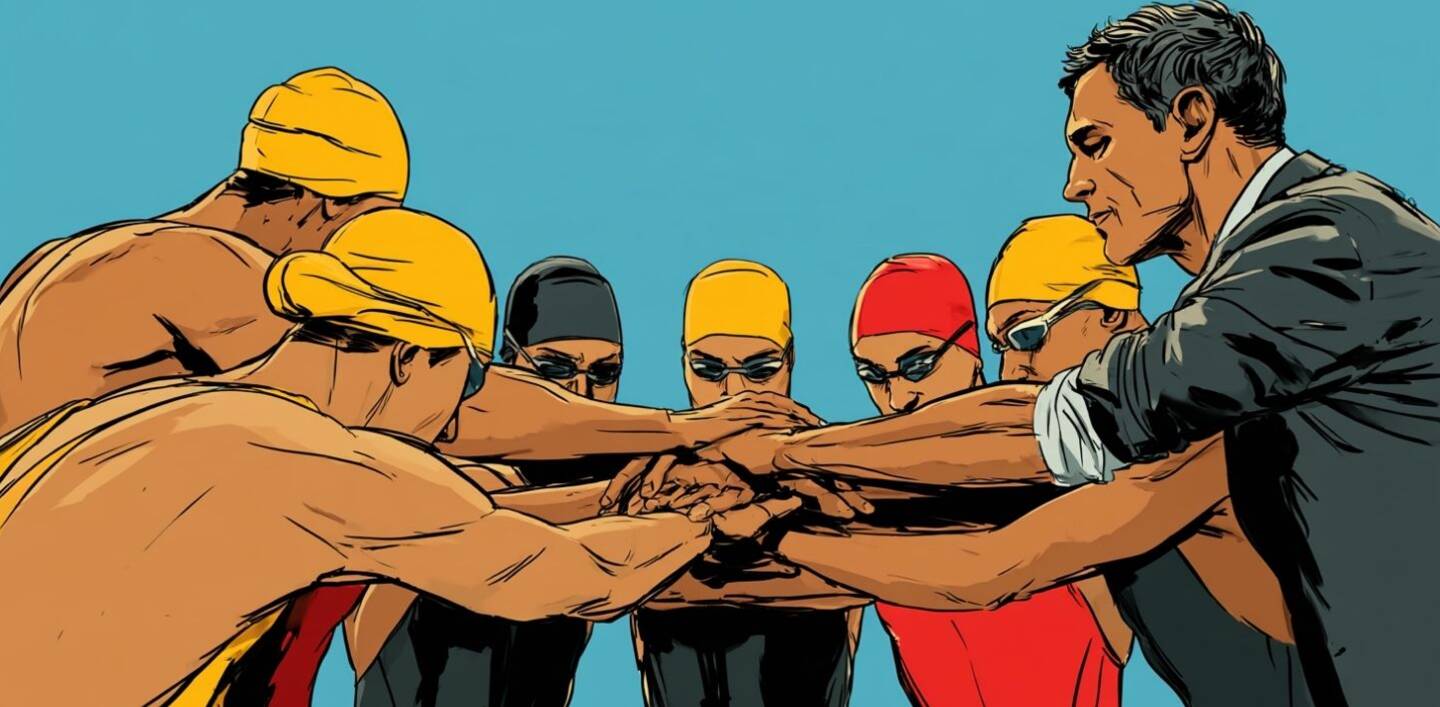
The second transformation looks almost paradoxical in a sport as individual as swimming: build a collective. Mandatory training camps were introduced from 1997. They initially triggered strong resistance from coaches attached to their own methods and swimmers accustomed to operating as a pair with their personal coach.
Yet Fauquet did not try to standardize every practice. Leading swimmers could remain in their clubs and continue working with their own coaches. The camps were used to circulate ideas, expose people to other methods, create a common language and encourage peers to observe one another. One coach captured the mechanism neatly: “Claude Fauquet forced us to evolve, but without imposing it on us.”
This approach is particularly important for companies that increasingly work through projects, alliances, cross-functional teams and expert communities. A temporary organization does not necessarily have the time or hierarchical authority to create culture through slow socialization. It can, however, create moments, rules and spaces in which people learn from one another without giving up their own expertise.
Professionalize the environment around performance
Cultural change was accompanied by very concrete professionalisation. The research describes a new attention to logistics, recovery and preparation. Before the 1998 World Championships in Perth, the timetable was planned backwards from the race date, integrating altitude training, jet lag, the change of season and adaptation time. Physiotherapists, osteopaths and strength and conditioning specialists became increasingly present around the swimmers.
Paris thus underlines a crucial point: a performance culture cannot rest only on demands placed on individuals; the environment has to make those demands achievable. Asking for more while leaving intact the conditions that produce old behaviors is to confuse ambition with management.
Change the definition of performance itself
Perhaps the deepest shift concerned the way talent itself was understood. Before 1996, the research suggests, performance was often viewed mainly through a physiological lens: identify the fastest swimmers, accumulate kilometers and develop power. Fauquet argued for a broader view, adding technical efficiency in the water, the desire to progress, the relationship between swimmer and coach, and the quality of the environment in which ability can develop.
That view meant resisting the automatic transfer of the best swimmers away from their existing ecosystems into a centralized structure. The real unit of performance became the swimmer-coach pair operating in an environment, rather than the isolated athlete. The business parallel is strong: hiring the “best people” is not enough if an organization ignores complementarity, working conditions and the relationships that allow expertise to translate into results.
Lead through influence, not only authority
The French case also adds nuance to a conventional view of cultural leadership. In a national team, the leader does not directly control the whole system: swimmers come from different clubs, coaches have their own methods and legitimacy, and the team is fully activated only for camps and competitions. Change could not simply cascade from the top.
Paris's study describes a more indirect model. The leader sets a direction, changes concrete organizational artefacts - selection criteria, the structure of training camps, the professionalism of the support team - and then relies on coaches and swimmers who can become reference points for others. Peer observation and early results gradually give the new approach credibility.
The results came quickly: six medals at the 1997 European Championships in Seville, then four at the 1998 World Championships in Perth, including the first world title in French swimming history through Roxana Maracineanu. At the Athens Olympics in 2004, France won six medals, including Laure Manaudou's gold. Success became a mechanism that reinforced acceptance of the emerging culture.
What the 2026 results allow us to revisit
It would be tempting to draw a straight line from the revolution begun in 1996 to the eleven French medals won in Paris in 2026. Thomas Paris's research does not support that conclusion: it ends in 2008 and explicitly points to the value of studying what happened after Fauquet left. Generations, coaches, structures and competitive conditions have all changed since then.
But the 2026 result gives striking contemporary relevance to the mechanisms identified by the study. It is a reminder that a durable performance culture is neither the presence of a superstar nor a slogan about excellence. It is built over time by combining clear expectations, consistently applied rules, collective learning, autonomy where it is productive, and a professional environment that makes high performance possible.
For leaders, the conclusion is simple but demanding: culture is not transformed through communication alone. It changes when an organization alters what it genuinely rewards, how people work together and the conditions under which they learn. Leadership matters, but less as the ability to impose a model than as the ability to create a system in which others can adopt it, adapt it and eventually sustain it without the original leader.
A winning culture is built through rules, routines and working relationships, not through declarations of excellence.
Rules change behavior only when they are credible and consistently applied, even when consequences become uncomfortable.
Temporary organizations can create collective performance by making people learn from peers while preserving useful autonomy.
Leadership works less by imposing a model than by building a system that others can adopt, adapt and sustain.



 Innovation & Entrepreneurship