


 Sustainability & Society
 Geopolitics & Public Affairs

The Strait of Hormuz has delivered a brutal reminder of a truth that energy markets often prefer to forget: geography can reprice the world economy in a matter of hours.
Before the latest conflict, more than 20 million barrels per day of crude oil and petroleum products moved through this narrow waterway. The U.S. Energy Information Administration estimates that flows fell from 21.6 million barrels per day in the fourth quarter of 2025 to 4.9 million in the second quarter of 2026. Limited pipeline alternatives could not compensate. The shock also reached gas markets: approximately one-fifth of global LNG supply normally passes through Hormuz, most of it from Qatar.
Calling this only a crisis of the old energy system would be too comforting. Hormuz also offers a warning about the system we are building. The energy transition will change the location and nature of strategic dependencies, but it will not make them disappear.
The old system is still with us
For almost two centuries, economic growth has been powered by fossil fuels. For decades, we worried about scarcity below ground: whether oil and gas reserves would eventually run out. Climate change has moved the binding constraint from below ground to above ground. The atmosphere's capacity to absorb additional carbon dioxide is far more limited than the geological resource base.
Yet physical systems change more slowly than political commitments. The International Energy Agency's Current Policies Scenario projects oil demand reaching 113 million barrels per day and natural gas demand 5,600 billion cubic meters by 2050. Coal remains the largest source of global power generation for another decade, while energy-related emissions stay close to 40 gigatons a year through mid-century, a level well in excess of what the Carbon Neutrality objective of the Paris Agreement require.
For the next decades, the global energy mix will remain in an addition mode rather than substitution. Solar, wind, nuclear power and electricity networks are expanding, but global oil, gas and coal demand shows little sign of abating as they remain deeply embedded in transport, heavy industry, petrochemicals and heating. New geopolitical risks are therefore arriving while the old ones are here to stay.
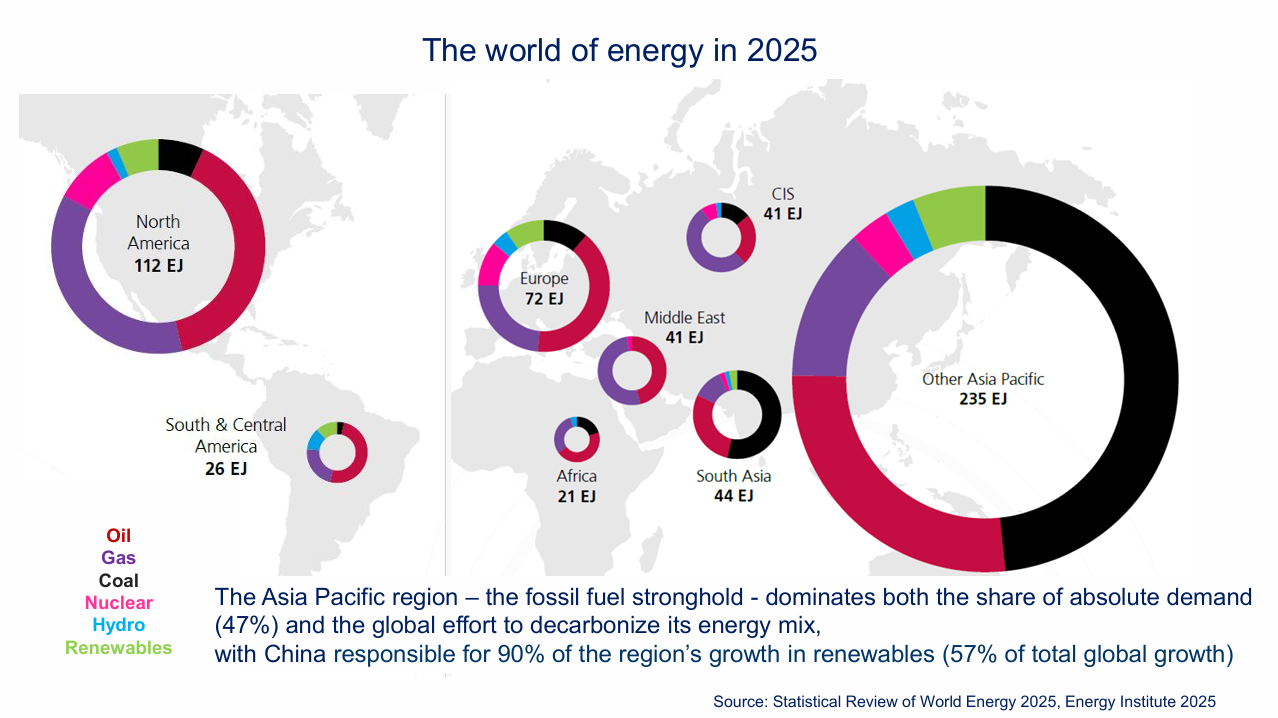
Statistical Review of World Energy, 2025, Energy Institute 2025
From the molecule to the electron
The low-carbon transition points toward a far more electrified economy. That transformation changes the organizing logic of energy. The global economy relies on a globally traded molecule (i.e. oil), priced through international benchmarks and deeply connected to the dollar. Electricity is an electron delivered through regional and national systems, with prices shaped by local grids, regulation and generation mixes.
This shift can strengthen energy security. The IEA estimates that renewable capacity added since 2010 has already reduced fossil-fuel import requirements substantially in importing countries. But electrification also requires enormous quantities of copper, lithium, nickel, cobalt, graphite and rare earth elements. It requires transformers, grids, batteries, solar modules, wind turbines and sophisticated power electronics.
The strategic question is therefore broader than access to a mine. It concerns the entire chain from extraction to refining, processing, component production, assembly, logistics and finance.
On that measure, concentration is increasing. According to the IEA's Global Critical Minerals Outlook 2025, the average share of the three largest refining countries for six key energy minerals rose from about 82% in 2020 to 86% in 2024. China is the dominant refiner for 19 of 20 broader strategic minerals analyzed by the agency, with an average share of roughly 70%. Fifteen of those minerals have displayed greater price volatility than oil.
The resulting energy system may be cleaner, yet it will remain extractive, capital-intensive and exposed to political decisions.
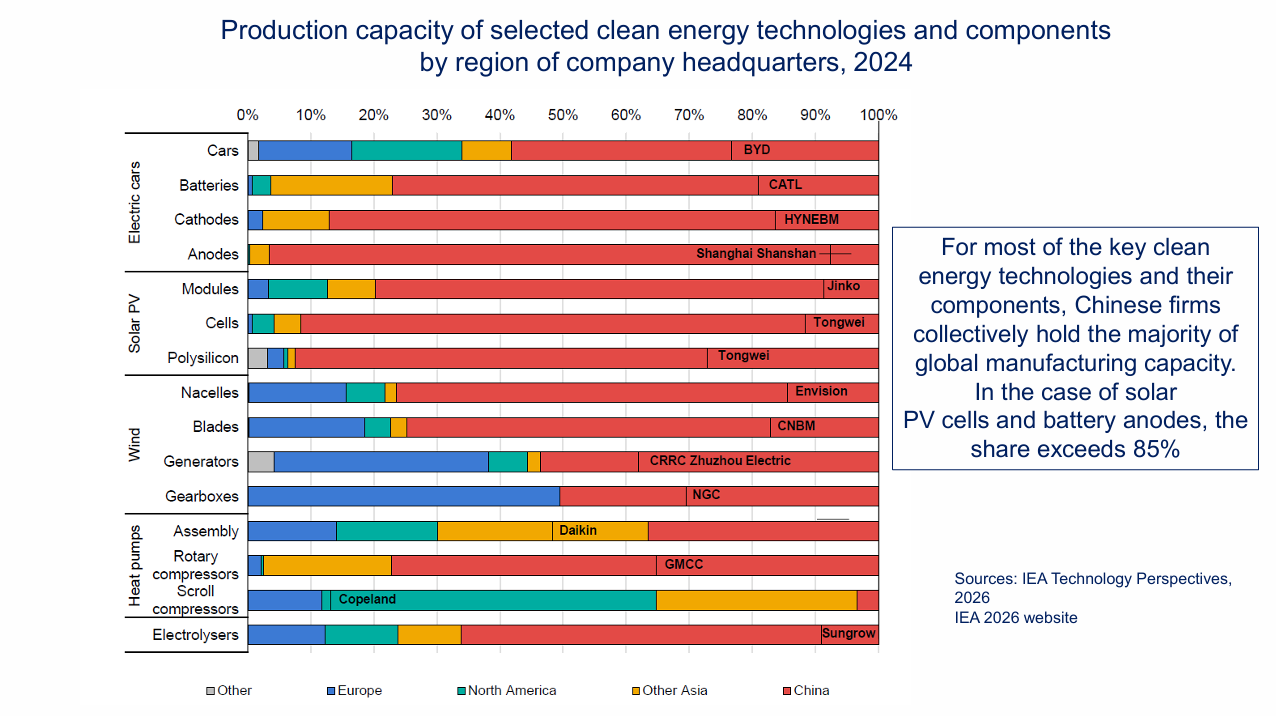
IEA Technologies Perspectives 2025
China's advantage is industrial, not geological
Mineral endowments alone do not explain China's position. Its advantage lies in the midstream: refining, processing, manufacturing and the ability to scale.
In solar photovoltaics, Chinese capacity exceeds 90% in several manufacturing segments, first and foremost photovoltaic panel production, and is expected to remain highly concentrated through 2030. China also accounts for around 90% of rare-earth refining and permanent-magnet production for wind turbines and other advanced applications. By creating deep industrial ecosystems and, in some sectors, large overcapacity, it has shaped global technology prices and made entry exceptionally difficult for competitors.
Europe has often treated the transition first as a deployment challenge: subsidize demand, install equipment and reduce territorial emissions. This accelerated adoption, but it did not consistently build the corresponding industrial base. The result is a troubling asymmetry: public support and consumer demand in the West have systematically generated manufacturing scale, technological learning and employment in the East, causing increasing indebtedness in the former and revenues in the latter.
The European Union has begun to respond. Its Critical Raw Materials Act sets 2030 benchmarks for extraction, processing and recycling, and aims to limit dependence on any single third country. These are useful objectives. Their success will depend on faster permitting, long-term purchasing commitments, credible price-stabilization mechanisms and financing able to absorb the higher cost of diversified supply.
Energy security requires a whole-system strategy
For boards, investors and governments, conventional energy risk maps are now insufficient. Monitoring oil fields, pipelines and the Strait of Hormuz remains essential, but decision-makers must also understand mineral provenance, refining capacity, equipment suppliers, shipping routes, grid bottlenecks, contract counterparties and the governance conditions under which materials are produced.
Two priorities follow. First, flexibility is key. Strategic stocks, alternative routes, interconnectors, storage and redundant productive infrastructure (too often seen as inefficient) create options when markets are under stress. Renewable energy sources – too often seen as the major or the ultimate contributors to the energy demand mix – bring intermittency, not flexibility.
Second, industrial policy must support technology development and technology sovereignty, rather than the sole demand for clean energy. Extraction without processing leaves value and leverage elsewhere. Processing without competitive manufacturing produces another weak link. Corporates, rather than governments, should be the drivers across the full chain, including recycling and substitution technologies.
The conclusion should not be to slow the energy transition. Renewables, nuclear power, efficiency and electrification can reduce exposure to imported fuels and address the climate constraint that defines our century. The task is to pursue them with a clear view of the industrial and geopolitical system they require.
Hormuz has shown:
- the cost of relying on a narrow passage for a large share of the world's energy, and
- our ongoing dependence on fossil fuels.
We should not reproduce that vulnerability in minerals, refining or clean-energy manufacturing. The transition is necessary, and its resilience will depend on the choices we make now.
Sources
Short-Term Energy Outlook: Global Oil Markets — U.S. Energy Information Administration, August 11, 2026. Oil flows through Hormuz and the persistence of constrained trade.
Oil Market Report - March 2026 — International Energy Agency, March 12, 2026. Scale of the supply disruption, limited alternatives and verified price range.
Amid regional conflict, the Strait of Hormuz remains critical oil chokepoint — U.S. Energy Information Administration, June 16, 2025. Pre-conflict oil and LNG shares, bypass routes and Asian exposure.
International LNG prices rise amid Strait of Hormuz closure — U.S. Energy Information Administration, April 28, 2026. LNG volumes, Qatar exposure and international price effects.
World Energy Outlook 2025: Current Policies Scenario — International Energy Agency, 2025. Oil, gas, coal and emissions outlook under current policies.
Global Critical Minerals Outlook 2025: Executive Summary — International Energy Agency, May 21, 2025. Mineral refining concentration, price volatility and projected supply gaps.
Renewables 2025: Executive Summary — International Energy Agency, 2025. Fuel-import reductions and concentration in clean-technology supply chains.
Critical Raw Materials Act — European Commission, accessed September 3, 2026. EU 2030 extraction, processing, recycling and diversification benchmarks.





 Economics & Finance