
From Climate Anxiety to Space Law, Meet HEC’s New PhD Cohort
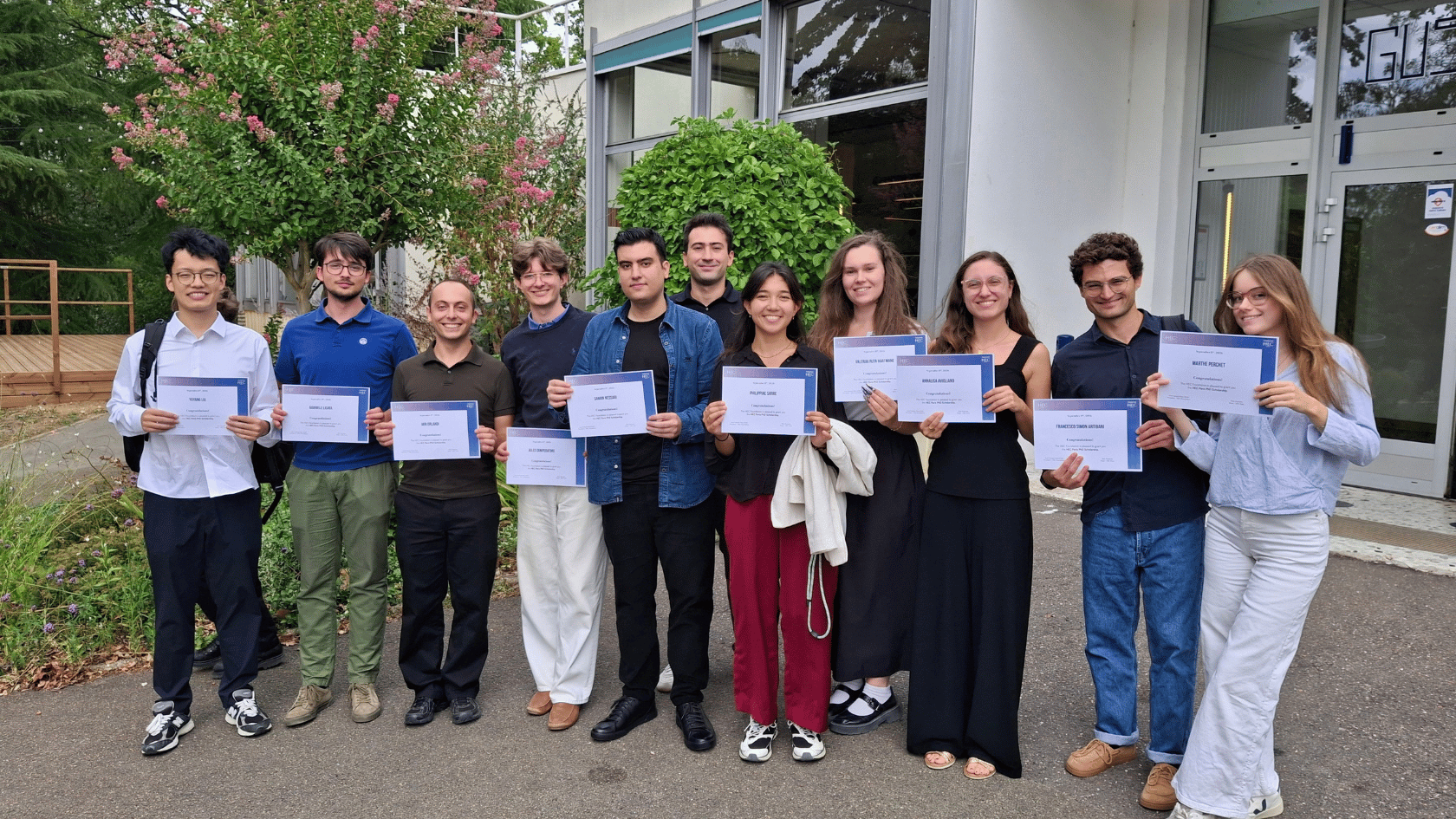
HEC’s incoming class of 14 doctoral students arrives with research interests ranging from climate anxiety and lower-emission cars to dynamic pricing, academic careers and the law governing private activity in space. Their arrival coincides with a recent study of leading US economics programs which finds academic placements falling and tech hiring rising.
Key findings
- 14 students joined the HEC Paris PhD Program in September 2026, slightly above the school’s customary intake of 10 to 112.
- 10 have substantial research-assistant or pre-doctoral experience, and several already have publications or working papers.
- Their professional experience includes software development, consulting, finance, EU institutions, government, public affairs and sustainability practice.
In the US, an academic job has become less common among graduates of business school PhD programs. A study published in August 2026 covering all doctoral graduates of the top 30 US programs from the late 1990s to the early 2020s shows that the share taking jobs at universities peaked at around two-thirds in 2009 and fell to 52% in 2021. Over a shorter period, tech’s share of placements rose from 1.3% in 2010 to 12% by the early 2020s.
HEC’s public placement page shows a more strongly academic pattern in its recent placements, however. Of the 20 placements listed across departments for 2023-24 through 2025-26, 17 are assistant professor or postdoctoral positions. Two are private-sector roles and one is a research economist post at the Bank of England. These figures show a useful signpost for a new class entering an international academic market while carrying skills valued well beyond it.
A warning and a wink
At a reception for HEC’s14 new doctoral students, Dean Eloïc Peyrache began with a warning. “There will be doubts in this long journey you are embarking on. But it’s worth it. Look at the happy faces of our professors here,” he added with a wink, but the advice that followed was more pointed: “Learn to accept feedback, separate the ego from the work and do not attempt the PhD alone.”
Andrea Masini, Dean of Faculty and Research, offered further insight: “You are incredibly lucky. For the next few years, you can devote yourselves exclusively to research on subjects that can change the world we live in.” Indeed, Peyrache added, there are few stretches in an academic career that offer such protected time, free from the usual demands of teaching.
This year’s class is larger than the 10 to 12 students HEC ordinarily enrolls each year. For most, the program will last five years: two years of research training followed by three years centered on a paper-based dissertation, conferences, academic visits and preparation for the faculty job market.
A small cohort in a global system
OECD data for 2024 put the scale of the undertaking in perspective. Across member countries, only 1.2% of adults aged 25 to 64 hold a doctorate. More than a quarter of enrolled doctoral students are international or foreign students. The new HEC cohort reflects that mobility through education and research experience spanning universities and organizations across Europe, Asia and North America.
Their routes into doctoral study also reflect a broader business-school pattern. A joint AACSB and EDAMBA survey of 429 students across 19 countries found that 62% had worked in industry before beginning doctoral study, while 30% had held an academic staff position. Among HEC’s newcomers, 10 already have substantial research-assistant or pre-doctoral experience. They have also held jobs in fields as diverse as software development, consultancy, finance, public affairs, government and European institutions.
Choices, markets and cities
Leonardo Bezzon supplies arguably the cohort’s most memorable thesis topic: Do Androids Dream of Utility Functions? It leads into research on decision theory, ambiguity aversion and the foundations of utility. Bezzon completed an MSc in Economic and Social Sciences at Bocconi, took substantial additional mathematics and worked as a research assistant to professor of finance Nicola Gennaioli after earlier field research at IGIER. Alexey Chuprakov is also interested in how people make decisions, through experimental and behavioral economics, information economics, game theory and industrial organization. His background combines the HEC Master in Economics and Finance with University of London studies directed by LSE and HSE-ICEF. Beyond the university, he has worked with the Moscow Exchange, coordinated and interpreted for a BRICS delegation and examined mathematics and economics Olympiads.
While Bezzon and Chuprakov focus on individual decisions, Jules Comperatore looks at firms and markets. His training in economics, econometrics and data science comes from his stints at ENSAE-École Polytechnique-HEC MPhil in Economics, while his coursework and projects point towards industrial organization, competition, public-policy evaluation, digital economics and environmental economics. Internships at Analysis Group and Allianz have already taken him into antitrust, pricing, policy evaluation and applied data work.
Gabriele Licata and Iari Orlandi both work with questions that take geography to another level. Licata’s interests include innovation geography, growth, migration and macroeconomics, combining theory with large US county-level datasets. He joins from the research-oriented MSc in Economics at EIEF-LUISS and has worked as a research assistant there, alongside placements with Confindustria Sicilia and the Bank of Italy. Orlandi focuses on econometrics, with interests ranging from consumers’ willingness to pay for lower car emissions to development, finance, structural transformation and city growth. A University of Bologna MSc graduate with a 110/110 cum laude result, he has been a pre-doctoral research associate at Bocconi and a research assistant at Bologna, developing strong geospatial and data skills.
Algorithms in the real world
Saman Nessari and Seyede Zahra SeyedFatehi arrive through industrial engineering and systems optimization. Nessari, who ranked first in his MSc cohort at the University of Tehran, is interested in optimization, causal inference, reinforcement learning and large language models for healthcare and service operations. He has published or submitted papers, served as a teaching assistant and previously worked as a software developer at Zarinpal and Denxa. SeyedFatehi studied at Sharif after ranking first in Industrial Engineering at Amirkabir and completing a minor in Computer Engineering. Her work covers integer programming, routing and scheduling, optimisation algorithms, data mining and machine learning; her experience includes teaching, research, Android development and developer roles for Next, Tesco and Tehran University’s AI-in-business laboratory.
For Kiarash Joolaei, it’s a case of algorithms meeting economics. A computer-engineering graduate of Sharif with substantial graduate-level coursework, he is interested in multi-armed bandits, online learning, dynamic pricing, robust optimization, game theory and mechanism design. His preparation includes research internships at HKUST and MBZUAI, research assistance at Tehran’s Game Theory Lab and extensive teaching-assistant experience.
Climate firms and institutions
Marthe Perchet and Philippine Sarre approach the environmental transition from different directions. Perchet is interested in climate anxiety, reproductive intentions, sustainable action and the influence of social media on life goals. Her HEC MSc in Sustainability and Social Innovation followed a Warwick degree in sustainable development and business, and she has worked on decarbonization and corporate social responsibility with Orient Express, Ulule, Greenly and Publicis. Sarre examines unusual disclosures in environmental, social and governance reports produced under the EU Corporate Sustainability Reporting Directive. Her wider interests include ESG reporting, sustainable finance and transition. She completed a master’s in Green Growth and Sustainability at KAIST after an ESSEC Global BBA, and has worked in CSR consulting, strategy and portfolio management.
The transition also raises legal questions. Francesco Simon Artibani is interested in EU environmental law, climate and energy policy, the rule of law, corruption, waste trafficking and green industrial policy. A College of Europe graduate with a law degree from LUISS, he has worked in EU public affairs, contributed to an energy and climate audit at the European Court of Auditors and gained legal experience with Legambiente. Valerija Ruta Hartmane extends the legal field into outer space. Her interests include space law, public international law, arbitration, digital law and governance; her thesis examined state responsibility for private space activity. She has worked as a lawyer at Latvia’s Ministry of Justice, as arbitration counsel and on research for senior European judges and the European Commission.
Careers organizations and political ties
Annalisa Avigliano studies gender, familiarity and academic careers, alongside discrimination, psychosocial well-being, masculinity, human-resources practices and career mobility. She specialized in organizational change and consulting during her Bocconi MSc in Management, then worked as a pre-doctoral researcher at Bocconi and a research assistant at London Business School.
Yuyang Liu, meanwhile, looks at organizations through nonmarket, international and behavioral strategy, including political affinity, supply networks, firm innovation and causal methods. A Tongji MA graduate and recipient of China’s National Scholarship, awarded to the top 0.2% of students, Liu arrives with two publications, several working papers and experience on major datasets built with large language models.
The work behind the questions
The topics are as varied as the students’ backgrounds, but the September 8 reception speeches kept returning to the same research principle: choosing a question, testing it honestly and learning from criticism. The physicist Richard Feynman put the standard bluntly back in his 1974 Caltech commencement address: “The first principle is that you must not fool yourself.” Eloic Peyrache translated that principle into advice for the years ahead: “You must begin to welcome feedback, even if it can seem harsh at times and it hurts. Separate your ego from your work. It’s all part of the learning process.”
The recent US economics placement study adds a job-market dimension to that advice. Candidates whose advisers had stronger academic networks were more likely to secure positions at top institutions, even after the authors accounted for adviser prestige. The association does not mean that networks substitute for research quality. The finding nevertheless shows why seminars, research visits and sustained contact with faculty and peers matter to an academic career and to the research itself.
Feynman’s address on scientific integrity also helps explain why criticism matters. Doctoral research can look solitary from the outside, but it depends on seminars, co-authors, supervisors and peers willing to challenge a result. “Don’t do your PhDs alone,” Peyrache told the cohort. “Connect with each other and those in the years above you because, let’s face it, it can be a lonely journey, too.”
Andrea Masini summed up his advice in two tasks: strategize, then ask the right questions. Faculty will guide the first years, he said, but independence is part of the degree. “Those final years, well, you’re on your own. There will be tough moments. But our doors are always open.” For 14 students arriving with strong methods, experience and a long list of interests, the next step is to decide which questions can withstand that process.