
Mission-driven companies and family businesses: Maison Le Breton and CRISTEL share their journeys (webinar replay)
The HEC Paris Family Business Center co-organized, with HAATCH, Family & Co, FBN France and the Communauté des entreprises à mission, the second edition of a webinar exploring how family businesses view the mission-driven company status. The program featured insights from Cécile de Lisle (HEC Paris), Sylvain Prévot (FBN Impact), Valérie Brisac (Communauté des entreprises à mission) and Laurent Allard (Family & Co), along with firsthand accounts from Morgane Le Breton (Maison Le Breton) and Damien Dodane (CRISTEL).
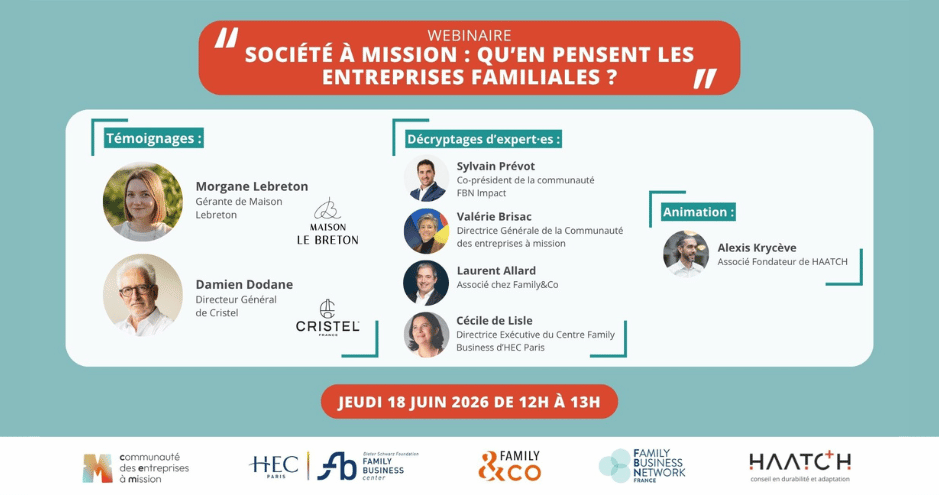
Following a first edition in January that drew more than 150 participants, this new session, held on June 18, brought fresh testimonials and an update on the work carried out by the five partners over the past year.
Sylvain Prévot, co-president of the FBN Impact community, outlined the three criteria that define a family business: ownership and control of capital by a family, that family's involvement in management, and succession already achieved across one or more generations, or the intention to pursue it. Valérie Brisac, Managing Director of the Communauté des entreprises à mission, detailed the four pillars of mission-driven company status and the benefits it offers family businesses in particular.
Cécile de Lisle, Executive Director of the HEC Paris Family Business Center, called for nuance around the commonly cited figure of 71% of French companies described as family-owned, a broad definition that includes any founder-entrepreneur. Applying FBN's stricter definition, which factors in succession, that share drops sharply: only 20% of these companies reach a second generation, and only 10% of those make it to a third.
Two leaders of mission-driven family businesses then shared their experience. For Morgane Le Breton, Managing Director of Maison Le Breton, the process was first and foremost a matter of clarity: "There was a legibility problem because we were making wine that wasn't organic, and people didn't understand why we were committed. The mission helped us clarify our positioning and our approach. It's not a label, it's not a checklist; these are boxes we create for ourselves."
At CRISTEL, it was the third generation that drove the push to formalize values that had previously been passed down informally. Damien Dodane, Managing Director, reflects on that collective effort: "It was about writing down the values we shared day to day, so they existed somewhere beyond the family. We worked with our employees to identify which values we wanted to share on a daily basis. It was an extraordinary process; we realized we were aligned with what we wanted to do and the values we wanted to share."
Laurent Allard (Family & Co) pointed to the "tipping points" where mission-driven status becomes a source of support for family businesses, such as the arrival of a new generation or the opening of capital to outside shareholders. Cécile de Lisle, for her part, identified three common obstacles among hesitant family businesses: reluctance to let in an outside perspective, a mismatch between corporate governance and family governance, and the risk that the mission may not be fully embodied by the family.
A new workshop on this topic is scheduled for September 30 at the PRODURABLE trade show.