
HEC Paris at Paris-Saclay SPRING 2026
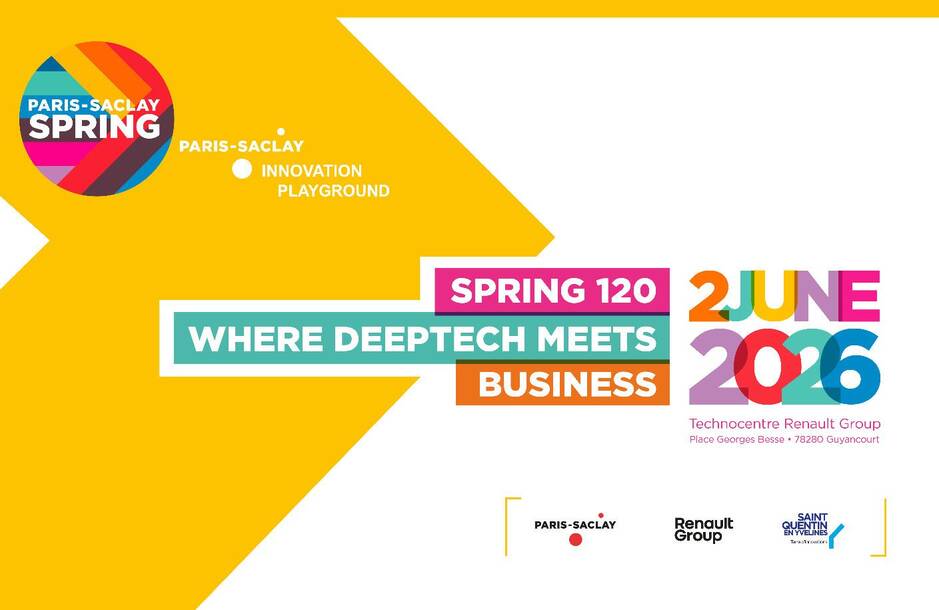
Paris-Saclay SPRING 2026: HEC Paris at Europe’s First Deep Tech HubOn June 2, the Renault Group Technocentre hosted the 2026 edition of Paris-Saclay SPRING. The HEC Paris team was there alongside nine startups from the Challenge+ program, which had come to meet with industry leaders, investors, and research labs within the ecosystem. Here’s a look back at the event.
The must-attend event for French deeptech
Organized by EPA Paris-Saclay, Renault Group and Saint-Quentin-en-Yvelines, Paris-Saclay SPRING has established itself in just a few editions as the leading annual event for technological innovation in the Paris region. Its promise can be summed up in a single phrase: "where deeptech meets business."
The area that hosts it is no ordinary cluster: the Paris-Saclay plateau brings together 70,000 students, 16,000 teacher-researchers, 7 research institutes and 2 academic hubs. It accounts for 15% of France's private R&D and 21% of the country's academic research, a scientific legacy that includes five Nobel Prizes and eleven Fields Medals. It is, to date, Europe's foremost deeptech hub.
SPRING is not a trade show where you wander around. Every attendee comes with a specific goal in mind, and the format is designed to help them reach it before the day is out.
Why HEC Paris was there
There comes a moment in the life of a deeptech project when the science is no longer the problem. The process works, the patent is filed, the results hold up, and that's where things can get complicated: whom to sell to, at what price, with what business model, and in which market first? This is precisely where HEC Paris comes in, and in particular its HEC Challenge+ program.
For more than thirty years, the Challenge+ program has guided engineers, PhDs and researchers through a narrow passage: turning a technology into a company. Nine months to test a business model, choose an entry market, structure financing, and step into the role of a company leader.
Céline Largeau and Gaëlle Guyader, co-founders of the start-up CGREEN, tell the story: it was the Challenge+ program that enabled them to structure their bio-based carbon fiber project and confirm that a start-up was indeed the right vehicle to carry it forward. Two years later, they raised €2.3M and set up their pilot line near Nantes, France.
Nine start-ups on hand, all from the HEC Challenge+ program
Nine companies from the HEC Challenge+ network made the trip and held meetings throughout the day:
- BEAMS, a spin-off of the CNRS and Université Paris-Saclay co-founded by Virginie Simon, Estelle Villedieu de Torcy, Laurent Ménard and Stéphane Palfi, and winner of the INPI-WIPO x HEC Challenge+ Pitch Contest at VivaTech in June, is developing a smart surgical probe that uses nuclear medicine to locate tumor cells during surgery and reduce the need for reoperations.
- CEMENTIC, a dental biotech co-founded by Dr. Samir Raddi and Thierry Cauche (an HEC graduate), incorporates liposomes into endodontic cements to improve the disinfection of root-canal-treated teeth, and closed a €4M funding round led by the investment club Blast in early 2026.
- CGREEN, co-founded by engineers Gaëlle Guyader and Céline Largeau, produces bio-based carbon fiber from recycled cellulose, with a CO₂ footprint cut by two-thirds at equivalent mechanical performance.
- CLICKNCRYPT, a spin-off of CEA-List co-founded by Olivier Héron and Kevin Legavre, is industrializing fully homomorphic encryption (FHE): processing sensitive data without ever decrypting it, for defense, healthcare and finance.
- DIAGANTE, a medtech start-up spun out of UVSQ Paris-Saclay and AP-HP, co-founded by Cécile Chevalier (an HEC graduate), Martin Rottman and Virginie Lebidois, has developed the TISSUtainer® device, which preserves and prepares solid biopsies between the operating room and the lab to improve the reliability of diagnosing bone and joint infections.
- DOCNKIT, founded by Dr. Clément Javelle, a general practitioner and emergency physician, is a consumer medical-triage app that helps patients describe their symptoms and find the right level of care.
- OMNIRIS, co-founded by Julien Dreveton and Dalila Guessoum, is a sovereign-AI software platform that translates the ESG and financial commitments of financial institutions into measurable, comparable trajectories.
- ORASUNA, co-founded by INRAE researchers Christine Delorme, Pascal Leuraud, Vincent Juillard and Séverine Layec, is developing innovative solutions to regulate human metabolism, in the form of a dietary supplement, to treat metabolic disorders and prevent disease.
- PERSEA, co-founded by Sophie de Ferrières, Olivier Pellerin and Marc Sapoval, is a biotech start-up developing BioTrojan, an advanced-therapy drug against solid tumors, liver cancer as its first indication, that destroys the tumor while producing a vaccine-like effect that guards against recurrence.
Materials, healthcare, cybersecurity, environmental transition: the range of sectors on display gives a good sense of just how much the term "deeptech" now covers. All of them share the same challenge: moving from scientific proof to commercial traction, and the same need: meeting the right industrial partners at the right moment.
The event was also a chance to reconnect with several key partners of the HEC Challenge+ program who were present on site: the INPI, the CEA, Dassault Systèmes (through its 3DEXPERIENCE Lab), SLB, the Carnot Institute network and the Paris-Saclay Cancer Cluster (PSCC), all essential players bridging research and industry.
The SPRING 120: the Paris-region players driving deeptech innovation
The event also shines a light on the players behind emerging deeptech innovation through the SPRING 120 list. This year marks the end of the SPRING 50 label, which had distinguished the fifty deeptech start-ups of the year since 2021. In its place comes the SPRING 120, a selection broadened to span the entire value chain: 24 start-ups raising funds, 10 (pre-)maturation projects coming out of the labs, 19 innovation venues, 30 public research players and 34 major industrial groups.
Alongside Renault Group, Safran, TotalEnergies, EDF, IBM, Danone and Stellantis, the list features CEA-List, INRAE, ONERA, Université Paris-Saclay, Institut Polytechnique de Paris and HEC Paris, listed among the region's innovation venues on the strength of its Innovation & Entrepreneurship Institute.
Five start-ups from the HEC Paris network appear in the selection of 24 start-ups on the list:
- PERSEA (Sophie de Ferrières, CEO), from the HEC Challenge+ program
- CLICKNCRYPT (Olivier Héron, CEO), from the HEC Challenge+ program
- CGREEN (Céline Largeau, CEO), from the HEC Challenge+ program
- Papillio.bio (Chiara Cespi Polisiani, CEO), from the WE4G program
- Aerleum (Sébastien Fiedorow, CEO), from the CDL-Paris program
Do you have a deeptech project and want to learn more about the HEC Challenge+ program? Discover the program.