
After Admission, HEC Paris Invites Its Students to Rethink Success
Nearly 1,450 new students joined HEC Paris's Grande Ecole and Master's programs in September 2026. In their welcome addresses, the School's leaders outlined the educational vision that will guide them. Above all, they set out what HEC Paris expects of its students: to rethink their relationship with success and put their ambition at the service of others.
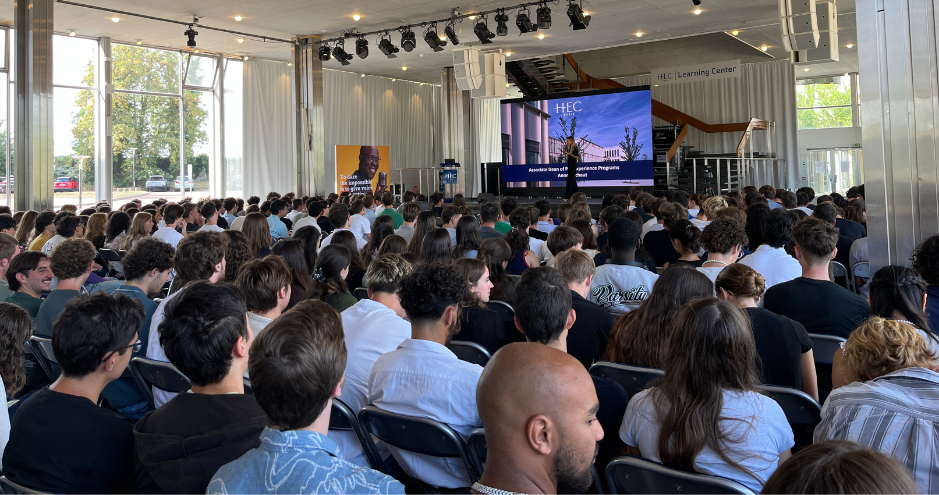
"HEC is not a box to tick on a prestigious path. It is a launchpad," Eloïc Peyrache, Dean and CEO of HEC Paris, had told the incoming students a few days earlier.
Whether they are among the 389 students admitted to the Grande Ecole program in 2026 after completing France's preparatory classes, or among the 1,054 international students joining HEC Paris's Master's programs (Master in Management, Specialized Masters and MSc programs), all have reached a major milestone in their academic journey. They have come through a highly selective admissions process, the culmination of demanding work and considerable perseverance.
Yet every welcome address - from Dean and CEO Eloïc Peyrache to Anne Michaut, Associate Dean of Pre-experience Programs, and Matteo Winkler, Academic Director for the L3 and M1 years - conveyed the same message: this first achievement is not an end point but a starting point. It opens a path that students will have to chart for themselves, with a strong sense of responsibility toward both themselves and others.
As they took their first steps on campus, these addresses introduced students to an educational philosophy that extends well beyond the classroom and the degree itself.
At HEC Paris, their journey should help them understand themselves better so they can choose their own path, make sense of the world before acting, and, more fundamentally, rethink what it means to succeed.
Moving Beyond Academic Performance
For many of these new students, admission to HEC Paris marks the culmination of several years shaped by a single goal, an intense workload and a strong culture of individual performance. The new academic year opens a different chapter, one in which high standards remain but gradually take on a different purpose.
Excellence, one of HEC Paris's five core values, is not defined as the desire to surpass others. It first and foremost means setting high standards for oneself and striving to go beyond one's own limits in pursuit of an ideal, a dream and the common good.
Anne Michaut therefore encouraged students not to measure their journey by grades alone. "I would like you to go beyond academic performance," she told them, inviting them to ask what their education would genuinely enable them to achieve: "What will allow me to have an impact? What will allow me to do what I truly want to do?"
This shift in perspective does not mean giving up ambition. It means broadening it: learning not only to develop one's abilities, but also to decide how and for whose benefit to use them.
Understanding the World Before Acting
The first year of the Grande Ecole program is designed as a year of exploration. Before delving more deeply into management studies, students encounter different disciplines and perspectives to better understand the economic, technological, social and environmental transformations reshaping the contemporary world, including through the "commitment path."
This multidisciplinary approach rests on close interaction with professors who are also researchers and experts across a wide range of fields. It gives students a strong foundation of knowledge, but above all teaches them to connect ideas, question assumptions and form their own judgment. "You have to reflect on what is happening in the world before you act," Anne Michaut summarized.
Do Not Delegate Intellectual Effort to AI
At a time when artificial intelligence can produce an answer or complete a task in seconds, intellectual autonomy has become even more essential.
Drawing on an analogy used during the welcome session, Anne Michaut noted that no one goes to the gym and asks AI to do the exercises for them. The same is true of learning: "We train our brains to reflect, think and make the right decisions, just as we train our bodies."
The challenge, then, is not only to know how to use these new tools, but also to avoid delegating the effort through which critical thinking, judgment and decision-making skills are formed. Rules governing the use of AI, the quality of academic work and academic integrity are not mere constraints: they are an integral part of learning to exercise sound judgment.
The Campus as a Place for Collective Learning
This approach to learning also extends beyond the classroom. "HEC is a community before it is a school," Matteo Winkler reminded students as he introduced the values that should guide their journey: curiosity, excellence, diversity, responsibility and entrepreneurial spirit.
"HEC is a community before it is a school"
On a campus that brings together 135 nationalities and more than 150 clubs and associations, diversity is more than a feature of the student body. It is part of the learning experience every day. Living, working and leading projects with people whose backgrounds, cultures and convictions differ requires everyone to listen, explain their choices, reconsider their assumptions and create the conditions for collective action.
In this sense, HEC Paris aspires to be a "living laboratory of inclusion." The School expects students not only to respect the rules of community life, but to contribute actively to the quality of the community they are joining. "The campus is your home," Matteo Winkler told them. Respect, attendance, punctuality and care for others are therefore both the foundations of a shared life and early training for a professional mindset.
Responsibility begins in these everyday interactions. It means not approaching a relationship, project or opportunity solely through the lens of one's own interests. Anne Michaut put it very directly: when students reach out to someone, they should do so "with as much interest in the other person as in themselves," because "life never works as a one-way exchange."
Exploring to Build a Distinctive Path
The Grande Ecole program structures this transformation over time. The L3 year broadens students' horizons through core courses, electives, Great Challenges and the engagement pathway. M1 takes them deeper into management studies and gives them greater exposure to real-world experience. The optional gap year allows them to explore several professional environments before specializing in M2.
At every stage, the range of courses, projects, student societies, encounters and experiences gives students opportunities to test their interests and abilities. Yet this abundance also confronts them with a new lesson: how to choose. "Your days will still have only 24 hours, even after preparatory classes," Anne Michaut reminded them. Her advice was not to accumulate commitments, but to select those that truly matter and pursue them fully.
These choices should gradually help each student discover what sets them apart. The aim is not for everyone to emerge from the same mold, but for students to combine their shared HEC education with skills, experiences and convictions of their own.
Their plans may evolve over the years, and the possibility of changing direction is itself an essential part of the journey.
"HEC does not automatically open every door for you. You alone can decide which ones to open," Anne Michaut concluded. This is where the autonomy expected of students begins: in the curiosity to explore, the responsibility to choose and the ability to turn the opportunities before them into a meaningful path.
Whether on campus or during exchanges at universities abroad, students are invited to learn how to place excellence and ambition within a community, and to direct them toward a contribution that extends beyond individual success.