
Nobel Laureate Philippe Aghion Receives Honoris Causa at HEC Paris
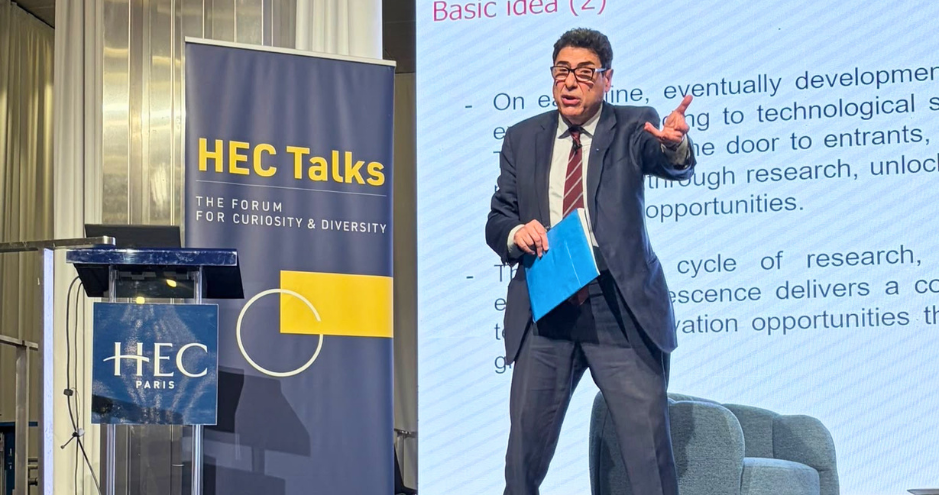
More than 700 students gathered for an HEC Talks exploring how innovation can support shared prosperity. They were in the school’s Hall d’Honneur to witness HEC Paris awarding Philippe Aghion the title of Doctor Honoris Causa. The ceremony celebrated one of France’s most influential economists and the enduring relevance of his research to the school’s ambition to combine academic excellence, innovation and impact.
A theory shaped over nearly four decades
Introducing the event, HEC economist Antonin Bergeaud retraced the origins of Aghion’s theory of growth through creative destruction (see https://www.hec.edu/en/dare/innovation-entrepreneurship/philippe-aghion-my-worry-not-technology-my-worry-institutions). Developed with fellow-academic Peter Howitt, the framework explains how new products, technologies and firms generate growth by displacing established ones. Innovation is therefore both a source of progress and a force of disruption. It is also a dynamic that places institutions, education and social protection at the heart of economic policy.
Aghion recalled that the journey from the first formulation of this research to its highest recognition - the Nobel Prize in Economic Science 2025 - lasted 38 years and three months. That long arc, he suggested, also illustrates the collective nature of academic progress: ideas mature through debate, collaboration and the work of successive generations of researchers. His warm acknowledgement of Bergeaud underscored the intellectual ties that connect him to HEC Paris faculty.
Research aligned with the HEC Paris mission
For HEC Paris Dean Andrea Masini, the honorary doctorate recognises both exceptional scholarship and a conception of economics that speaks directly to the School’s purpose. Aghion’s work does not treat growth as an end in itself. It asks which institutions allow innovation to flourish, how competition can prevent established firms from blocking new entrants, and how education and public policy can ensure that progress is more widely shared.
These questions closely reflect HEC Paris’s impact objectives. The School seeks to equip leaders to understand technological change, encourage entrepreneurship and translate knowledge into solutions for society. Aghion’s research offers students a demanding but hopeful message: societies are not condemned to choose between innovation and inclusion, provided they design institutions capable of supporting both.
A much anticipated HEC Talks
The scale of the audience reflected the anticipation surrounding Aghion’s visit. More than 700 HEC Paris students, representing nationalities and programmes from across the campus, came to hear him discuss the future of growth and the responsibilities that accompany innovation. Their questions brought the theory into the present, from artificial intelligence and education to European competitiveness and the green transition.
Throughout the exchange, Aghion returned to a central conviction: ideas need not run out. What matters is whether societies build the conditions that allow new ideas to emerge, challenge established positions and improve lives. This requires open competition, investment in research and education, and protection for people navigating economic change.
A source of pride for HEC Paris
By welcoming Philippe Aghion into its community of Doctors Honoris Causa, HEC Paris honours a scholar whose work has transformed the study of economic growth and continues to inform public debate around the world. It also affirms a shared belief: academic excellence achieves its fullest value when it helps leaders reconcile innovation, prosperity and impact.