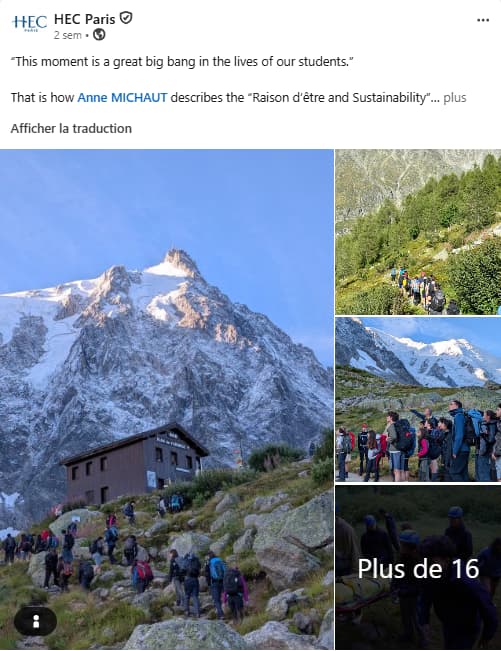
From Chamonix to the Field: A Return Driven by Commitment
Close to 400 first-year students in the Grande École program began their academic year at HEC Paris. From Chamonix to the Jouy-en-Josas campus, this opening week launched the Parcours Engagement, designed to accompany them all year long.
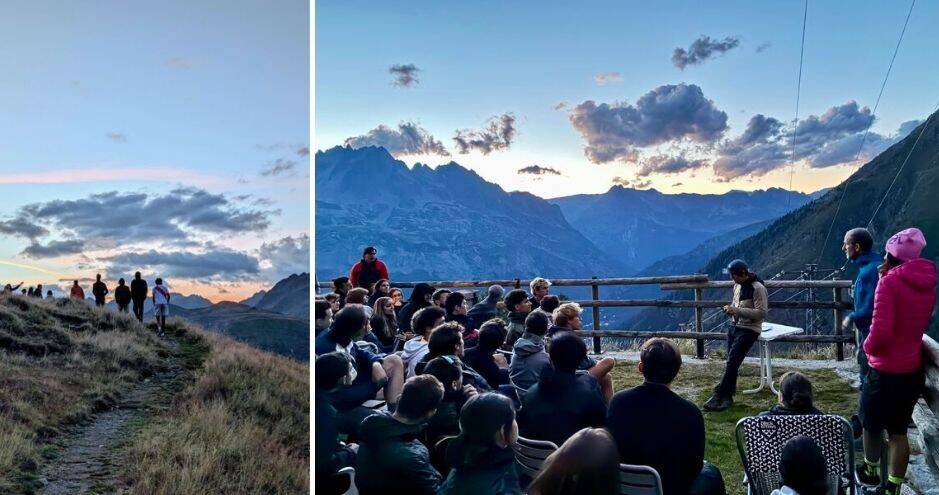
After two years dedicated primarily to preparing for entrance exams, the Parcours Engagement encourages students to shift their outlook: to better comprehend the world around them, experience other realities, and consider how they intend to carry out their responsibilities.
“We are at the service of your dreams—the question is, which one?”, said Romain Briat, Executive Director of Purpose Lab and Naos LAB, as he opened the pathway.
Chamonix: Stepping Outside the Comfort Zone
The first module took place over four days in Chamonix. Hiking, spending a night in a mountain refuge, climbing, first-aid training, glacier exploration, and reflection sessions placed students in new situations rooted in active listening, cooperation, and solidarity.
Fifteen HEC Paris faculty members experienced the seminar at their side this year. Together, they witnessed the effects of climate change on the Mer de Glace and learned about the key challenges confronting the valley: glacial retreat, tourism pressure, resource depletion, housing, and transportation.
This region thereby becomes a field of learning to examine leadership, planetary limits, and the long term. The objective is to encourage students, upon their arrival at HEC Paris, to consider several fundamental questions: Who do they wish to become? Where do they want to dedicate their energy and ambition? What form of leadership do they want to practice?
Éloïc Peyrache, Dean of HEC Paris, urged them to fully take ownership of the four years ahead, explore unexpected avenues, and leverage the opportunities that will allow them to build their own trajectory.
Leadership Tested in the Field
Upon returning to campus, the students engaged with some thirty executives from business, foundations, associations, and public sector organizations. Each brought a distinct vantage point on work, purpose, and commitment.
In a session hosted by Professor Rodolphe Durand, Academic Director of the Purpose Center at HEC Paris, Julien Hueber, CEO of Nexans, introduced a simple object: an electric cable made in France. A concrete way to illustrate that financial flows are rooted in physical realities, and that without cabling, electrification, industry, hospitals, and digital networks cannot function.
Drawing from his global career and factory floor background, he suggested three benchmarks for students constructing their professional path: "being yourself" to know your aspirations; "being with" to select the teams and culture to evolve alongside; and "being for" to apply your skills in service of convictions.
His main recommendation: start as close to ground operations as possible. "There is no lying in operations—it is the truth," he noted. Working on the ground allows one to understand a business’s core issues, accelerate learning, and drive better decision-making. When he conducts factory visits, his primary metric is not financial: he pays attention to the workers' faces, their drive, and their involvement.
Lastly, Julien Hueber presented Nexans’ "E3" model, elevating economic efficiency, employee commitment, and environmental performance to the same level. This strategy illustrates his belief that executive leadership requires making choices coherent with corporate purpose, even if that means walking away from profitable business lines that no longer match the strategic trajectory.
Commitment as a Collective Responsibility
Elsa Da Costa, Executive Director of Ashoka France, built upon this reflection by addressing the students directly: "You are going to shape society, whether you mean to or not."
Joined by Marieke Huysentruyt, Academic Director of the S&O Institute and the Impact Lab, she encouraged them to reflect on how the public interest fits into their upcoming choices. Her key message: purpose and commitment shouldn't belong to a select few heroic individuals. It can be a shared reflex, open to everyone, and properly valued across academic and career paths.
From Reflection to Action
These opening discussions kick off an academic year structured around concrete experience.
Each student will undertake at least 30 hours of volunteer work within a non-profit or public service body. Whether visiting senior citizens, joining food distribution drives, offering administrative support to asylum seekers, providing academic tutoring, or taking action for the environment, the assignments prioritize direct interaction with beneficiaries, staff, and volunteers.
Data from last year's class underscores the significance of this journey: 99% of students stated they gained new skills, while 77% wished to pursue their community involvement.
The pathway also encompasses a three-week operational placement. Students will take on hands-on positions in manufacturing, supply chain, catering, retail, agriculture, recycling, or caregiving services. This immersion aims to give them firsthand understanding of working conditions, organizational hierarchies, and the needs of the workers they might lead in the future.
Learning Through Experience
Guided by academic advisors, students will consistently reflect on their experiences and connect their field observations to theoretical concepts. They will finalize the pathway with a dissertation addressing leadership, work, organizational operations, or social and environmental performance, complemented by a personal essay defining their view of success and career aspirations.
A degree requirement offering 7.5 ECTS credits, the Parcours Engagement places real-world experience, self-discovery, and accountability at the center of student education.
A high-altitude start to broaden horizons, before venturing into the field and shaping one's individual journey.