
As Conflicts Multiply, What Responsibilities Do Businesses Have?
To mark the International Day of Peace, HEC Paris and the French Red Cross brought together researchers, experts and business leaders at HEC Alumni on Monday, September 21, 2026, to explore corporate responsibilities in armed conflicts. Co-organized with the HEC Alumni Geostrategy Club, the conference examined international humanitarian law and ways for businesses to anticipate risks.
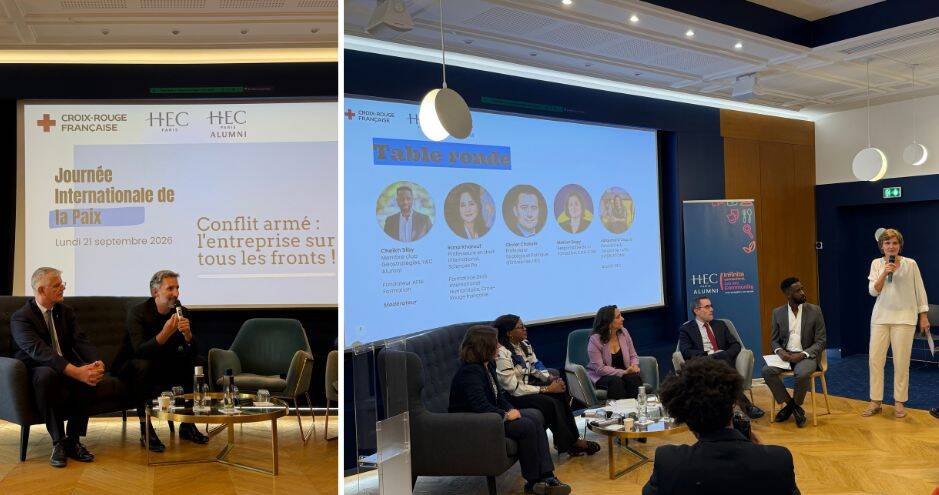
In February 2024, HEC Paris and the French Red Cross signed a partnership to connect educational innovation with social and humanitarian challenges. In a world shaken by a growing number of conflicts, the two institutions affirmed their commitment to strengthening education, action research and pathways into employment in fields such as solidarity and the inclusive economy.
Two years later, the partners came together on the International Day of Peace for a joint conference entitled Armed Conflict: Businesses on All Fronts. Co-organized with the HEC Alumni Geostrategy Club, the evening brought together different perspectives to examine the role and responsibilities of businesses in conflict situations.
A Partnership Supporting Social Cohesion and Peace
Eloïc Peyrache, Dean of HEC Paris opened the evening alongside Claude Girardi, Vice-President of the French Red Cross, highlighting the strong synergies between HEC Paris and the humanitarian organization and emphasizing the importance of their collaboration in a changing geostrategic landscape. As the campus becomes increasingly international, he outlined the school’s efforts to promote social cohesion and peace through new courses, scholarships for students from conflict-affected countries and support for social entrepreneurship.
Echoing these remarks, Claude Girardi recalled the longstanding commitment of the International Red Cross Movement, whose origins date back to the Battle of Solferino in 1859 and which has worked to alleviate the human consequences of armed conflict for more than 160 years. Throughout this period, the Red Cross has actively contributed to the development of international humanitarian law (IHL) and helped promote widespread understanding of it, particularly among businesses.
“The French Red Cross aims to help businesses understand the requirements of IHL, identify their responsibilities and better manage the risks associated with their activities in situations of armed conflict.”
Understanding Corporate Responsibilities and Rethinking Strategies
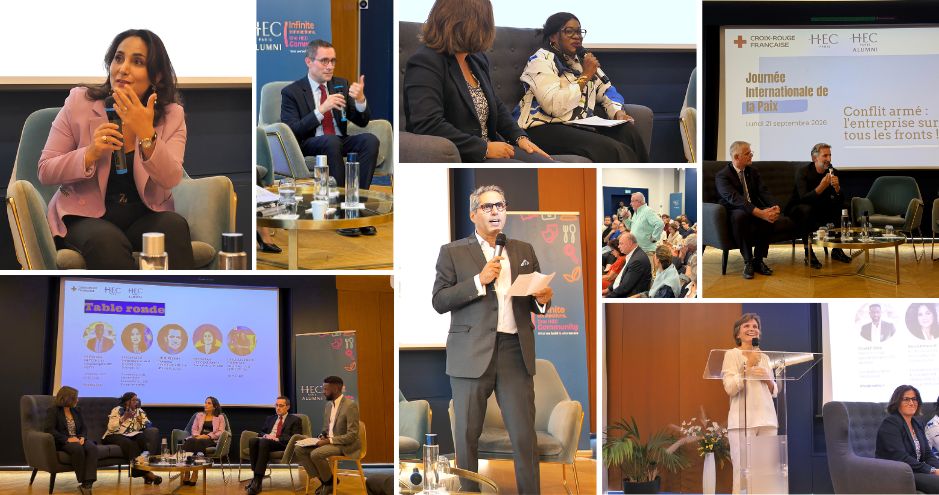
A panel discussion then explored the evening’s theme from a multidisciplinary perspective. Moderated by Cheikh Siby, a trainer and member of the HEC Alumni Geostrategy Club, it featured four speakers. Rana Kharouf, an educator and trainer in IHL, outlined its core principles: distinction, proportionality and precaution. She then explained the different dimensions of corporate responsibility in conflict zones, revisiting key milestones such as the adoption of the Montreux Document in 2008 and the Lafarge case in Syria.
Strategy Professor Olivier Chatain focused on how business leaders must adapt to the growing number of crises and “grey zones”—situations of confrontation that fall outside conventional armed conflict. He stressed the need to develop a geostrategic doctrine, particularly in Europe, following several decades without major conflicts.
From Large Corporations to Small Companies: Anticipating Risks and Taking Action on the Ground
The contributions of two speakers from the private sector brought valuable practical insights to the discussion. Marion Dupuy, Head of the CMA CGM Foundation, described how a large company such as hers responds to global instability. Risk analysis plays a central role in the shipping industry. Beyond protecting employees and the group’s assets, she explained how the company can contribute through its corporate social responsibility policy by making its expertise available to humanitarian organizations such as the International Committee of the Red Cross.
Fatoumata Diop Lo rounded out the discussion with the perspective of an SME leader. As the founder and head of a business operating across Senegal and Côte d’Ivoire, she explained how businesses on the ground, particularly in sub-Saharan Africa, navigate risk every day. Without dedicated teams, companies such as hers must anticipate these risks and factor them into decisions from the outset:
“A business leader like me [must] pay close attention to her operating environment […] and map out our vulnerabilities.”
Several key themes emerged from these contributions. Building business resilience will require changes in practices, alongside corresponding developments in both initial education and continuing professional development for decision-makers. Academic research must also continue to explore the various “fronts” opened up by the growing pace and complexity of conflicts, providing a robust evidence base to help businesses adapt their strategies. Finally, interdisciplinary collaborations such as the partnership between HEC Paris and the French Red Cross will need to expand: no organization can address the new challenges posed by war alone.