
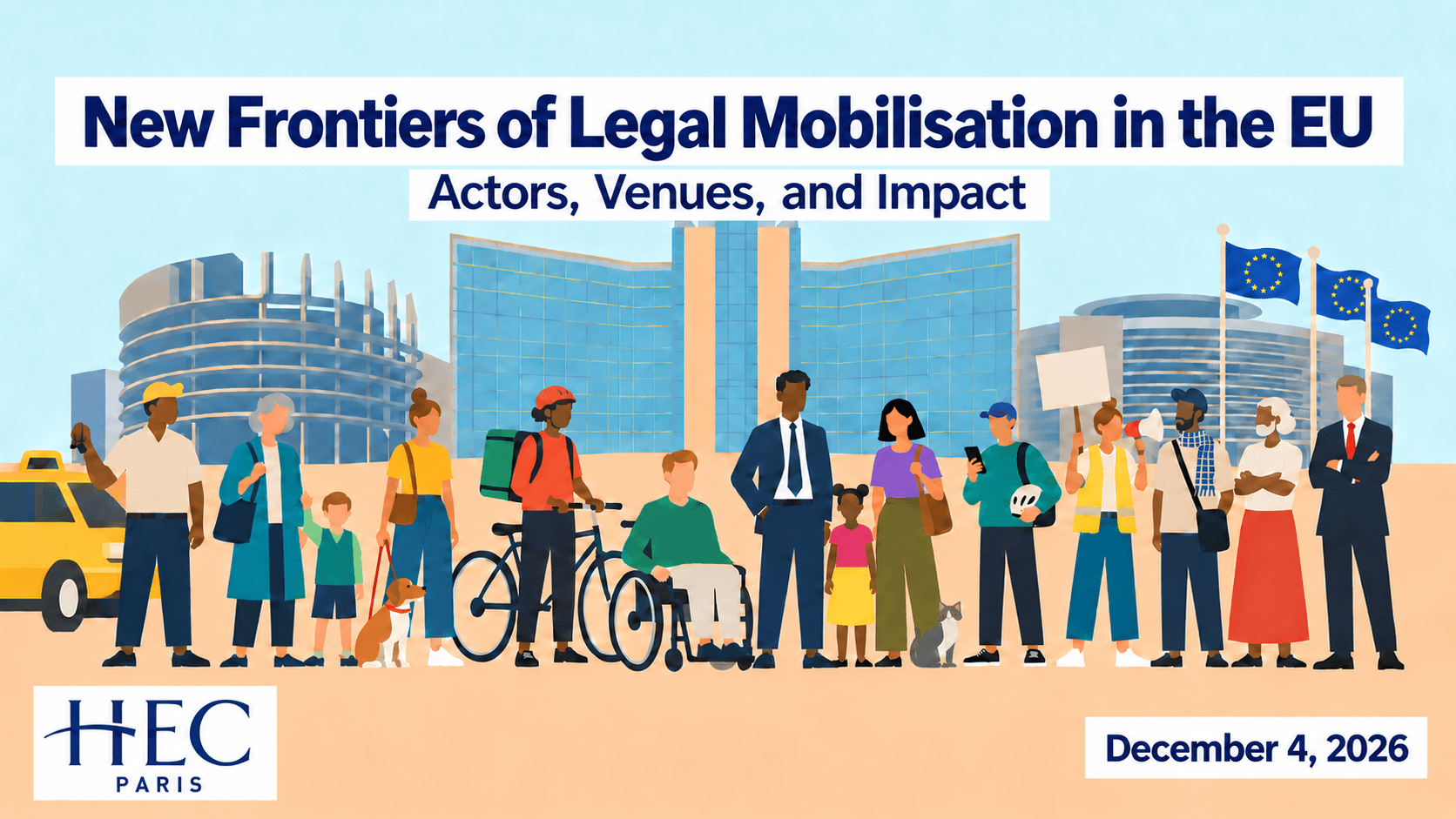
New Frontiers of Legal Mobilisation in the EU - Actors, Venues, and Impact
Participate
CALL FOR PAPERS
HEC Paris, 4 December 2026
Two traditions have shaped the study of legal mobilisation in the European legal order. The first, ‘integration through law’, cast individuals as enforcers of directly invocable EU rights and builders of supranational constitutionalism (Stein 1981; Cappelletti, Seccombe & Weiler 1986; de Witte 1999; Stone Sweet 2004). The second, a socio-legal ‘litigation-as-mobilisation’ literature, documents how civil society and interest groups deploy EU law and the preliminary reference procedure to advance policy goals that legislative channels foreclose or delay, from gender equality to environmental protection to migrant rights (Alter & Vargas 2000; Cichowski 2007; Evans Case & Givens 2010; Vanhala 2011; Passalacqua 2025). Most recently, this literature has turned to the concept of strategic litigation itself, defining it as normatively open and contextual, and deployed by actors across the political spectrum rather than by a single ideological camp (Braun & Stolk 2023; Cebulak, Morvillo & Salomon 2024), and examining its capacity to function as a form of participation in the Union’s democratic life (Alemanno 2024), one that carries real democratising potential but also risks reinforcing existing asymmetries of legal literacy, capacity and acces (Khadar, 2019).
Both strands remain indispensable, yet both still study mobilisation mainly through litigation, an arena that sociological work on ‘Euro-lawyers’ has shown to be shaped by a narrow circle of repeat players (Vauchez 2015; Pavone 2022).
This call for papers, and the editorial project that will follow it, instead takes the broader mobilisation campaign as its unit of analysis: the organised, sustained invocation of EU law to advance a claim, rather than the individual lawsuit. It asks who is able to mobilise, and how actors combine, sequence and replicate claims across judicial, administrative, participatory and supervisory venues. It also addresses legislative advocacy and the funding and staffing structures that make such mobilisation possible in the first place. The developments that motivate it point to a landscape of instruments, actors and claims considerably more diverse and more unsettled than the doctrines built to describe earlier moments of European legal mobilisation allow.
Recent practice illustrates the range. Associations of judges are challenging Council decisions before the Court of Justice. Gig workers are using the GDPR to contest algorithmic management. Cities are bringing annulment actions to defend environmental standards. NGOs are increasingly using Aarhus internal review as a route to judicial review. Academics are submitting amicus curiae briefs, although these are not formally recognised by the Court, to influence the outcome of pending cases (Alemanno 2025; Pech, 2024)). Organisers of European Citizens’ Initiatives (ECIs) increasingly contest the Commission’s follow-up, or lack of it, to successful initiatives. The same repertoire is now used across the political spectrum, from digital-rights groups filing templated GDPR complaints to the organisers of the ‘Save Europe Act’, who are challenging before the General Court the Commission’s refusal to register their immigration moratorium as an ECI. Such practices cannot be assimilated to a single repertoire of action or ideological project. They suggest instead that legal mobilisation in the European Union is diversifying along four connected axes: the actors involved; the instruments and procedural sequences deployed; the claims and values invoked; and the publics addressed or constituted through them.
This call poses two connected questions. The first is conceptual: what counts as legal mobilisation when actors invoke EU norms and institutions across venues; how do resources and legal opportunities shape those choices; and who generates and who absorbs the administrative load as claiming becomes cheaper to replicate? The second concerns consequences: does mobilising EU law necessarily advance integration, or does it also redirect, contest, fragment or resist it?
Four converging trends make this a timely moment. First, a wider base of claimants is emerging amid a strengthening sense of European identity (Dennison 2026; Ulrich, Schröder & Rehm 2025) and at a time when the Commission has sharply curtailed its own enforcement of EU law (Kelemen & Pavone 2023). Second, there are broader grounds to claim before both administrative and judicial bodies, following the Court’s treatment of Article 2 TEU as self-standing (Case C-769/22, Commission v Hungary, judgment of 21 April 2026). Third, standing case law is evolving in ways that widen access to the courts (Opinion of AG Ćapeta in Case C-555/24 P, Medel and Others v Council). Fourth, non-judicial avenues have risen sharply, from Ombudsman complaints and Aarhus internal review to GDPR, DSA and AI Act complaint mechanisms, increasingly assisted by AI-supported drafting tools.
We invite doctrinal, empirical, historical, ethnographic and comparative contributions from law, socio-legal studies and political science examining how EU law is mobilised across judicial, administrative and participatory venues, and how changing uses of EU law reshape claims, strategies and the publics they constitute. Ideally, papers will either provide the state of the art of legal mobilisation, broadly defined as in this call, within a given policy area (for example migration, public health, climate, digital, animal welfare, climate, environment, LGBTIQ rights, transparency and open government, rule of law), or focus on one of the specific mobilisation tools available (for example petitions, Ombudsman complaints, ECIs, digital complaints, amicus curiae briefs, third-party interventions, influencer campaigns, and complaints against EU political parties (Morijn, 2019)). Papers on legislative advocacy and on the funding (philanthropy; third-party funding; crowdfunding) and staffing structures that sustain EU legal mobilization strategies. Papers that treat legal mobilisation as constitutive of European publics, rather than merely expressive of pre-existing ones, are particularly encouraged.
Submission Instructions and Practical Information
Keynote Address
The keynote address will be delivered by Advocate General Tamara Ćapeta of the Court of Justice of the European Union.
Format and Access
Alongside paper presentations, the workshop is open to non-presenters and to the broader public, who are warmly invited to attend and take part in the discussion.
Key Dates
Abstract deadline: 18 October 2026
Notification of selected papers: 21 October 2026
Workshop: 4 December 2026, HEC Paris
Abstract Guidelines
• An abstract of up to 500 words, outlining the paper’s argument, method and contribution.
• A short bio (up to 100 words) and institutional affiliation.
• Please submit both to francesco-simon.artibani@hec.edu, with alemanno@hec.fr in copy, by 18 October 2026.
Support for Invited Speakers
• A travel grant of up to €250.
• One night of accommodation, covered by HEC Paris (the night before the workshop).
• An informal dinner on the eve of the workshop.
Contact
Prof. Alberto Alemanno, HEC Paris – alemanno@hec.fr