

 Geopolitics & Public Affairs
 Sustainability & Society


- A cause that crosses party lines: 92% of 16–20-year-olds see high school protesters’ demands as justified.
- Unprecedented institutional anger: withdrawing a reform would not quell protests for 34%, or 56% of those worried about their future.
- The same democratic grievance, different targets: over 80% on the radical left and right distrust democracy. Left: the rich and inequality (35%); right: immigration (40%).
- The illusion of purchasing power alone: protests stem from perceived stalled growth (“zero-sum thinking”) and feeling unheard.
Key facts
- 92% of young people surveyed consider the high school students’ demands justified.
- 34% want the movement to continue even if its main demands are met.
- 43% say their teachers and school administration do not listen to them.
- 18% believe they will be better off than their parents.
When the promise of progress no longer holds
First emerging in Créteil on 18 September 2026, the high school protest movement quickly spread beyond schools to join demonstrations against the high cost of living. One figure captures the scale of the phenomenon: 92% of 16–20-year-olds consider the movement’s demands justified, whether their parents are executives or manual workers.
Yet, unlike the mass protests against the Devaquet bill in 1986 or the First Employment Contract (CPE) in 2006, this time there is no piece of legislation whose withdrawal could put out the fire. Everyday grievances — overcrowded classrooms for 65% of high school students, absent teachers going unreplaced for 60%, or anxiety about Parcoursup, France’s higher education admissions platform (79%) — are only the tip of the iceberg.
Survey data from CEPREMAP’s Well-being Observatory and HEC Paris reveal that immediate material concerns explain only a small fraction of participation in the movement. What matters most is the widespread belief that economic progress has ground to a halt. Economists call this “zero-sum thinking”: the certainty that whatever one person gains, someone else must have lost.
This feeling is rooted in a stark economic reality: over half a century, the relative income of 20–29-year-olds in France has fallen from 99% to 67% of the national average, while that of people in their sixties has risen from 78% to 99%. For the first time in decades, youth is no longer the happiest stage of life.

Anger at a particular moment or institutional anger?
Asked what should happen to the movement if the government met its main material demands, 34% of young people say it should continue because “other things need to change”.
The analysis therefore reveals a crucial dividing line:
- Anger at a particular moment (55% of young people): it identifies a specific injustice, appeals to institutions and subsides when concrete responses are provided.
- Institutional anger (34% of young people): it expresses a systemic breakdown in trust that no concession in a particular sector can resolve.
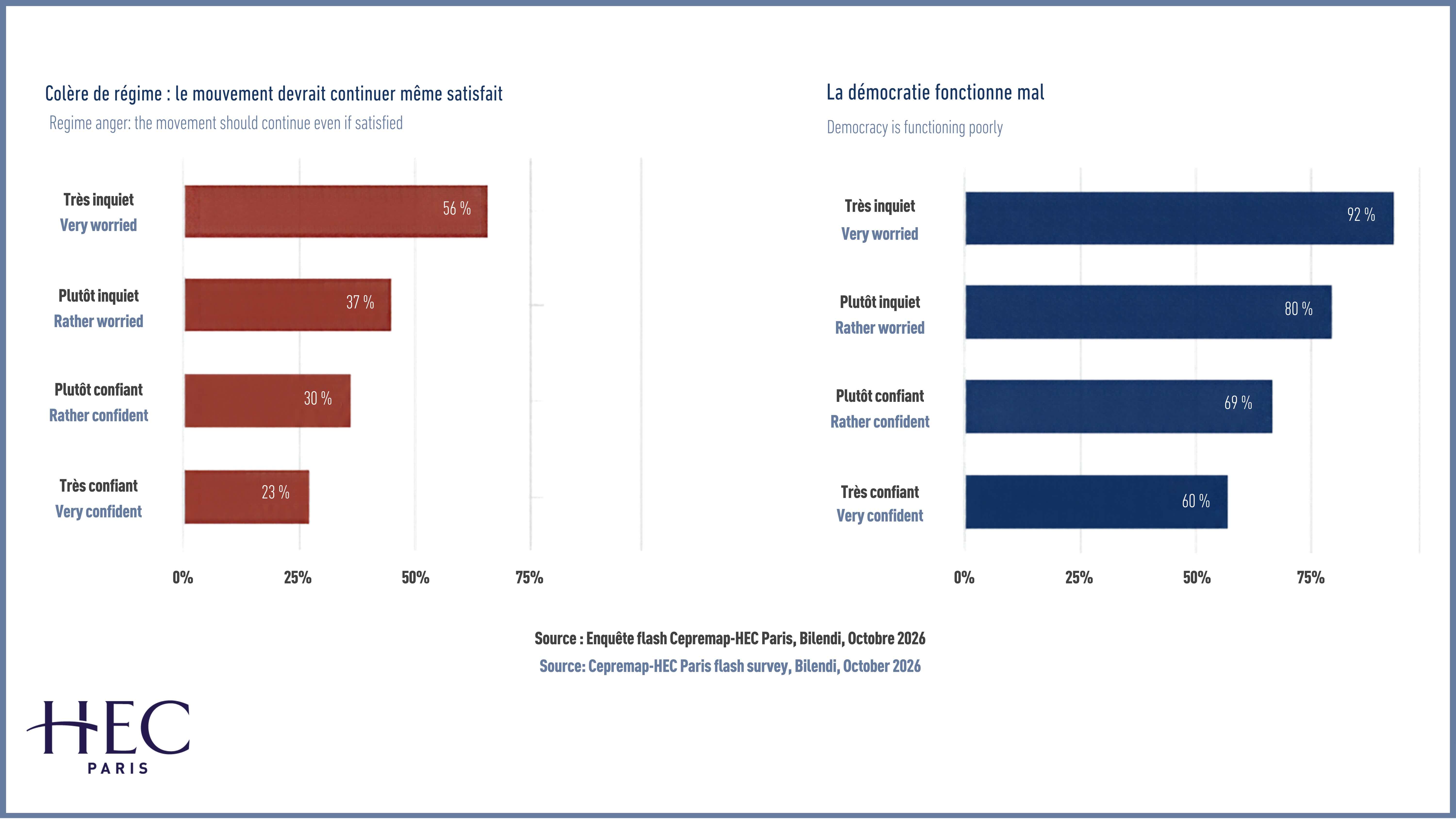
This institutional anger is directly fuelled by narrowing career prospects and technological uncertainty. Recent studies from HEC Paris’s LIFT Lab show that permanent-contract hiring among 21–29-year-olds has fallen by 28% in occupations most exposed to generative artificial intelligence since the end of 2022.
The same democratic wound with two different enemies
While the cause unites young people, political affiliation divides them deeply. Those close to the radical left and the radical right share exactly the same sense of institutional failure: more than eight in ten (86% on the radical left and 82% on the radical right) believe that democracy is not working well in France.
Yet their views of society lead them to blame diametrically opposed groups:
- The radical left (35% of grievances) targets “those at the top”: the rich, elites and social inequality. It demands a comprehensive transformation of the system (49% express institutional anger) and actively takes to the streets.
- The radical right (40% of grievances) targets “people perceived as outsiders”: immigration and social disorder. Although three-quarters support the cause, they do not take part in blockades, stay at home and demand a return to order.
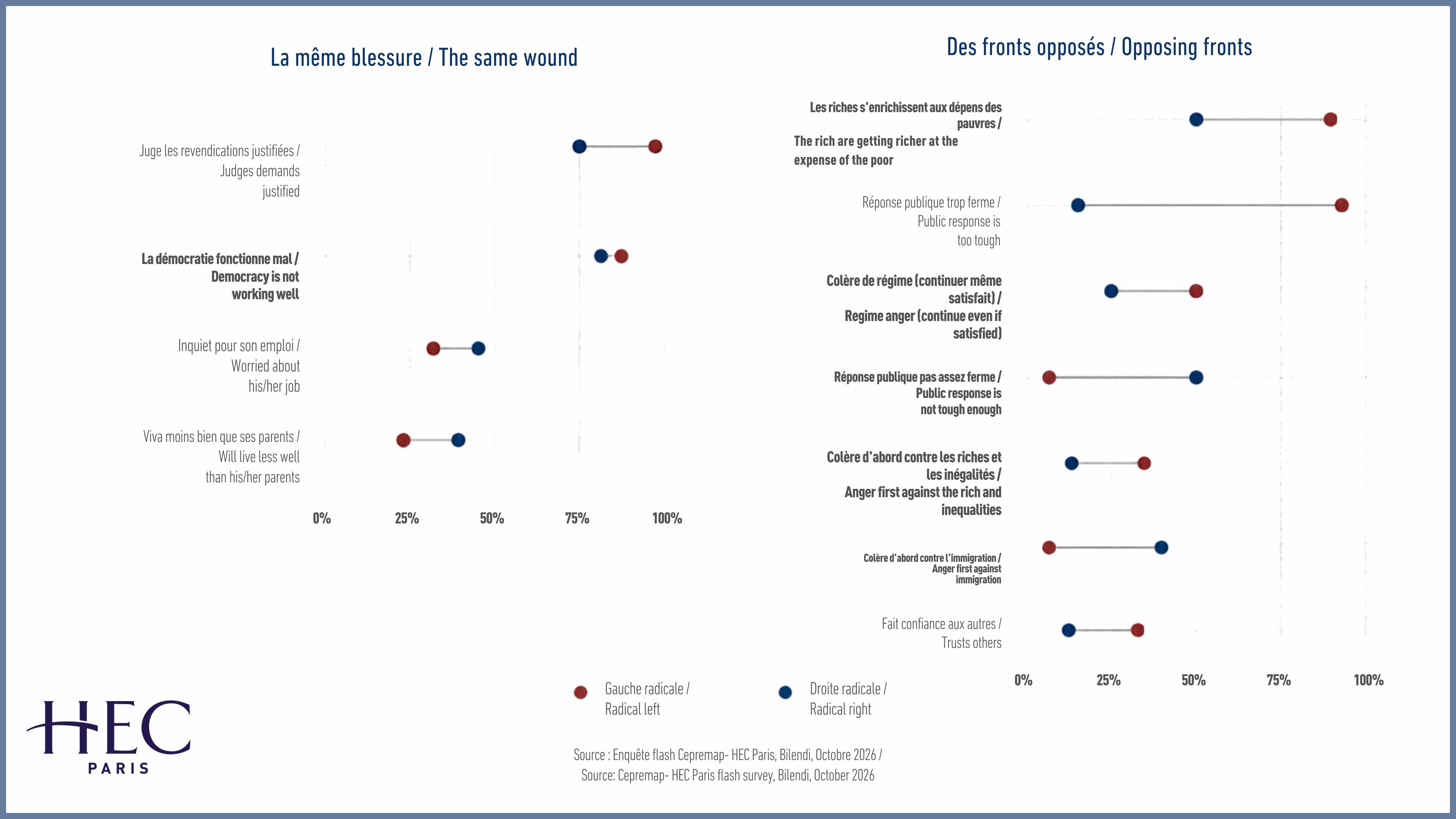
This divide is strikingly reflected in attitudes towards violence. Among young people on the radical left, 60% consider it legitimate to confront the police, whom they see as embodying a system to be challenged, compared with just 5% on the radical right. Conversely, 81% of young people on the radical right approve of the police detaining protesters.
Restoring a sense of possibility through intermediary organisations
Another major finding concerns voices that go unheard. Among high school students, 43% say their teachers or school administration do not listen to them. Of those who have reported a problem at their school, 70% say their action had no effect — an experience directly correlated with a 25-percentage-point increase in participation in blockades.
With deindustrialisation and the weakening of traditional spaces for social interaction — factories, trade unions and local associations — society has lost the places where individual frustration could be turned into demands open to negotiation. Isolation intensifies this feeling: 16% of young people now say they regularly feel lonely. While loneliness fuels passive indignation, rebuilding collective life and spaces where people are heard remains the only driver of constructive action.
Defusing the crisis requires action on two fronts:
- At the local level (defusing anger at a particular moment): establish meaningful shared governance and decentralised decision-making in schools, as 56% of students would like, so that high school students’ voices carry weight again.
- At the national level (addressing institutional anger): rebuild the promise of upward social mobility and shared prosperity, ensuring that every young person can trust that their efforts will secure them a dignified place in society.
Sources
Yann Algan, “Ce que la colère des lycéens dit des colères françaises” [What high school students’ anger reveals about anger in France], CEPREMAP Well-being Observatory Note No. 2026-20, 28 October 2026 (survey of 1,077 young people aged 16–20).



 Tech & AI
 Economics & Finance