


 Sustainability & Society
 Economics & Finance

Executive Summary
The Omnibus rollback of the EU sustainability disclosure rules, the CSRD and CSDDD, was justified by the belief that competitiveness had to come at the price of sustainability. Although sustainability goals enjoyed strong support among citizens and companies, the cost and time burden of these regulations, and the resulting competitive disadvantage for European firms, meant that these goals had to be partly put on hold.
A team of HEC Paris professors proposes a new disclosure architecture that allows Europe to have both. Instead of relying on company-level reporting, every product, European or imported, would come with a standardized digital scorecard displaying objective, comparable environmental and social indicators. The system would reduce reporting burdens through distributed, automated data collection: each company would report only its own operations, while upstream impacts would be drawn from suppliers’ product scorecards. Missing information would be clearly flagged through default intervals that would propagate down supply chains.
Added to the regulatory toolkit, this approach would create a level playing field, improve information for consumers, investors and regulators, and encourage firms to be more transparent and improve their sustainability performance. By letting information cross borders, it could strengthen European competitiveness abroad while extending the reach of EU sustainability standards.
Context & Challenge: A backlash against sustainability regulation
Once a flagship measure of the EU's Green Deal, the bloc's disclosure pillar, comprising the CSRD (Corporate Sustainability Reporting Directive) and the CSDDD (Corporate Sustainability Due Diligence Directive), has been scaled back. In the wake of the Draghi report and a wider push in the name of competitiveness, EU institutions adopted the so-called Omnibus package in 2026, simplifying and reducing parts of the CSRD and CSDDD requirements.
The sustainability goal itself was not in question. In fact, environmental and human welfare objectives continue to enjoy broad support among citizens, and tellingly, among 85% of the businesses impacted by the regulation, according to a May 2025 survey conducted by WeAreEurope in collaboration with HEC Paris.
Rather, the backlash focused less on the objectives than on the architecture chosen to pursue them. Concerns about cost, complexity and competitiveness became the main reasons used to defend the Omnibus. Its supporters presented the reform as a competitiveness measure: EU firms, they argued, should not be placed at a disadvantage relative to non-EU peers that do not face the same financial, administrative and organizational costs of disclosure. Relatedly, they also pointed to the practical burden of compliance, especially the manpower and money required to collect and format supply-chain data such as Scope 3 carbon emissions. Yet although businesses recognized these issues, many did not oppose sustainability-promoting regulation: according to the same survey, 90% of critics wanted a level global playing field, not the rolling back of regulation altogether.
But did Europe really need to choose between sustainability and competitiveness?
Could a better disclosure architecture have allowed it to have both?
 Find out more
The solution: A standardized, digital scorecard for all products
In this policy paper, the authors set out smart, product-level sustainability disclosure. In concrete terms, this would involve a digital scorecard akin to food nutritional tables: available for every product and service, albeit digitally. The standardized scorecard would list key sustainability metrics such as carbon footprint, measures of impact on biodiversity, wage inequality and human-rights records. Like a nutritional table, the information should be concise, clear and comparable; crucially, it should also be objective, verifiable and verified. Everything written on the scorecard would have to be certified as true, with liability responsibility landing accordingly. Verification could piggy-back on existing audits, official records and the newest technologies that preserve business secrecy, ensuring credibility without requiring a wholly new bureaucracy. No need to start from zero, either, as concerns implementation: the system could draw on existing industry-specific systems for calculation methods, such as Ecobalyse for textiles, and for electronic completion and transmission, on a tool currently in development, the EU's Digital Product Passport (DPP), which only applies to the ecodesign of industrial goods – for now. Like nutritional tables, the scorecard would not itself be a label; but it could provide the underlying data to support labels, sustainability apps or even a revived Green Claims framework, much as nutrition tables support systems such as Nutri-Score, apps like Yuka or nutritional claims legislation.
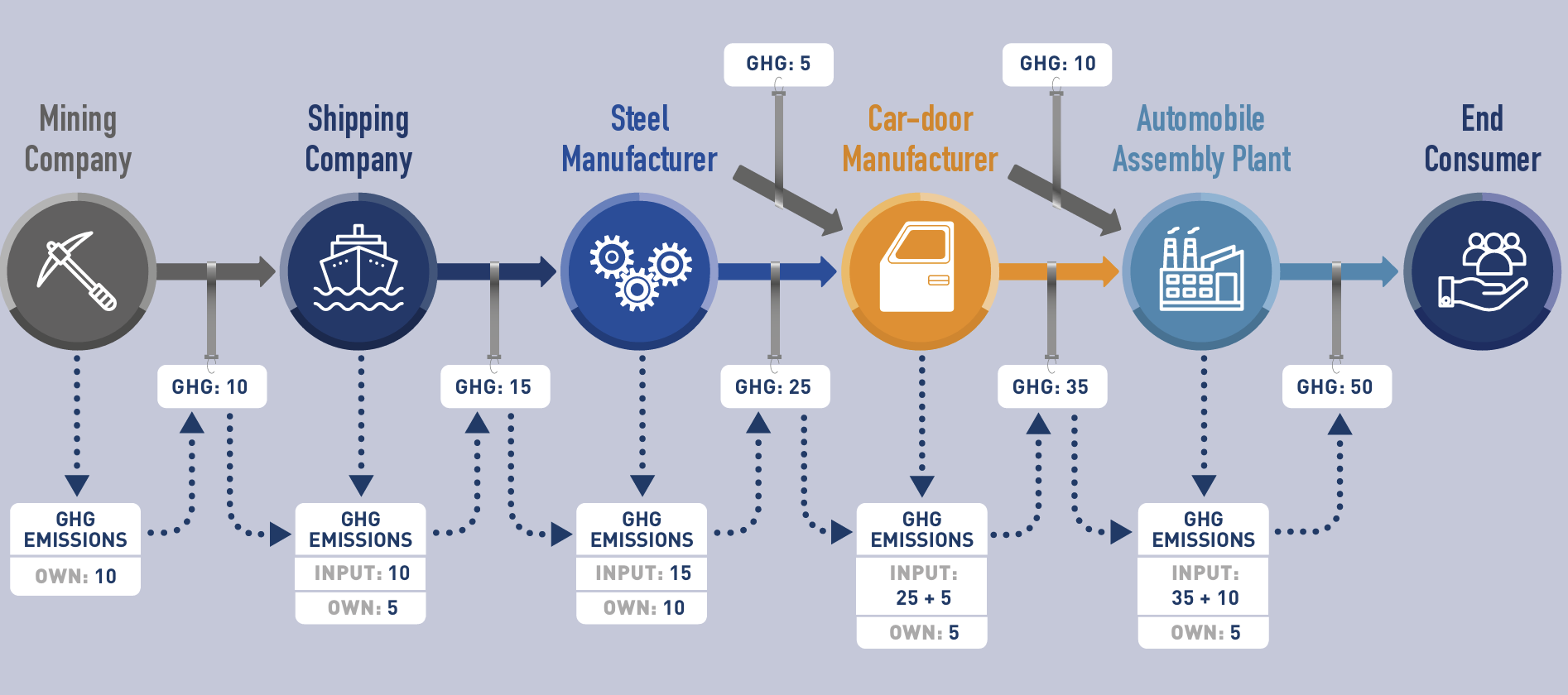
Two smart features would make reporting easy, if not automatic, for firms, while also confronting the problem of non-reporting, especially for firms and supply chains that extend outside the EU. Mapping the value chain, as typically required, is costly and time-consuming. Instead, the system would employ distributed reporting: firms report their own impacts, while upstream data is provided by suppliers in their products’ scorecards. Much of this could plug into accounting and ERP systems, making Scope 3 reporting less detective work and more routine data flow. Missing information would be handled using propogated transparency: gaps would be flagged, and the missing value would be carried along the supply chain as an interval ranging between best-in-class and worst-in-class benchmark values, ending up in the scorecard of the final product.
A response to industry concerns
For businesses, the modular and smart treatment of Scope 3 and upstream impacts makes reporting easier and more automatic. Firms remain responsible for their own operations, while upstream information is supplied through the scorecards attached to suppliers' products. Missing information is handled through visible default ranges, rather than through costly supply-chain investigations. But the proposal also addresses competitiveness. Where current approaches to regulation seek more or less workable patches to correct competitive distortions, the level playing field is built into the scorecard proposal itself: all products on the EU market would be covered, irrespective of whether they were made in Berlin, Beijing or Boston. And, because of the propogated transparency dimension of the proposal, this holds whether or not non-EU firms chose to report: if they don’t, their products’ scorecards will be populated by the relevant default intervals.
Achieving EU sustainability goals
What can this do to help sustainability objectives?
Transparency can drive change only if the information is available at the point of use. With firm-level disclosure, many interested stakeholders have to trawl through several-inch-thick corporate reports. With product-level disclosure, meaningful information becomes available at the point of decision-making: in the marketplace (be it the e-commerce site, the supermarket aisle or the warehouse). Investors could also benefit from more granular insights into a firm's environmental and social strategy, as opposed to analyzing aggregated evaluations in annual reports. Public authorities would gain the information ecosystem needed to devise and implement new regulations, design policies, police compliance and define procurement criteria.
A further advantage is that the scorecard avoids the pitfalls of making value judgments on behalf of consumers. It provides raw, comparable information, while leaving stakeholders to decide which indicators matter most to them. This neutrality avoids the interminable debates that plague synthetic labels or certifications: which indicators should be combined, how they should be weighted, which thresholds should count as acceptable … and ultimately, is the certification answering these questions in a way that the citizen trusts?
At the same time, state-of-the-art research in the behavioral sciences, some of it carried out in the Economics and Decision Sciences Department at HEC, shows that the treatment of absent data promises to create strong incentives to report and improve performance. Non-disclosure remains possible, but it becomes conspicuous; because people tend to dislike uncertainty, missing information will often be interpreted negatively by consumers and buyers. All of which piles on the incentives for firms to disclose and perform when it comes to sustainability.
Enhancing global standards
With this architecture, every product entering the EU market would automatically receive a scorecard; companies that decline to report would still be assigned visible default ranges. This would create the same pressure on non-EU producers as on EU ones – without requiring Brussels to devise ways and means to regulate them directly. Because the information is digital and globally accessible, consumers, investors and buyers anywhere could compare products using the same sustainability indicators.
Properly conceived, sustainability disclosure can thus become a source of both economic leverage and regulatory soft power. European companies could turn their reporting efforts into reputational capital abroad, while EU standards spread through purchasing and investment choices rather than treaties or legal coercion. Instead of waiting for every government to agree, the system offers stakeholders an opportunity to reward transparency. A gradual uptake of European sustainability norms across global markets and supply chains, could hand EU a leadership role in the global sustainability transition.
Conclusion and main takeaways
- EU sustainability disclosure architecture, viewed by many as a handicap for European firms, could be redesigned to create a more level playing field.
- The authors propose standardized digital sustainability scorecards for individual goods and services, including both EU and imported products.
- Reporting would be distributed across supply chains: each company reports only its own impacts, while upstream data is provided automatically by suppliers in the scorecards for their products.
- Missing information would be replaced by default intervals, which would be propogated down supply chains and show up in the final product’s scorecard.
-
Product scorecards could inform consumers, investors and policymakers, thus incentivizing firms to adopt more sustainable practices. Because the system would be accessible worldwide, it could become a form of international soft power.
Properly implemented, standardized scorecards would make transparency less burdensome, competition fairer and sustainability information more useful. Instead of asking Europe to choose between competitiveness and sustainability, this policy paper offers a way to make each reinforce the other.
About the Authors
The Policy Paper Squaring Disclosure Regulation and Competitiveness was published by the Sustainability & Organizations (S&O) Center of HEC Paris in October 2025.
Its lead author is Brian Hill, Research Director at the French National Centre for Scientific Research (CNRS) and Professor in the Economics & Decision Sciences Department at HEC Paris.
His co-authors are Rodolphe Durand, Professor in the Strategy & Business Policy department at HEC Paris, Founder of the S&O Center and Academic Director of the Purpose Center; Jinhong Eom, HEC Paris Student in the Master in Management; Marieke Huysentruyt, Associate Professor in the Strategy & Business Policy department at HEC Paris. Academic Director of the S&O center and the Impact Lab; Stefano Lovo, Professor in the Finance department at HEC Paris and Academic Director of the Center for Impact Finance Research; Leandro Nardi, Assistant Professor in the Strategy & Business Policy department at HEC Paris; Crystal Shi, Assistant Professor in the Accounting and Management Control department at HEC Paris.



 Tech & AI

 Strategy & Leadership