
Laurent Bernard: Conviction as the Only Instrument of Measurement
Thirty years at the same firm. Technical authority nobody questioned. A succession plan worked out at letter. None of it prepared Laurent Bernard for the day he had to decide in the dark.
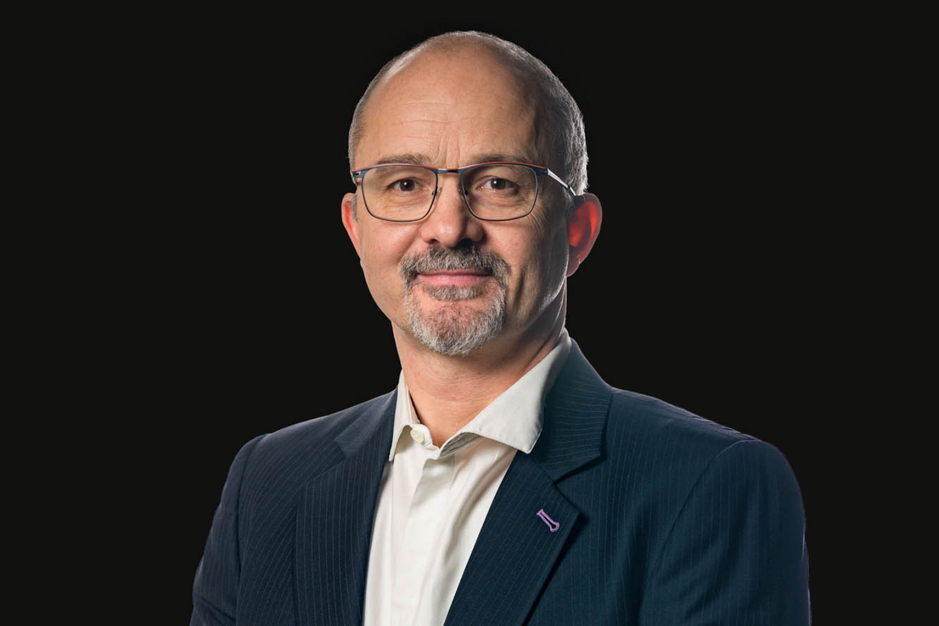
Laurent Bernard joined Barbanel, an engineering firm specialized in fluid systems, electrical engineering, and thermal and energy design, almost thirty years ago, as a project manager. In December 2024, he became its president, having bought out his predecessors' shares and restructured the capital to bring in a new generation of partners. In between, he worked his way up in the trade to national technical director, and picked up back his old passion, diving instruction. 'A different kind of intellectual exercise, a way to step back, but always with that same idea of passing on what you know'.
Partway through, he enrolled in HEC Paris Executive Education's Dirigeant PME: Innovation, Impact & Croissance program, to close what he called his "blind spots". A "toolkit" that let him take control of a trajectory he had already mapped out.
A Decade of Preparation, One Day to Sign
Laurent Bernard became president of Barbanel to feed a logic that suits him: look at what's being built, find where he can be useful, and move. He graduated from ESTP in 1996 with a specialization in mechanical and electrical engineering, started out doing research at INRIA on high-frequency inductive power transmission, spent time in the air force, worked briefly on the execution side of a company, then landed at Barbanel, in conception. When he arrived in 1998, the firm had about thirty people. Today it has 110.
At Barbanel, you can't take over opportunistically. Succession follows an old governance rule: whoever leads it comes from within, knows the trade down to its technical details, and has earned legitimacy from the generations before.
'Here, a leader can't be non-technical. We sell brainpower. The engineers we manage think and expect at a high level. You have to hold yourself to the same standard.'
Laurent is the fourth generation to run the company. The fifth, if you count the American founder.
He tells his own story with the precision of an engineering file: dates, sequences, trade-offs. When the succession question came up in 2015, he put himself forward. From his post as technical director, he started shaping the company's strategic direction, from internal organization, going through training and job descriptions, to environmental priorities drawn from IPCC reports. He joined leadership decisions from 2018 onward, partly because his predecessor was on his way out, and partly because the future partners needed to see a direction take shape.
And he noticed that, while he knew his trade by heart, and the company inside out, there were blind spots. He had touched on finance, HR strategy, marketing, accounting, but never dug into. That would become central the moment he took over. Si, in 2022, he joined HEC Paris's Dirigeant PME program to work on the missing pieces, two years before he signed the buyout, on December 18, 2024.
' It happened naturally', he says. That's true. And it isn't. True, because he didn't change course overnight. But behind that apparent smoothness lies a considerable amount of groundwork: building legitimacy before taking the title, arranging financing, rallying incoming partners, identifying future ones, and anticipating the post-takeover workload so he wouldn't be overwhelmed on day one. An engineer's logic, applied to subjects that reach far beyond engineering.
'I didn't need an MBA, or a bigger address book. I just needed to be in the room with people who know management inside out, on subjects I needed to structure'. He knows what he wants to do with the company. He needed the tools to execute it.
'I took everything I learned at HEC to build my company strategies. It meant I could press the button and launch every project the day I took over'.
Learning sometimes means unlearning first. Laurent went through that reverse process throughout the takeover.
What He Had to Unlearn
At Barbanel, technical legitimacy outranks everything else. Laurent Bernard had nothing left to prove on that front. So he treated it as an asset to protect. The real transformation happened somewhere else.
'In engineering, I knew exactly what I was doing, because it's black or white: hypotheses, calculations, results. As president, in strategic leadership, it's more random, so harder to justify. And I like justifying my choices.'
As president, that's the exact reflex he had to unlearn. His mindset shifted from proof to posture, from an authority built on demonstration to one built on direction. 'I need to be strong on conviction, rather than on justifying the reality of the subject'.
Then there's the standard he holds work to. Laurent Bernard had to learn to accept a level of output lower than what he would have produced himself, 'not out of resignation, but out of clear-sightedness. A company that only moves forward when everything is perfect doesn't move forward.'
And then there's distance. Coming from technical management, he still stays too close to operational projects. 'That might be something I still have to unlearn, to take on a longer-term view.'
A Collective That Carries the Weight, a Handover Built to Last
Barbanel today has ten partners: five long-standing majority buyers, and five new ones who came aboard before the sale.
With the long-standing partners, the future capital split was designed with the long game in mind, capping the LBO leverage to make room for newcomers. Before the sale was even finalized, he convinced the outgoing leadership to bring in five partners to take advantage of the new mechanism, so capital distribution would be built from the start around handing it on to the next generation.
'I don't need to end my career a millionaire. I need to enjoy what I do, feel good with the people I work with, and have a real social value. I think there's a new generation that needs meaning, and probably recognizes itself in that".
For him, cohesion within the group is non-negotiable. In a trade that sells expertise, where people are the core asset, a leadership team that fractures loses credibility with its own teams. That unity builds loyalty.
'We're all very loyal to the company. Everyone has been with it for ten to thirty years. That loyalty carries the group'. And like any group, he adds, 'it needs a captain, someone who drives it. I put myself forward'.
What Barbanel Builds, and Why It Lasts
In the morning, Barbanel's engineers are on site with the construction crews. In the evening, they're building case files with lawyers. They design buildings from a blank page, engineer electrical and thermal networks, renewable energy systems, and carbon-reduction solutions. 'When I drive past La Défense with my daughters, I point out what we built. We're proud to show that we've added our own stone to the building'
That pride in something concrete, something that lasts twenty-five or thirty years, and has a measurable impact on how spaces are used and how much energy they consume, is at the heart of what Laurent Bernard talks about. Since 2020, he has worked on giving engineers' work meaning through an environmental lens: the group measured its own carbon footprint, built a dedicated energy-efficiency department, and launched reuse and refurbishment projects.
'Renovation and restructuring, that's where we're really relevant. Building new is fairly simple; we know technologies by heart. But taking something that already exists, understanding it, reworking it down to the detail, that's where engineering thinking actually matters. And there's real meaning in saying: I'm not going to tear it all down; I'm going to make something better while doing as little damage to the planet as possible.
Despite these achievements, fluid engineering is a structurally low-visibility sector. Ninety percent of French firms in the field have fewer than twenty-five people. Barbanel has a solid reputation in its market. Clients call it 'the Rolls-Royce of fluid engineering firms'. Yet it had never tried to capitalize on that perception.
HEC forced a reckoning with something deeply entrenched at Barbanel.
' When I was choosing between a business-school track and an engineering one, I used to think marketing was just hot air'.
The program has changed his mind. He realized Barbanel had a brand, without knowing it, without naming it, without packaging it.
Since taking over, he's been working to convince his partners, all engineers like him, and skeptical from day one, that visibility isn't vanity. In a real estate downturn, a heavily fragmented market, being seen becomes a matter of survival.
The return is already visible. A 'Raconte ta boîte' video shot with Florian Pingaud, his head of the Optimal Énergie department, recruitment talks in engineering schools, and press relations have laid the first stones of a communication strategy that the company now owns, one that is slowly working its way into the firm's DNA.
What Younger Generations and AI Have Forced Him to Relearn
On Gen Z in engineering, Laurent won't take the received line. He doesn't generalize or condemn. He talks in proportions instead: ' Some proportion of young people don't make work a priority. Another proportion tends to settle for the first workable answer instead of the best one. They act like AI: they find an answer and stop there.'
But he also turns the problem around. ' They come to us with questions we stopped asking ourselves ten years ago, because we know the answers by heart. It forces us to pick them back up, ask them again, tackle them with today's tools'.
Knowledge transfer doesn't move in only one direction. Plenty of leaders say that. Few built it in how they actually manage. At Barbanel it's structural: knowledge travels partly by ear, in the open space, on live projects. Remote work fragilizes that. The rising generation is questioning it. For Laurent Bernard, that friction is productive, as long as you don't run from it.
As for digitalization, and now AI, both have already reshaped support functions at Barbanel: where it once took one assistant for every five people, two now cover thirty to forty. Even though the company got ahead of the subject early, Laurent points out that what doesn't replicate is 'the engineer who walks onto a site and reads it, who takes a material built for one purpose and repurposes it to solve another', before adding, 'AI doesn't know how to innovate. It searches what already exists and hands you a checkbox answer'.
The One Problem That Won't Budge
Today, he worries about human resources. Talent shortages, a volatile market, client deadlines that force punishing rhythms, profitability that's hard to measure: a permanent balancing act, with no simple answer.
Laurent has rethought his own relationship to volatility since taking over. The Dirigeant PME program had prepared him for it, notably through a speaker from the GIGN, France's elite police intervention unit, on decision-making under crisis. 'When I took over the company, the market fell apart. We lost 20% of revenue. I had to step back instead of getting buried in.'
Stepping back during a crisis, while, as an engineer, he'd rather act on the parameters he knows. His time at HEC built in him the ability to suspend that reflex, look at the system from outside, and call that leadership. Thirty years into the same company, Laurent Bernard is still learning how to do his job. For him, that's exactly the point. 'As long as you're learning, you're alive'.