
Family Businesses: Long-Term Thinking for Tomorrow's Economy
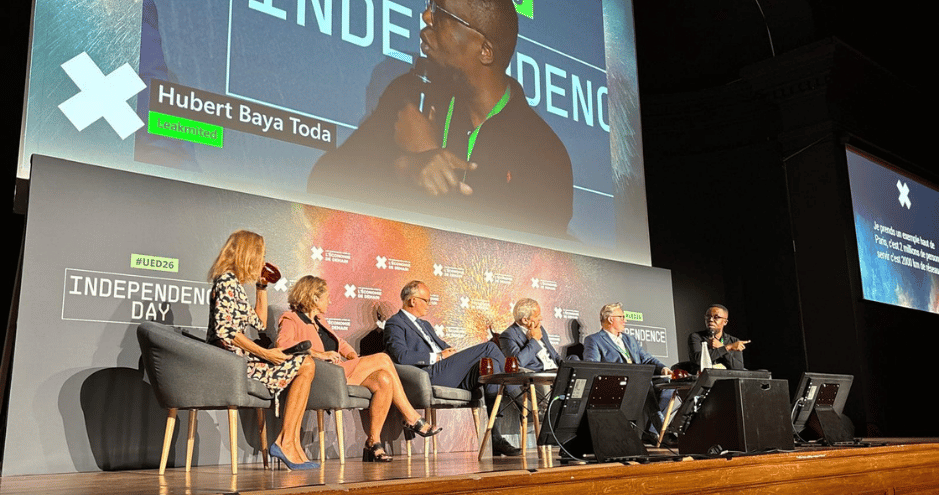
At the Universités d'Été de l'Économie de Demain, held on August 28, 2026 in Paris, a round table on family businesses brought together Camille Vever, Xavier Unkovic, Caroline Schildt and Thibault Petithuguenin. Moderated by Cécile de Lisle, Executive Director of the Center for Family Business, the discussion highlighted what sets these companies apart when facing major transformations: their ability to combine heritage and change, territorial roots and long-term thinking. The day was also marked by a strong presence of the HEC Paris community among the speakers.
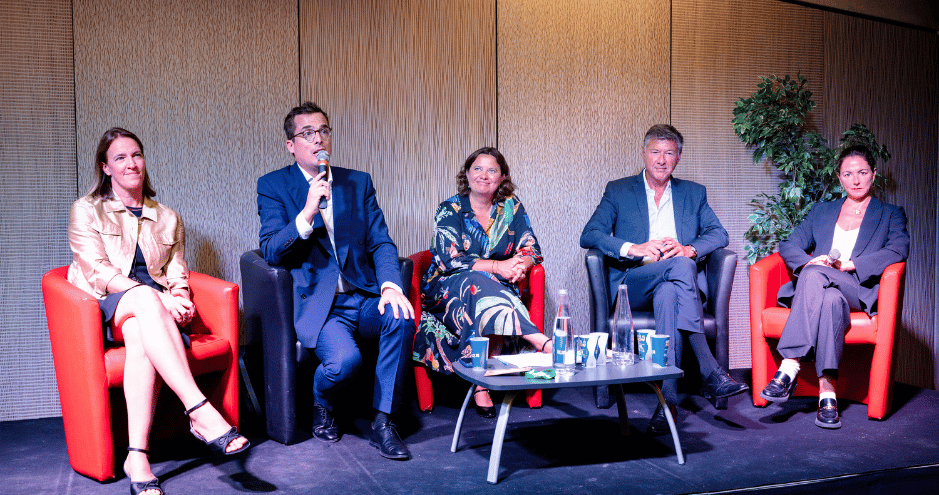
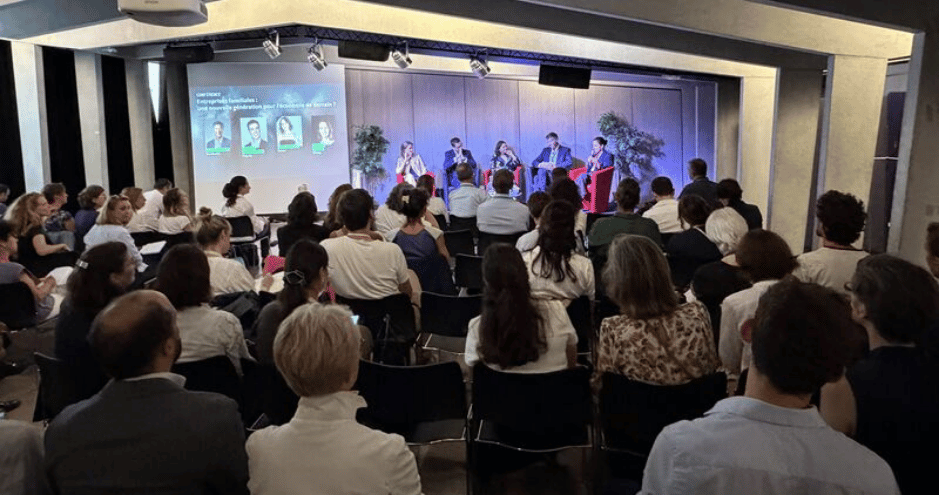
The Universités d'Été de l'Économie de Demain brought together business leaders, entrepreneurs, public officials and experts around a shared question: how can Europe build a more resilient, more sovereign economy capable of driving the transformations it needs? Within this context, the round table "Entreprises familiales : une nouvelle génération pour l'économie de demain ?" examined how family businesses approach these challenges. The program invited participants to consider the ability of new generations to evolve models built to last while still respecting their heritage. The wave of family business successions expected over the coming decade carries high risk, but it is also a major opportunity for transformation and for new generations to integrate sustainability into these companies. Moderated by Cécile de Lisle, the discussion brought together Camille Vever, seventh generation of Maison Vever; Xavier Unkovic, CEO of Bonduelle, a seventh-generation family business; Caroline Schildt, fourth generation of the Picoty family and Sustainability Director of the group; and Thibault Petithuguenin, second generation of Paprec.
Businesses Anchored in Time and Place
In her introduction, Cécile de Lisle recalled the weight of family businesses in the French economy, and above all two characteristics highlighted by academic research: their grounding in the long term and their territorial roots.
"They are anchored in time and in space."
Because they project themselves into the future and plan for succession to the next generation, family shareholders can reason across different time horizons. Their history also often ties them to a territory, to employees and to an ecosystem with which they maintain long-standing relationships. This does not mean that family businesses are inherently more virtuous than others. Their governance can also generate its own difficulties. But their ownership structure and their relationship to time can give them specific levers to invest, transform and stay the course over several decades. The four experiences shared during the round table offered very different illustrations of this.
Inheriting, But Also Reinventing
For Camille Vever, heritage takes a singular form. Maison Vever, a historic name in French jewelry, had closed its doors in 1982. As a seventh-generation representative, Camille chose to relaunch it nearly forty years later. She inherited a name, a history, and a heritage still present in museum collections. What remained was to define what this house should become in the 21st century.
"The question is to say to yourself: great, I've inherited the name, the DNA, the family; now, what trajectory do I want to give it? What's the mission?"
The new Maison Vever was built around commitments centered on responsible sourcing and French manufacturing. The company adopted mission-driven company status (société à mission), reflecting these refounding commitments. But Camille Vever above all stressed one essential condition for new generations:
"You need entrepreneurial legitimacy in addition to a name."
Taking on a family heritage is therefore an entrepreneurial act: it requires asking what one wishes to keep, transform or reinvent.
« Heritage Does Not Mean Immobility »
Xavier Unkovic brings a different perspective: that of a non-family CEO leading a seventh-generation family business. For Bonduelle's CEO, understanding the family's history and DNA is essential. But respecting it does not mean repeating the same choices as markets and consumer expectations evolve.
"Heritage does not mean immobility."
The relationship between a family shareholder base and an external CEO then rests on trust and on alignment around the company's values and mission. Xavier Unkovic also pointed to another possible strength of the family model: shorter decision-making chains, which can allow the company to respond more quickly when the environment demands transformation.
Transforming a Historic Business: The Picoty Case
At Picoty, the challenge goes to the heart of the business model itself. Founded in 1922 and historically built around fuel and combustible distribution, Picoty must prepare its future in a world that must gradually move away from fossil fuels. Caroline Schildt explained how the fourth generation first worked on family governance: a family charter, a family council, clarifying roles between family, ownership and the business, evolving governance, and bringing in external board members. This work was meant to allow the new generation to look far ahead:
"We had in mind writing the chapter of the next hundred years."
This governance work then went hand in hand with work on the business model itself, including the development of various low-carbon alternatives. Caroline Schildt's account also shows that transformation is never just a matter of strategy or technology. It requires convincing the family, but also supporting employees whose skills and professional identity were built around the historic business. As she summed it up:
"The biggest job is overcoming resistance to change."
Investing Before Being Proven Right
With Thibault Petithuguenin, the long-term perspective took the form of investment. Since Jean-Luc Petithuguenin took over a small recycling company in 1994, Paprec has grown by investing heavily in its industrial facilities, in recycling technologies, and through successive acquisitions. For Thibault Petithuguenin, this growth requires accepting that some investments take several years before producing their full effect.
"These are not success stories built in six months. They are success stories built over ten, twenty or thirty years."
Long-term thinking makes it possible to anticipate here: investing in a technology or an industrial tool before the market has fully proven the decision right. This kind of timeframe also requires building a lasting relationship with financial partners, based on transparency and a shared understanding of the company's strategy.
What Role for Family Capitalism?
Through Vever, Bonduelle, Picoty and Paprec, the round table ultimately raised a broader question: what can the family business model bring to an economy facing transformations that take time? These four companies obviously do not draw a single model. But their trajectories illustrate the possibility of striking a different balance between immediate performance and long-term investment, between heritage and innovation, between the company's interests and maintaining territorial roots.
Cécile de Lisle placed these testimonies within a broader reflection on the different forms of capitalism and their ability to create value over time. She closed the round table with a deliberately open formula:
"A family business is a matter of the heart but, more important still, it may be the last bastion of capitalism with a human face."
A Strong HEC Paris Community Presence
Au-delà de cette table ronde, HEC Paris était largement représenté parmi les intervenants des Universités d’Été de l’Économie de Demain, à travers ses professeurs et ses alumni.
Beyond this round table, HEC Paris was widely represented among the speakers at the Universités d'Été de l'Économie de Demain, through both its faculty and its alumni.
Antonin Bergeaud, professor at HEC Paris, took part in the major debate on French excellence and the conditions needed to rebuild skills and production capacity in strategic sectors.
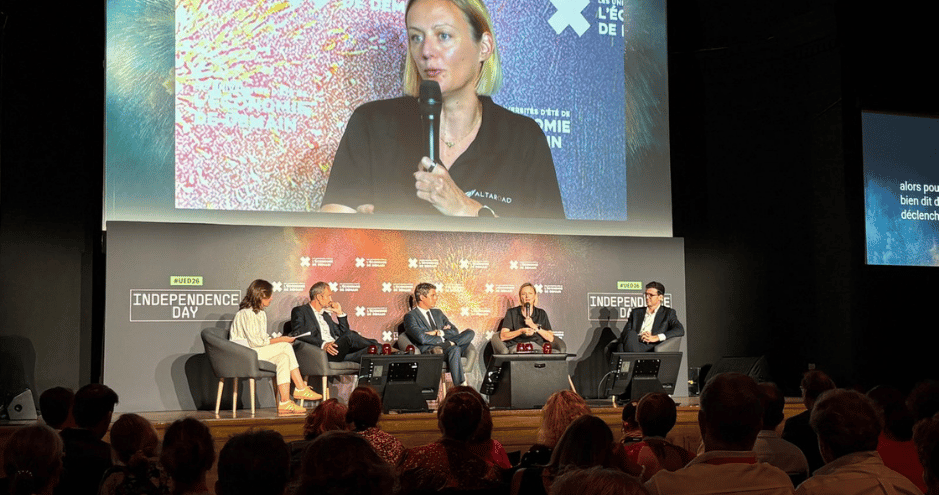
Several HEC Paris alumni also spoke throughout the day on very different topics. Among them, Cécile Villette (MBA HEC Paris), CEO and co-founder of Altaroad, took part in the major debate "AI: Chosen or Imposed Dependence?", focused notably on technological sovereignty and Europe's position in the development of artificial intelligence.
Hubert Baya Toda (MBA HEC Paris), founder and CEO of Leakmited, spoke at a session on cooperation between businesses and territories, addressing major challenges related to resources, infrastructure and adaptation.
Fatma Chouaieb, co-founder of Hello Charly and an HEC Paris alumna, brought her entrepreneurial experience to discussions on new business models and the social and solidarity economy. The program included her among the speakers of the session "Reinventing Business to Take Back Control."
Élisabeth Laville (H.88), founder of Utopies, took part in the debate on long-term finance, alongside representatives from banking, insurance and private equity, a topic that directly echoed the morning's discussions on companies' ability to invest for the long term.
Also among the speakers was Marie-Ange Debon (H.86), an HEC Paris alumna, who took part in the major debate "Building New Securities," devoted to the responses needed to address new economic, social and environmental vulnerabilities.
This presence, across very different profiles and sectors, illustrates the contribution of the HEC Paris community to the debates shaping the transformation of the economy: entrepreneurship, artificial intelligence, long-term finance, territories, impact models and business transformation.
For the HEC Paris Center for Family Business, this edition of the Universités d'Été above all served to highlight a conviction: in an environment that pushes companies to transform ever faster, the ability to think far ahead is a strategic advantage.
Learn more about the Family Business Center