
Three Students, Three Family Businesses, One Challenge: Listening
This summer, the Family Business Voices Challenge sent HEC Paris Summer School students back to their own relatives, camera in hand, with instructions to ask rather than assume. Family businesses are, by most accounts, badly understood by the people who inherit them: the balance sheet is legible enough, the reasoning behind it rarely is. Out of a strong field of entries, the jury retained three submissions.
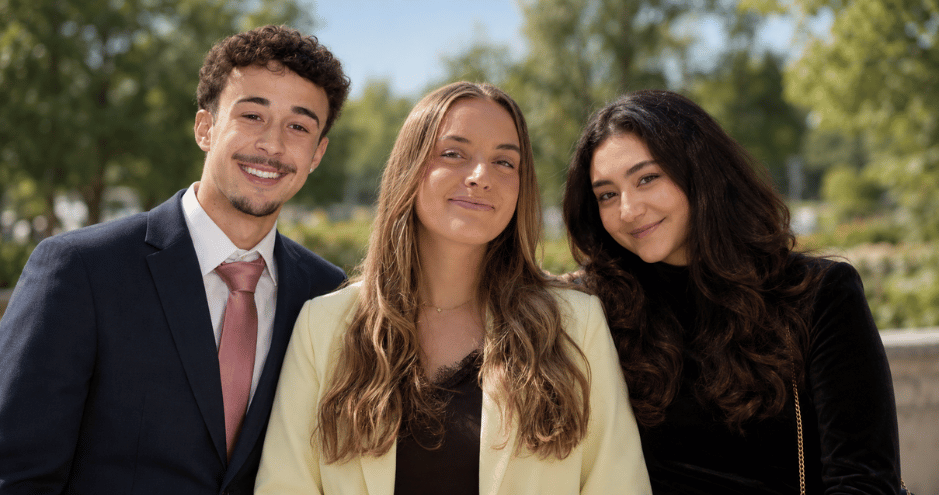
From left to right: Margaux Le Goff, Henrique Bernardes Rezende and Rita Saliba, the three students selected by the jury of the 2026 Family Business Voices Challenge, HEC Paris Summer School.
Family businesses are, by most accounts, badly understood by the people who inherit them. The balance sheet is legible enough; the reasoning behind it rarely is. That gap, between what a family enterprise looks like from the outside and what it actually took to build, was the premise of the Family Business Voices Challenge, which this summer sent HEC Paris Summer School students back to their own relatives, camera in hand, with instructions to ask rather than assume. Out of a strong field, three submissions stand out.
Henrique's was, in some ways, the most technically demanding: sitting across from close relatives, he had to steer the interview toward the pivotal moments of change rather than settle for the familiar version of the story. What his conversations with his godfather and uncles produced was not new information so much as structure, the connective tissue between episodes he had always known separately but never as a single account. An early setback that forced a generation into responsibility sooner than planned; the improvised governance that filled the vacuum; the slow work of turning sibling loyalty into something durable enough to survive decades of shared ownership. Drawing that out required exactly the kind of patient, well-sequenced questioning the jury singled out. "I would like to thank Family Business Center and HEC a lot for promoting this project," Henrique said. "It gave me the chance to sit down with my godfather and uncles and really listen to the story of our family business. I knew that they have such a rich story, but I couldn't imagine how rich it is."
Margaux's interview with Valérie Le Graët read less like a family portrait than a strategy memo. Her questions moved the conversation toward the mechanics of family-business strategic advantage, why territorial anchorage, diversification and a carefully chosen equity structure functioned as a hedge. That analytical discipline, judges noted, is what elevated the piece. "This is what makes family businesses such a fascinating object of study," Margaux reflected. "They operate on a fundamentally different time horizon, one shaped not only by financial performance, but also by continuity, responsibility, and the generations to come."
Rita's submission turned the camera on her own father. The result was the rare interview that used a business as the occasion for something more personal, highlighting the interfamilial dynamics that are both a strength and a heritage for family businesses, without losing its discipline as an interview. "I'm very grateful for the opportunity to meet a side of my father I had never known," she said, "to see who he was before I knew him as my father." Different subjects, different registers. That is precisely what the Challenge set out to reward, and their material will now feed directly into the Center's research on what allows family enterprises to last.