
From Zero Pharma Experience to Global Recognition: HEC Paris MBA Team Shines at Gilead Competition
From Zero Pharma Experience to Global Recognition: HEC Paris MBA Team Shines at Gilead CompetitionHow did two accountants, an industrial engineer, and a civil engineer, competing against seasoned scientists and doctors, take home a prize at the Gilead Sciences Pharma Case Competition?
According to the team, it came down to trust, extensive preparation, and strong team dynamics.
Akshay Agarwal, Ayushman Poddar, Anushka Puntambekar, and Shyama Sadashiv, all members of the HEC Paris MBA Class of 2027, had little to no experience in pharmaceuticals or life sciences. Yet they were motivated by both the challenge and the opportunity to deepen their understanding of the industry. It was also their first time participating in a case competition.
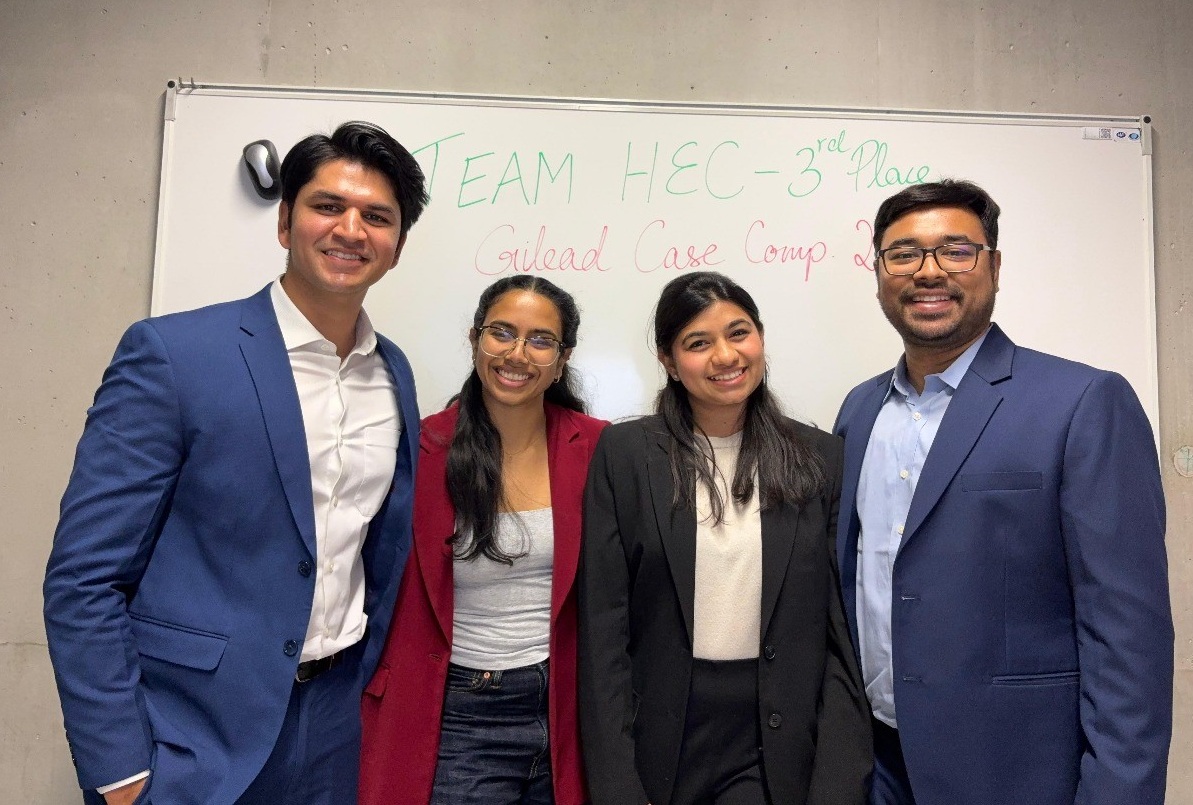
(L-R) Akshay Agarwal, Shyama Sadashiv, Anushka Puntambekar and Ayushman Poddar
The 2025 competition, now in its sixth year, is one of the largest healthcare case competitions in the world, attracting more than 130 teams from over 50 top universities—including several US Ivy League schools.
While The Wharton School secured first and second place, HEC Paris earned an impressive third-place finish and a $3,000 award. The jury included senior leaders from Gilead Sciences, such as the executive director of clinical trials and directors in clinical development, medical affairs, and beyond.
“I was interested in healthcare and looking for events on Handshake (HEC Talents’ internal recruiting platform),” said Akshay, former business finance lead with Philips MedTech and Co-President of Healthcare Club.
Shyama was particularly excited to compete head-to-head with leading US schools. She had researched previous Gilead Sciences competitions and was impressed by the diversity of cases, ranging from investment and sustainability to general strategy and health equity.
The four-person team had just two weeks to analyze the case by synthesizing a 40-pager case document and prepare a presentation outlining how a pharmaceutical company could pursue tuberculosis drug trials. Their work had to cover logistics, timelines, potential challenges, and strategies to mitigate risks. Their 20-slide presentation—produced during late nights squeezed between midterms and internship applications—placed them among the top five finalists invited to present live on Zoom in late November.
Despite the workload, “it never felt like additional work,” Anushka said. “Team dynamics were so important. We all respected each other’s schedules and divided tasks so that everyone could contribute meaningfully.”
Each team member became the designated expert on a specific topic—and then taught it to the others. “Everyone wanted to put their best foot forward, even though none of us were experts,” Ayushman explained.
The goal, Akshay added, was for all four members to have equal mastery of the material so that any one of them could confidently answer questions from the panel. This required multiple rounds of internal critique and practice. “Shyama is a bit of a workaholic,” he joked. “She would research at till 4 or 5 a.m., then teach us everything the next day.”
“You have to trust that you’ve chosen the right team members,” Shyama said. “Everyone can’t do everything.”
During the live Zoom presentation, the team had 10 minutes to present and 10 minutes for Q&A. Not once were they caught off-guard. Many questions mirrored the ones they had already discussed among themselves or with classmates. Shreya Pal (MBA ’27), a former research scientist in drug discovery, and Kazuhiro Yokoyama (MBA ’27), a professional with extensive experience in clinical trial development, provided additional support.
“It really wasn’t just us doing everything ourselves—it was about using our community,” Shyama added. “Whenever we faced challenges, teamwork and trust came in.”
During the live Zoom, each member answered the first question related to their section, giving others time to reflect and build on the response. It became more than a competition—it was a powerful learning experience.
“If you want to get the most out of your MBA and apply what you learn in class, you should do a case competition,” Shyama said. “It’s not a tradeoff; it enhances what you learn. You can’t fully understand it until you put it into practice.”