
 Geopolitics & Public Affairs
 Economics & Finance
- BRIC began as an investment acronym but became a political bloc challenging Western-led governance.
- The emergence of the T25 reveals a world defined more by transactions than convictions.
- Regional dynamics, like the Gulf’s engagement with Africa, are reshaping global geography beyond traditional alliances.
- Globalization’s cognitive map is no longer bipolar - leaders must navigate volatility without clear blocs.
There were BRIC nations and there was a G20. The Economist now talks about the T25. The labels that once clarified global realities keep expiring. The mental maps that guided strategy for decades (G7 versus emerging markets, West versus East) no longer match the terrain. Old categories dissolve faster than new ones form. The arc from the Mediterranean through the Gulf to India is a case in point. But it has no name - and that's precisely the point. How should business leaders navigate when the map never stops redrawing itself?
From Investment Acronym to Political Bloc
On September 11, 2001, as the twin towers burned, Jim O'Neill, then chief economist at Goldman Sachs, reached a conclusion that would reshape how investors understood the world: globalization would no longer be synonymous with the Americanization of the world. He ran the numbers on emerging markets. What he found was arithmetically straightforward: Brazil, Russia, India, and China were growing faster than the G7. The center of gravity of globalization would inevitably shift. These four countries would become essential engines of global demand, capital flows, and the transformation of international economic governance.
He needed a shorthand abbreviation. One of the most famous acronyms of the century was born: BRIC. The term was meant to capture an economic phenomenon: rapid growth originating from the non-Western part of the globe. But these four letters would also reshape how investors, policymakers, and strategists understood where power was heading: economics, as so often happens, was pulling politics behind it. To progress, O’Neill concluded, globalization had to open itself to non-Western populations and move beyond “dominant American social and philosophical beliefs and structures.” In this reading, politics merely reacted to economic transformations. The dynamic seemed inexorable: America’s unipolar moment would necessarily come to an end.
BRIC vs. G20: A Crisis of Global Forums
The 2008 recession tested that logic. The crisis revealed the limits of existing forums: the G7 had lost legitimacy and struggled to respond to a shock of such magnitude. Within months of the Lehman Brothers’ collapse in 2008, the G20 imposed itself as the reference forum, its members accounting for ninety percent of the world economy. Global governance had a new face, one that acknowledged the weight of emerging powers.

Yet this consecration of the G20 proved precarious. In June 2009, almost simultaneously with the London summit that established the G20’s primacy, the first BRIC summit took place in Yekaterinburg. The acronym was no longer merely a portfolio category for investors. Instead, it had become a political platform. Countries that had been grouped together for their growth trajectories were now coordinating as a bloc, asserting an alternative to Western-led institutions. The engagement of non-Western countries in globalization was acquiring a political dimension that pure economic logic could not fully explain.
Naming that group, it turns out, reshaped thinking. Writing about the influence of the BRIC acronym, the Financial Times’ Gillian Tett observed that O’Neill had redrawn “powerbrokers’ cognitive map, helping them to articulate a fundamental shift of influence away from the western world.” The label not only described a new global reality but also drove one. It suggested an East-versus-West split that seemed to clarify everything.
What followed would scramble that binary entirely.
Beyond BRIC: The Rise of the T25
The transactional language that now characterizes international relations proves compatible with a far wider range of countries than classic powers once cared to admit. Consider what The Economist called the “T25:” twenty-five largest non-aligned economies representing forty-five percent of the world’s population and eighteen percent of the global economy – that is, a loose category of countries rather than an institution. These countries did not impose sanctions on Russia after its invasion of Ukraine and seek to remain neutral in tensions between the United States and China. Their “ruthless pragmatism,” as the British weekly called it, stems from the fact that these powers no longer depend on the West exclusively.
India accords considerable importance to Washington’s security guarantees, especially in the framework of what is known as the Quad (which brings together India, the United States, Australia and Japan). This does not prevent New Delhi from trading with Russia or seeking dialogue with Beijing, its regional rival. New Delhi is reinventing the non-alignment that was its hallmark in the previous century. Saudi Arabia’s historical relationship with Washington has weathered many turbulences since the turn of the century, often pushing the Kingdom to seek allies in the East, China foremost among them. Yet Riyadh remains a key actor in Western strategic concerns, from the Middle East to Ukraine. Instead of unraveling, these relationships are becoming fluid in ways the old categories cannot capture and call, yet again, for a new cognitive map.
From the Mediterranean to India: A Case Study of A Region Without a Label
This cartographic confusion is not confined to global forums, as it now shapes regional dynamics and the very contours of globalization as well.
Consider the arc from the Mediterranean to the Gulf.
Israel’s recent decision to recognize Somaliland has fractured the map in ways that were not entirely unpredictable but remain unprecedented, touching a coastline that overlooks the Bab el-Mandeb chokepoint and some of the busiest trade routes between Europe and Asia.
The fractures did not fall along traditional lines. Morocco, the UAE, and Bahrain (Israel’s major partners in the Abraham Accords) did not publicly disavow the recognition. By contrast, Saudi Arabia, Qatar, and other Gulf and Arab states explicitly condemned the decision as a violation of Somali sovereignty and a dangerous precedent for secessionist movements.
Why We Need a New Cognitive Map, Again
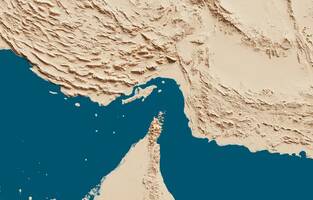
There is no single political or ethnic variable that explains these alignments. Instead, a changing vision of geography is transforming the calculus of key regional actors: a more accurate political reading of geography would now stretch from Greece to the Horn of Africa, from the Mediterranean to Iran, and perhaps to India. Gulf capitals have spent the past decade projecting power, capital, and security partnerships across this arc, from ports and bases in the Red Sea to infrastructure investments tying the Arabian Peninsula more tightly to Africa’s northeast. For Saudi Arabia, Qatar, the UAE, and others, this space is increasingly a single, Gulf-centered strategic system in which the Red Sea, Arabian Sea, and eastern Mediterranean are stitched together.
This emerging geography includes both Western and non-Western powers. The region has a new architecture. It does not yet have a new name. But names shape how we think, and globalization’s cognitive map keeps redrawing itself, leaving business leaders who cling to yesterday’s acronyms at risk of misreading where volatility and opportunity now lie.
Learn more in Professor Olivier Chatain's article: "Why Business Schools and Businesses Need a Geopolitical Reset".

 Strategy & Leadership

 Sustainability & Society