


 Geopolitics & Public Affairs
 Strategy & Leadership

- The geopolitical environment has shifted in ways that invalidate many Western assumptions about trust, shared values and predictable interdependence.
- For companies, security is no longer a background condition: it has become a stakeholder expectation, alongside performance and responsibility.
- Business schools can add value by integrating disciplines that rarely talk to each other and help business leaders build the reflexes to anticipate shocks. HEC Paris’ new Lab for Business & Geopolitics builds around this premise.
This article introduces an upcoming special Dare edition devoted to HEC’s commitment to geopolitical issues which are impacting the world of business in unprecedented ways.
A decade ago, executives could treat geopolitics as background noise: something handled by states, occasionally surfaced by sanctions, and largely separated from day-to-day strategy. That separation no longer holds. From supply-chain chokepoints and payment rails to data governance and industrial policy, the structures that make markets run have been turned upside down. They’ve become tools of power. For companies, the challenge is not only to react faster, but to rethink what they assumed was stable.
A world that won’t “snap back”
The Western business environment of recent decades was shaped by a largely implicit bargain: deep trade and investment ties rested on an expectation of trust, converging interests, and a minimum of shared rules. That bargain has been shattered - sometimes abruptly, sometimes gradually - by strategic rivalry, weaponized interdependence, and a return of coercive state power into domains once assumed to be purely commercial.
The uncomfortable implication is that many decision-makers are learning in real time. Few leaders have spent their adult lives in an environment where cross-border economic relations could be turned against firms with little warning. The temptation is to cling to older frames - because they are familiar and reassuring - but the priority is to recognize that the environment is structurally different. The goal is not pessimism; it is clarity and modesty about what can no longer be taken for granted.
What a business school can add
In this context, the value proposition of a business school like HEC Paris is to do three things that organizations often struggle to do internally. First, to integrate perspectives that are usually siloed. Political scientists, economists and sociologists often work in parallel; executives receive fragmented advice as a result. Business schools are positioned to convene these disciplines and make them engage with the organizational realities of firms - the channels through which risks propagate and the constraints under which leaders decide.
Second, the school is there to help leaders assess expertise. When geopolitical risk becomes a top concern, an “expert market” appears which is crowded, uneven, and sometimes agenda driven. Academic institutions can offer a more rigorous filter: not by claiming certainty, but by evaluating the quality of arguments and evidence, and by making disagreement productive rather than paralyzing.
Third, to cultivate reflexes. Many geopolitical failures occur not because information is absent, but because warning signs are not recognized as strategic and therefore are not escalated. Teaching, case discussion and simulation can help executives and future leaders spot patterns that do not appear on standard KPI dashboards, and to pause when a decision that looks ‘routine’ may carry geopolitical exposure.
These three features are being integrated in HEC’s drive to expand its geopolitics courses into a fully-fledged laboratory on geopolitics. As its Dean told the Times Higher Education in February/ "Incorporating a deeper understanding of how global political changes can affect businesses is integral to remaining a leading business school, especially as global supply chains, economic sanctions and decisions by leaders such as the US president can have a direct impact on how businesses operate."

Security becomes a business responsibility
Why is security so vital? Well, in today’s geopolitical setting, the notion of what firms owe their stakeholders expands. Companies have long been expected to create value, manage risks, and act responsibly toward employees, customers and communities. But security (of operations, data, payments, and even the continuity of employment) has moved from an assumed public good into a central expectation. This is not limited to defense, energy or critical infrastructure. Any sector can find itself exposed when a geopolitical dispute runs through logistics, finance, technology, standards or regulation.
The first practical step is therefore diagnostic: mapping dependencies with more precision than conventional risk dashboards allow. That includes supply chains and industrial inputs, but also financial networks, digital dependencies and infrastructure layers that rarely feature in strategic discussions until they fail.
From mapping to action: building options and keeping lines open
Mapping is only the beginning. Once dependencies are visible, organizations must decide which ones are acceptable, which ones require mitigation, and where new options must be created. In some domains, scale will matter. Alternatives to dominant infrastructures - particularly in digital domains - often require market-building efforts that no single firm can carry alone. That creates a space for collective action by industry, coordination with public authorities, and experimentation with new market designs that make strategic options both available and viable.
At the same time, firms are increasingly social forums: employees and customers expect them to take part in debates that affect security, values and international exposure. The resulting dialogue is not mere communications management; it is part of governance. It also connects to a longer-term idea: even in a fragmented environment, many ties are not broken, they become more adversarial. Businesses can help keep channels open, sometimes by participating in forms of informal, non-governmental dialogue that complement official diplomacy. Historically, the courageous contributions by key South African business leaders in ending apartheid peacefully in the late Eighties illustrates the impact of such behind-the-scenes negotiations and it is still cited 40 years later. It helped pave the way to an unprecedented democratic transition and avoid a worst-case scenario.
Why ‘boring’ infrastructure can become strategic
A useful way to see the new reality is to focus on infrastructures that once looked like neutral utilities. Payment systems are a case in point. In normal times, the only requirement is reliability: cards swipe, transfers clear, settlements occur. Yet behind these everyday actions by firms and individuals the sector’s economics relies on a narrow set of providers. And those providers are themselves subject to political pressure. The ability to operate can become contingent on decisions taken far from the firm’s control.
This flips a familiar managerial instinct. Procurement once focused on price, efficiency and the assumption that a deep market of substitutes existed. The new environment requires a different question: can the firm secure credible second options that will not respond to the same pressures at the same time? In other words, resilience is not only redundancy; it is political diversification.
The trap of projecting your own rationality
Another recurring failure is the tendency to assume that partners and competitors define interests in the same way. One emblematic pattern can be seen in global manufacturing relationships. Even when firms negotiate aggressively and diversify suppliers, they may miss that counterparties are playing a different game - one centered on long-term learning and capability-building rather than immediate profit. Local authorities may support that long game as part of broader industrial or strategic objectives. The result is that a firm can win short-term bargaining battles while becoming more dependent in the long run.
A documented illustration is Apple’s experience in China in the 2010s. It wasn’t that Apple failed to negotiate hard in these pivotal years. It did what sophisticated firms do, constantly pitting suppliers against each other and maintaining second sources. The blind spot was assuming everyone was playing the same game. Some Chinese suppliers were willing to work at near-zero profit because their objective was long‑term learning: absorbing capabilities that would later be difficult to replicate elsewhere. Local authorities had reasons to welcome that dynamic, as it supported the development of indigenous capabilities. The result is strategic lock‑in: once a company’s critical supplier ecosystem is concentrated in one country, exiting becomes far harder than standard sourcing logic suggests. Similar mismatches in priorities underpinned many Western companies misinterpretations (or lack of) of Russia in the past 15 years.
The broader lesson is that commercial logic is no longer a reliable guide to intent. Strategy must incorporate how political regimes, societal priorities and state objectives reshape incentives. That does not mean treating every relationship as hostile; it means doing due diligence with the assumption that rationalities can diverge - and that divergence can be consequential.
 Find out more
From conversation to capability: building the Lab
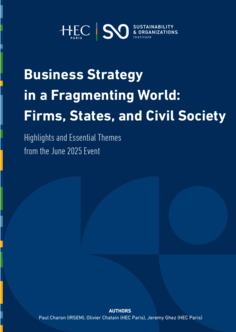
The Lab for Business & Geopolitics is being designed as a platform for that kind of capability-building: convening research, teaching and structured dialogue with business and civil society. Recent initiatives have already tested the approach, including a major convening in June 2025 that brought together different communities to address how economic ties can transmit coercion as well as value.
The next steps focus on programming that can sustain the conversation and translate it into tools: a new conference format, seminar series that connect geopolitical questions to business realities, and teaching that brings these issues into the classroom. Partnerships matter here, both within HEC, including work that intersects with technology and AI. And externally with institutions that can broaden comparative perspectives across countries.
International partnerships, long a hallmark of business education, take on a sharper purpose in this new setting. Exchanges are not only about exposure and experience; they become opportunities to build shared understanding of how integration can create prosperity - and how it can also create vulnerability. The aim is to educate students and executives to navigate both sides of that equation.
A subtle but urgent mandate
Geopolitics is now a management problem because it is an environment problem. It shapes the availability of inputs, the reliability of platforms, the legitimacy of operations and the durability of partnerships. For businesses, the choice is not whether to engage, but how: whether to drift from shock to shock, or to rebuild the concepts and capabilities that allow strategic autonomy without abandoning values.
The Lab for Business & Geopolitics’ ambition, ultimately, is to help leaders make that shift in perspective - moving beyond checklists toward a deeper, more realistic understanding of interdependence. In a world where the mirror has been shattered, the task is not to pretend it can be restored as it was, but to learn how to operate safely with the reflections we have.
Learn more in Professor Jeremy Ghez's article: "Can Leaders Still Rely on the Old Global Playbook?".
Article written by Daniel Brown.



 Economics & Finance


 Sustainability & Society