

 Innovation & Entrepreneurship
 Sustainability & Society
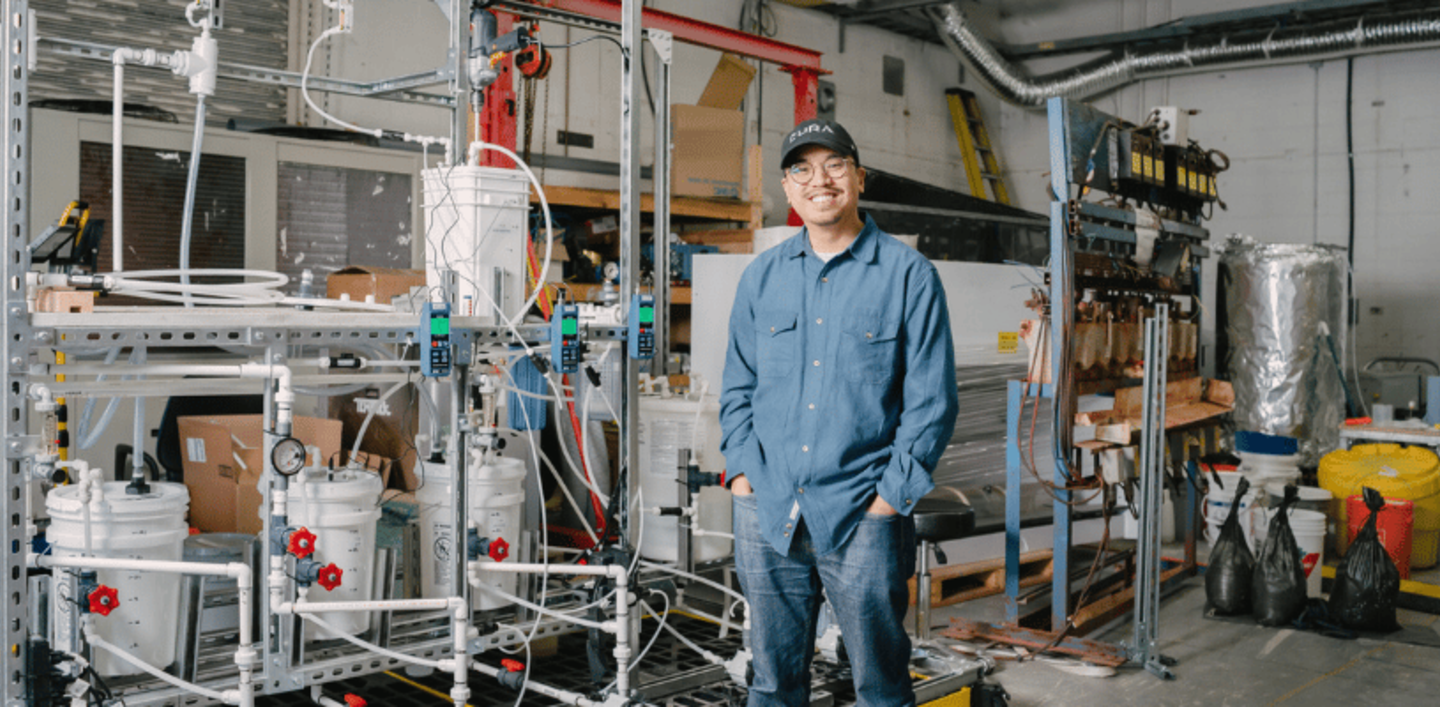

Cement is the second most consumed substance on Earth after water and it is also the largest industrial source of CO on the planet. Decarbonizing it is one of the defining₂ technical challenges of the century, and one that resists almost every shortcut climate tech has tried so far.
The startup Cura Climate, based in Canada and co-founded by Erin Bobicki, Sabrina Scott, and Phil De Luna in 2025, takes a different angle. Part of the CDL-Paris Climate stream, the startup is commercializing an electrochemical process developed at the University of British Columbia in Curtis Berlinguette’s lab. This technology can reduce CO₂ emissions by up to 85% while operating with lower energy use and cost.
Rather than developing a new type of cement, Cura Climate focuses on integrating its solution into existing cement plants. Its system is designed to retrofit current manufacturing operations, enabling major industry players to decarbonize without rebuilding infrastructure. This retrofit-first approach, improving what already exists rather than replacing it, is central to the company’s strategy and narrative.
The Problem
The cement industry is responsible for about 8% of global CO emissions₂, and it is also, by Erin Bobicki's own description, "very risk-averse" and "very conservative" and not without reason: Cement is all around us, it is the foundation of everyday life: "This is about our safety, our kids, our families.” To de-risk and certify a new cement material takes about 50 years on average. The result is a paradox: a massive climate footprint sitting inside an industry that resists change almost by design. Nearly every attempt at clean cement has run into that wall.
Supplementary cementitious materials only displace part of the cement in concrete and leave the binder problem untouched. Silicate-based cements require new mines, and U.S. permitting alone runs an average of 29 years. The only truly available option today: point- source carbon capture and storage, multiplies the cost by three to four times, according to Cura Climate's industry partners.
And in some communities, like the Alberta plant the founders visited, residents do not want amine-based capture on site. The problem is that none of the existing ideas can be deployed today at scale, and at a cost the market will absorb. This is one of deep tech founder's recurring dilemmas: the bigger the problem, the more entrenched the system. A breakthrough in the lab means little if the industry it targets cannot, or will not, adopt it. Cura Climate's first strategic decision was to take that reality as a given and design backward from it.
The Solution
Cura Climate's electrolyzer produces acid and base through a proprietary chemistry that runs at roughly one-third the voltage of a standard hydrogen electrolyzer, slashing both energy consumption and production cost. Unlike carbon capture bolted on at the end of the process, the technology intervenes at the pre-calcination stage, enabling to reduce CO₂ emissions by up to 85%.
Critically, it requires no new mines, no alternative binders, and no new infrastructure; it integrates directly into existing cement plants and supply chains. And rather than disrupting an industry worth hundreds of billions, the business model is built to serve it: Cura licenses or deploys its technology with cement producers, positioning decarbonization not as a regulatory burden but as a cost advantage.
Discover the startup
Key Figures
- 8% of global CO₂ emissions come from cement
- $480B to ~$800B projected global cement market by 2050
- 50 years average time to certify a new alternative binder
- Up to 85% reduction in CO₂ emissions targeted for partner plants
- One-third the voltage of a standard hydrogen electrolyzer
- 6 MOUs already signed
How They Did It
Cura Climate is a spinout from Curtis Berlinguette's research group at the University of British Columbia (UBC), where the core electrochemical technology was originally developed. The startup operates under a strategic license from UBC, with sub-licensing rights, and sits at the intersection of three trajectories and disciplines: The three founders each came from hard science and crossed into business via different routes. Erin did it through a first startup (Aurora Hydrogen, 2021), an EMBA at HEC Paris, and four previous pilots that gave her hands-on scale-up experience. Phil did it through McKinsey, a Carbon XPRIZE finalist company, directing a program at Canada's National Research Council, and building Deep Sky — he describes the science-to-business transition as feeling "natural," driven by developing emotional intelligence alongside technical rigor. Sabrina did it the most directly, straight from post-doc bench to COO, guided by a desire to see chemistry have tangible, visible impact. She frames it strikingly: "One day I want to go down the street and say, 'This home is built with Cura cement.'"
Like the company itself, Phil De Luna believes the most impactful solutions emerge at the intersection of disciplines rather than from decades of narrow specialization. “Throughout all of my experiences, what I've come to realize is that impact happens at the interface of disciplines. A lot of times, traditionally, people think that impact comes from experts who spend decades and decades on one problem. But solving problems today is so complex, it's the people who can bridge between disciplines who actually come up with really interesting solutions."
The Creative Destruction Lab connection gives Cura access to mentors who, as Phil puts it, for some of them, have "scars they've collected" from building deep tech companies, which is precisely what a team of scientists-turned-founders needs at this stage. They chose CDL-Paris specifically to facilitate access to European cement producers facing intense regulatory pressure to decarbonize, and it is already generating investor and customer pull.
What's Next?
Being launched in late 2025, Cura Climate is still in build mode, but has made significant progress since enrolling in Crea. Back in September 2025, ahead of the December CDL session, the team laid out three clear objectives for the period ahead.
- Close the seed round: Cura is focused on identifying lead investors and securing signed term sheets, looking for partners who will stay through the scale-up, rather than simply raising capital.
- Run customer interviews and secure signed EOIs: Cura is focused on finding where the traction is across its business model, with a goal of converting early interest into milestone-based MoUs (Memorandum of Understanding) and off-take agreements that are non-binding if the team is unable to deliver.
- Validate the science at industrial relevance: Cura plans to set up a dedicated lab outside the University of British Columbia and to partner with operators of small-scale high-temperature kilns to validate that its cement meets ASTM (American Society for Testing and Materials) standards as ordinary Portland cement.
Since then, the results speak for themselves: In April 2026, Cura Climate received a €860K grant, signed six MoUs with cement producers and project developers, and is actively hiring nine people. A strong signal of early momentum for a startup launched less than a year ago.
Beyond that lies the larger market: Cement consumption is set to roughly double in India, Africa, and Southeast Asia. These regions will build the next century of infrastructure, and they will do it on whichever cement is cheapest, most available, and acceptable to the communities being built. The developed world has a responsibility to de-risk these technologies so emerging economies can leapfrog the constraints the Global North spent a century locking into place.