

 Tech & AI
 Innovation & Entrepreneurship
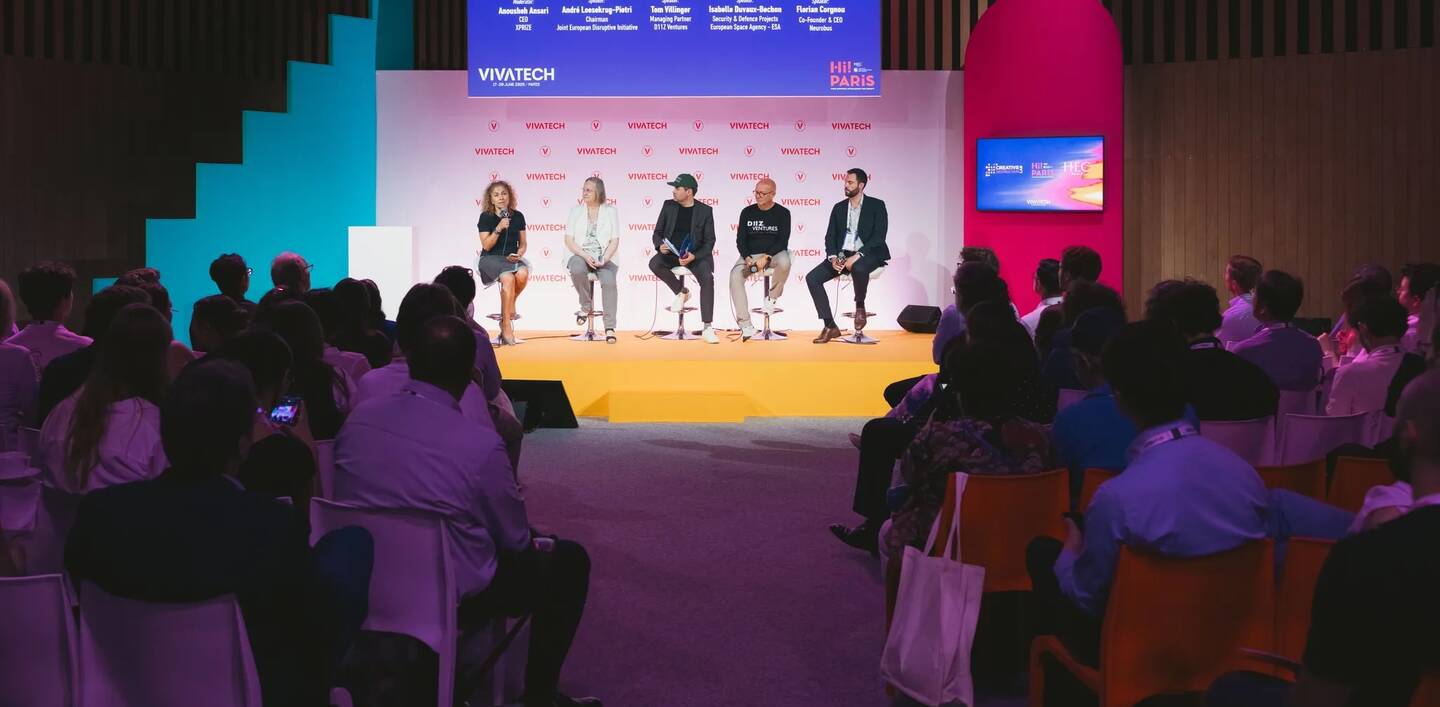

When an AI chatbot makes something up, the stakes are usually low. When a machine acting in the physical world does, they are not. "If your GPT hallucinates… no harm, no foul. But if your robots hallucinate and kill someone… that's real physics," said Abdelalim El Hamichi, CDL-Paris AI Lead, setting the tone for a HEC Paris workshop at VivaTech devoted to a fast-emerging frontier: physical AI and its dual-use dimension. Dual-use means a single technology can serve two purposes at once: a civilian one and a defense one. The technology itself is neutral, what changes is who uses it and why.
Co-organized by the HEC Paris Innovation and Entrepreneurship Institute through the HEC Paris Deep Tech Center, the Creative Destruction Lab (CDL) along with Hi! PARIS, the session brought together investors, founders, as well as space and defense specialists around the theme “Dual-Use & Defense in the Age of Physical AI”. Moderated by Anousheh Ansari, CEO of the XPRIZE Foundation and the first self-funded woman to have travelled to space, the central question was blunt: as AI leaves the screen for the real world, how Europe, rich in research and talent, can turn that advantage into industrial and strategic impact before others do?
- Physical AI moves intelligence into robots, drones and satellites, where mistakes have physical consequences.
- Defense and space act as testing grounds for dual-use, exposing AI's hardest reliability challenges.
- Europe leads in research and talent but lags the US and China on funding, scaling and deployment.
- Speakers urged focused "calculated bets," faster procurement and more appetite for risk.
When AI leaves the screen
For years, artificial intelligence has largely lived on screens: generating text and images, writing code, automating workflows and accelerating digital tasks. Physical AI changes the setting. It brings intelligence into the real world, through robots, drones, autonomous systems, satellites and intelligent devices already finding applications in logistics, energy, manufacturing, healthcare and defense.
For Vincent Rapp, Executive Director of Hi! PARIS, the decisive challenge is no longer whether these systems can work, they will. The real challenge lies in integration: the ability to embed them into organizations, operations and decision-making processes. In that context, value depends less on technological performance alone than on the confidence these systems can inspire. Trust becomes the condition for adoption, and when AI acts in the physical world, that requirement reshapes the engineering itself.
A robot, a drone or an autonomous device cannot always afford to wait for data to travel to a distant cloud server and back. It must often perceive, decide and react locally, in real time, with limited connectivity and constrained energy resources. This is where Edge AI becomes essential: artificial intelligence that runs directly on the device, at the “edge” of the network, rather than relying on remote cloud processing. By keeping computation close to where data is produced, Edge AI reduces latency, improves resilience and limits the energy spent transferring information.
That is precisely the challenge addressed by Neurobus. The startup develops Edge AI systems that allow machines to perceive their environment and act on it in real time, using neuromorphic architectures inspired by human biology to reduce both energy consumption and response times. On a small First Person View drone with roughly fifteen minutes of autonomy, computing onboard rather than sending data back and forth can make the difference between reacting in time and not reacting at all.
 Find out more
Why defense entered the conversation
The organizers were careful to frame the discussion. This was not a session about defense, insisted Inge Kerkloh-Devif, Senior Executive Director of the HEC Paris Innovation and Entrepreneurship Institute: historically, innovation has emerged through dual-use dynamics, and physical AI is likely to follow the same trajectory. Defense simply exposes the hardest problems of physical AI: autonomy, resilience, energy efficiency, operation at the edge with limited connectivity, and very high standards of safety and reliability.
The stakes are already concrete. André Loesekrug-Pietri, who runs the Joint European Disruptive Initiative (JEDI), pointed to Ukraine, where automated systems now detect 90% to 95% of incoming drones. Drones, he noted, represent only 2% to 3% of the Ukrainian army yet account for 60% to 80% of the attrition inflicted on Russian forces. For him, the next leap will come from embedding AI more deeply into hardware. Unlike pre-trained models operating at a distance from the physical world, embodied AI systems can learn from feedback loops generated by real environments. In defense, as in industry, energy or logistics, that shift could significantly expand the impact of artificial intelligence.
Space and the 30-minute dream
Space offers a longer perspective on both physical AI and dual-use. Isabelle Duvaux-Bechon, scientist and consultant on security who spent 38 years at the European Space Agency (ESA), observed that space has relied on physical AI for years; a probe sent to a comet cannot wait for instructions to travel back and forth. Dual-use, too, has existed from the start: weather forecasting, launched with the first Meteosat application satellite in 1977, has always served both civilians and armed forces. What has shifted is explicit, as she quoted from a resolution signed by ESA member states last November: "The member states of ESA recognize that ESA's intergovernmental framework provides the credentials and tools for developing space technologies and defense, including for security and defense."
It was, she noted, the first time the word "defense" appeared in such a document from the member states. The ambition it unlocks is the ERS program (European Resilience from Space), a system for the acute phase of a crisis, from natural disasters to border emergencies. The dream: less than 30 minutes between an operator's request on the ground and the delivery of data, imagery or a telecom link. A first demonstration is planned for 2028, with an initial resilience node likely in Poland, drawing on 23 member states plus associates and Canada. ESA, she stressed, is forbidden from placing armament in space, its remit remains peaceful purposes.
Europe's real gap: Money and speed
If the talent exists, why does Europe struggle to lead? For investor Tom Villinger, founding partner of D11Z Ventures, the answer lies in the money. Software and generative AI companies show results within a year or two, making early-stage funding straightforward. Physical AI, dual-use and defense are a long-haul bet, ten to fifteen years, that demands far more capital. Europe can back companies through their earliest rounds but cannot carry them to scale, he argued, and too often they leave the continent for the US:

His prescription: a pension-fund system, co-investment with corporates and family offices, and lessons drawn from the US and Israel. The recent 1.4-billion round raised by German robotics company Neura, he added, came 80% from the US.
André Loesekrug-Pietri pushed back on the cliché that Europeans are risk-averse, plenty take risks in Silicon Valley and European savings flowed into SpaceX's IPO. The real problem, he argued, is a reluctance to make big, calculated bets, and a habit of missing leapfrog moments: Europe missed the transformer that reshaped search, and missed the efficiency breakthrough of DeepSeek, so close to European values of frugality.

Fragmentation compounds it: "French tech," "German tech," a single market that remains, in his words, an illusion, with national watchdogs adding friction and little value. Europe, he said, has too many managers and not enough leaders.
Florian Corgnou urged a harder look in the mirror. If this is a race against China and the US, Europe must honestly weigh its strengths and weaknesses. Talent is real, but, as he put it, "hard work will beat talent, 100% of the time." Hard work plus capital wins.
What Europe could do in the near future
Asked to name the single tangible action that could make the biggest difference over the next twenty-four months, the panel converged on two imperatives: focus and speed. Not a scatter of initiatives, but a handful of decisive moves.
For Isabelle Duvaux-Bechon, the most promising first step is to prove capability through action. Europe could stand up a first operational crisis-response node: an integrated platform that brings together, in real time, Earth observation, telecommunications, positioning, drones and verified data. The opportunity here is concrete: When a natural disaster, a health emergency or a conflict strikes, much of the value comes not from holding these capabilities separately (Europe already has them in abundance) but from orchestrating them instantly into a single and reliable system. Demonstrating that power of integration could do more to build confidence than many years of smaller separate pilots.
André Loesekrug-Pietri suggests going further on speed. He points to the COVID vaccine, developed in roughly eight months, as an encouraging reminder that when political will, resources and urgency align. His suggestion is to complement broad-based funding with a sharper concentration of resources on a small number of goals that anyone can grasp, the public included. Three examples bring the idea to life: a robot able to run 50% faster than the fastest finisher at the latest Beijing marathon, a positioning system ten to a hundred times more accurate than GPS, and the ability to refine critical materials on European soil without environmental damage. Their shared strength is that they are concrete, measurable and galvanising, the kind of clear objective that funding, talent and industry can readily rally around.
Tom Willinger offers an encouraging signal from the market: large corporations and investors are beginning to move into physical AI. That shift matters, because it means momentum need not rest on public impulse alone. Private capital, understandably cautious about technologies that blend hardware, software and real-world deployment, increasingly sees fertile ground there, which bodes well for turning scientific breakthroughs into durable industrial sectors.
Florian Corgnou highlights procurement as an area with real room to help. Faster, more agile purchasing could keep better pace with innovation and give European solutions more space to scale. He also suggests deepening ties with ecosystems that innovate quickly and under pressure, Ukraine and Israel among them, where operational urgency naturally compresses the cycles of design, testing and adoption. He also encourages a collective openness to taking risks, recognising that the freedom to experiment and to learn from what doesn't work the first time is part of how bold ideas mature.
A single thread runs through every answer and it is an optimistic one. Europe's real strength is invention: the labs, the patents and the talent are all there. The opportunity lies in connection: turning research into prototypes, prototypes into startups, and startups into fast deployment. Strengthening each of these junctions, with well-timed funding, responsive procurement and space to experiment, is where the greatest gains now sit. As Anousheh Ansari summarized in closing: focus, pick strategic lanes, move fast, procure, innovate and invest. Whether Europe can do that in time is the question physical AI now forces it to answer.
Sources
This article is based on the HEC Paris VivaTech workshop ““Dual-Use & Defense in the Age of Physical AI”, co-organized by the HEC Paris Deep Tech Center, CDL-Paris and Hi! PARIS Center during VivaTech 2026. Learn more about HEC Paris presence at VivaTech this year.

 Sustainability & Society