


 Innovation & Entrepreneurship
 Sustainability & Society


In September 2026, the European Commission proposed the European Innovation Act, designed to help European innovations move more effectively from research to market and scale across borders. It also proposed common principles for regulatory sandboxes, while other recent policy and market mechanisms aim to improve startups' access to research and experimentation infrastructures, and mobilize more capital for Clean Tech scale-ups.
Together, these initiatives address a familiar European challenge: the continent has world-class science and significant innovation capabilities, yet translating them into technologies deployed at scale remains difficult. But the presence of finance, infrastructure and regulation make up only parts of a functioning ecosystem that allow Clean Tech venture to scale and diffuse.
- Deep Tech and Clean Tech are central to Europe’s strategic transformation
- Strong innovation ecosystems are essential for scaling Deep Tech and Clean Tech
- Experimentation spaces are critical enablers of innovation and still emerging in innovation strategy
- The level of maturity across European ecosystems and experimentation spaces differ, reinforcing the need for intermediaries specialised in science-based venturing
- Policy support, market intelligence and cross-border collaboration drives ecosystem success.
Clean Tech, a subset of Deep Tech, focuses on technologies and business models that reduce environmental impact, industrial toxicity, and drive solutions for climate resilient and net-zero futures. Accelerating the scaling and deployment of Clean Tech is a key driver of the EU’s strategy to become the first climate-neutral continent by 2050.
FINEX, a Horizon Europe project, aims to support the quick deployment and uptake of Cleantech solutions. Its research was conducted across Finland, France, Estonia, Latvia, Lithuania, Bulgaria and Cyprus, in four Clean Tech priority areas: energy, mobility and transport, the built environment, and governance and data. Its findings suggest that the strength of innovation ecosystems lies in how effectively their different assets are connected.
A region can have excellent universities, sophisticated testbeds or living labs, ambitious startups, public funding, venture capital and supportive policymakers, and still struggle to turn scientific breakthroughs into scalable businesses.
For leaders responsible for Deep Tech and Clean Tech ecosystems, this raises a different question. Beyond asking "What resources do we have?", they also need to ask: "What can an innovator actually do with them?"
Can a venture find the right testing facility? Access it? Move from prototyping to real-world experimentation for scaling? Navigate regulation? And if the capability it needs does not exist locally, can it find it elsewhere in Europe?
This also points toward a larger opportunity: Europe does not necessarily need every region to develop the same capabilities. It needs to make its distributed capabilities easier for innovators to discover, access, combine and reconfigure.
What is an Innovation Ecosystem?
Innovation ecosystems are often described by their components: universities, startups, accelerators, investors, corporations, laboratories and public institutions. But a list of institutions and actors is not yet an ecosystem. A functioning innovation ecosystem requires a cohesive interaction between all its parts to support ventures as they move through different phases of development.
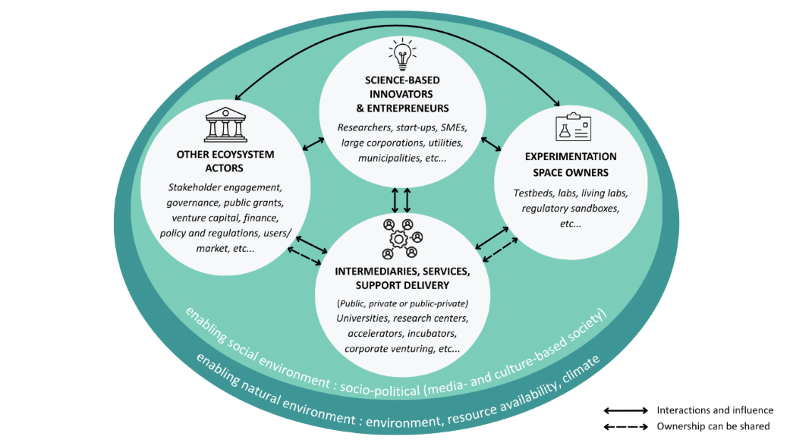
Innovation ecosystem actors, from the FINEX report.
Consider a startup that needs to test a technology at scale or in a real-world setting. The appropriate facility may already exist, but in another region or country. Perhaps the startup does not know about the available infrastructure, or the facility is not connected to the accelerator supporting the venture. Perhaps financing is available elsewhere, while regulatory requirements remain difficult to navigate.
The building blocks are in place. The challenge is turning them into a connected ecosystem.
FINEX research illustrates this point. Its Resource Catalogue, developed by HEC Paris with project partners TalTech, University of Cyprus and 28Digital, identified more than 70 facilities across the seven participating countries, spanning Technology Readiness Levels 2 to 9, and including smart grids, AI laboratories, hydrogen testbeds, and more. Yet the research found that some facilities remain predominantly locally bound or underused by wider national or European networks.
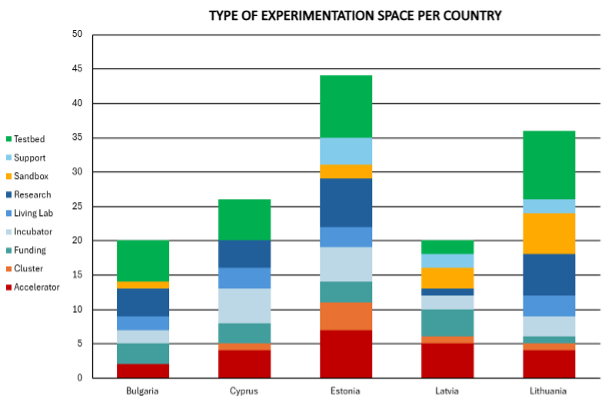
Type of experimentation space per country.
For ecosystem leaders, this changes the starting point.
Before asking "What should we build next?", it may be equally important to ask "What do we already have, and who can actually access it?"
 Find out more
Connecting the lab with the market
At some point, Deep Tech has to leave the laboratory and encounter the real world. Where testbeds allow innovators to develop and validate prototypes (early-stage experimentation), living labs provide environments for testing technologies in real-life settings with users and stakeholders, and regulatory sandboxes allow controlled experimentation under a regulator’s supervision when existing rules may not yet be adapted to an emerging technology (late-stage experimentation).
FINEX findings suggest that despite the presence of world-class experimentation spaces across all countries, their maturity and connectivity are unevenly developed. A small survey of 15 ecosystem actors within the project, found incubation and acceleration services to be more institutionalised, while sandboxes and living labs were generally less mature or connected to the ecosystem.
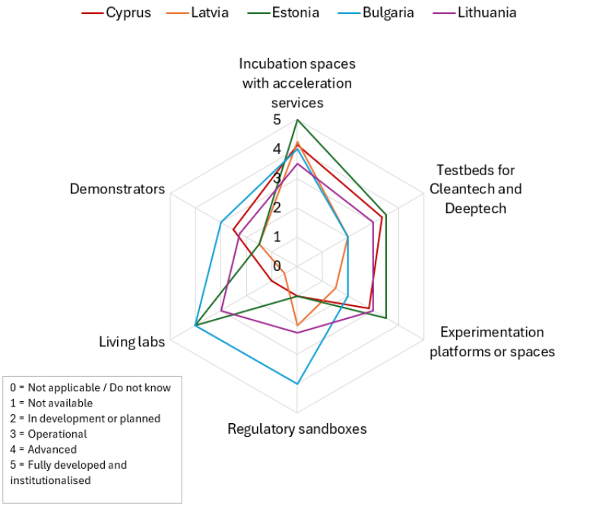
Experimentation space maturity for Clean Tech / Deep Tech. Based on data from a FINEX survey of ecosystem actors, results based on the average of 1-5 answers per country.
The sample is too small to compare national ecosystem maturity. But it raises a useful question: are we as good at helping science-based ventures test and demonstrate technologies as we are at helping them start businesses?
Late-stage experimentation also reveals obstacles that cannot be identified in the laboratory. A mobility-as-a-service initiative examined through FINEX in Latvia, for example, encountered fragmented regulatory responsibilities across different levels of government. In Cyprus, digital-twin experimentation encountered fragmented data availability and institutional capacity.
These pilots work with different technologies and contexts, but the common challenge is that technology can be ready to progress while the surrounding ecosystem is not.
Experimentation as a tool for regulatory change
Experimentation can do more than demonstrate whether a technology works. It can help institutions understand what needs to change around it and become co-learning systems.
France provides one example. Its Energy-Climate Law created a framework allowing the French Energy Regulatory Commission (CRE) to grant temporary regulatory exemptions for energy innovation projects, that are monitored, evaluated and provide lessons for regulatory change.
Elsewhere, Lithuania's National AI Sandbox and Finland's Regulatory Energy Sandbox also combine supervised real-world testing with regulatory guidance and learning, to help technologies, markets and regulations learn together.
This idea has become particularly timely. The European Commission's September 2026 proposal for common principles for regulatory sandboxes seeks to make their use more consistent across the EU. Its recently adopted Charter of Access also aims to make facilities such as advanced laboratories, pilot lines and other technology infrastructures easier for companies to access.
The challenge now is to connect these instruments to the wider ecosystem around the venture.
The ultimate connectors: Intermediaries
Universities, accelerators, incubators, science parks, clusters and specialized support organizations can help ventures find testing facilities, understand regulatory requirements, access expertise and financing, build relationships outside of their immediate networks, and help build trust and shared agendas between actors in the ecosystem.
Intermediaries play a connective role that is less visible than a laboratory or testbed but remains central to scaling: funding a sophisticated facility without supporting the organizations that help ventures find and navigate it can leave parts of its potential unrealized.
The Creative Destruction Lab (CDL) at HEC Paris illustrates this intermediary role. CDL supports science-based ventures through an accelerator program that connects entrepreneurs with experienced mentors from venture capital, industry, science and entrepreneurship, at an international scale, with streams including Climate, Space, AI, Next Generation Computing and Biotech.
Players like these allow ventures to navigate the socio-cultural, legal and institutional infrastructure around them.
FINEX therefore recommends strengthening intermediary bodies for ecosystem mapping and coordination.
Four priorities for ecosystem actors
For innovation agencies, universities, clusters and science parks, improving connectivity can begin by redesigning the journey innovators take through the infrastructure that already exists.
- Map pathways, not just assets.
On top of cataloguing organizations and facilities, map how a venture moves from research and prototyping through to later-stage experimentation, regulatory validation, financing and market deployment. The important question is where that journey becomes difficult or stops. - Make experimentation easy to find and access.
A sophisticated testbed creates limited ecosystem value if entrepreneurs do not know it exists or cannot realistically use it. Shared platforms can improve visibility, while simpler access and administrative support can make experimentation more accessible to smaller ventures. - Turn experiments into institutional learning.
The knowledge generated by a sandbox or living lab should not disappear when a pilot ends. FINEX recommends mechanisms for feeding evidence from experimentation back to regulators and other ecosystem actors so that testing can inform future rules and practices. - Connect experimentation to demand.
Proving that a technology works does not create a market. FINEX identifies weak procurement mechanisms, market incentives and post-pilot funding as barriers to deployment. Testing therefore needs to connect earlier with investors, customers and public procurement.
These priorities shift ecosystem development from accumulating resources to organizing pathways for real scaling.
From strong hubs to a European network
But there is a limit to what ecosystem orchestration can achieve if it stops at national borders. Deep Tech increasingly relies on specialized capabilities. Reproducing every testbed, area of expertise or support function in every European region would be neither realistic nor necessarily desirable.
Imagine instead a venture whose scientific foundations are developed in one region, whose specialist testing takes place in another, and which enters a regulatory sandbox elsewhere when existing rules are not yet adapted to its technology.
The venture would not need every capability locally. It would need to find and access the right capability at the right stage of development.
The FINEX policy roadmap points in this direction. It proposes an ambitious dual strategy for national and EU-level ecosystem connectivity, recommending more harmonized cross-border testing procedures, shared application and monitoring processes, an EU-wide platform providing visibility of experimentation facilities and intermediary service providers, and stronger links between experimentation and market deployment.
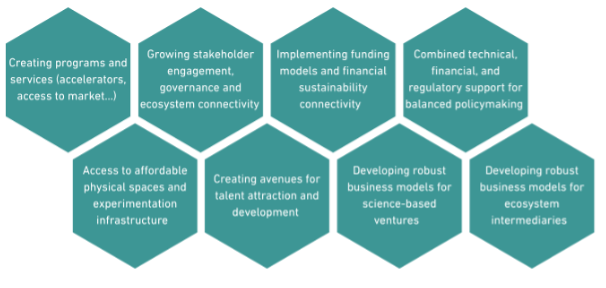
Dimensions to grow for a well-functioning IE, based on FINEX Best Practices Report.
Turning Europe’s diversity into an advantage
Europe’s innovation ecosystems have different strengths. By turning specialization into complementarity, Europe can create an ecosystem in which ventures draw on the capabilities they need to build, test, scale and deploy, transforming its diversity of innovation assets into a coordinated cross-national strategic advantage.
This article draws on research from FINEX, a Horizon Europe project involving partners across seven European countries. FINEX combines ecosystem mapping, policy analysis, workshops, project research and a small survey of ecosystem actors. Survey findings discussed here are exploratory and should not be interpreted as representative comparisons of national innovation ecosystems.
Sources
- Ruiz de Apodaca OB, Frolund L, Murray F. (2023) What is “Deep Tech” and what are Deep Tech Ventures? . MIT Management: Global Programs.
- Caprotti F. (2011) The cultural economy of cleantech: environmental discourse and the emergence of a new technology sector. Transactions of the Institute of British Geographers.37(3):370-85.
- Coenen L, Díaz López FJ. (2010) Comparing systems approaches to innovation and technological change for sustainable and competitive economies: an explorative study into conceptual commonalities, differences and complementarities. Journal of Cleaner Production.18(12):1149-60.
- Edquist C. (2013) Systems of Innovation : Technologies, Institutions and Organizations. Hoboken: Taylor and Francis.
- Hekkert MP, Suurs RAA, Negro SO, Kuhlmann S, Smits REHM. (2007) Functions of innovation systems: A new approach for analysing technological change. Technological Forecasting and Social Change.74(4):413-32.
- Carayannis EG, Campbell DFJ, Barth TD. (2012) Mode 3 Knowledge Production in Quadruple Helix Innovation Systems : 21st-Century Democracy, Innovation, and Entrepreneurship for Development. 1st 2012. ed. New York, NY: Springer New York : Imprint: Springer.
- Ye W, Hooper J, Andal S, Zhin Ng Y. (2025) Global Deep Tech Ecosystems: Catalyzing Innovation for Sustainable Development UNPD. Singapore: UNDP
- Global Centre for Technology, Innovation and Sustainable Development,.
- Suurs R, Hekkert M. (2012) Motors of Sustainable Innovation: Understanding Transitions from a Technological Innovation System's Perspective. Governing the Energy Transition: Routledge. p.
- European Commission. (2024) Eco-Innovation Index: Eco-Innovation Ranking [Available from: https://projects.research-and-innovation.ec.europa.eu/en/statistics/performance-indicators/european-innovation-scoreboard/eis-2024#/eii].
- Wipo Green: The Marketplace for Sustainable Technology. (2025) Wipo Green Database [Available from: https://wipogreen.wipo.int/wipogreen-database/category/8].
- Fauth J, De Moortel K, Schuurman D. (2024) Living labs as orchestrators in the regional innovation ecosystem: a conceptual framework. Journal of Responsible Innovation.11(1).
- ENoLL. (2026) European Network of Living Labs: Global Community of Changemakers [Available from: https://enoll.org/].
- Muñoz Ferrandis C, Perset K. (2023) Regulatory sandboxes can facilitate experimentation in artificial intelligence8/5/2026. Available from: https://oecd.ai/en/wonk/sandboxes.
- Kert K, Vebrova M, Schade S. (2022) Regulatory learning in experimentation spaces. European Commission: Joint Research Center.
- Startup Genome. (2022) The Global Startup Ecosystem Report: Cleantech Edition. Startup Genome LLC.
- European Commission (2023). Guidance on regulatory sandboxes, testbeds, and living labs in the EU, with a focus section on energy.
- European Commission (2026) European Commission’s Impact Report on Scaling Deep Tech in Europe. https://eic.ec.europa.eu/news/eic-impact-report-2026-europe-strengthens…


