
 Sustainability & Society
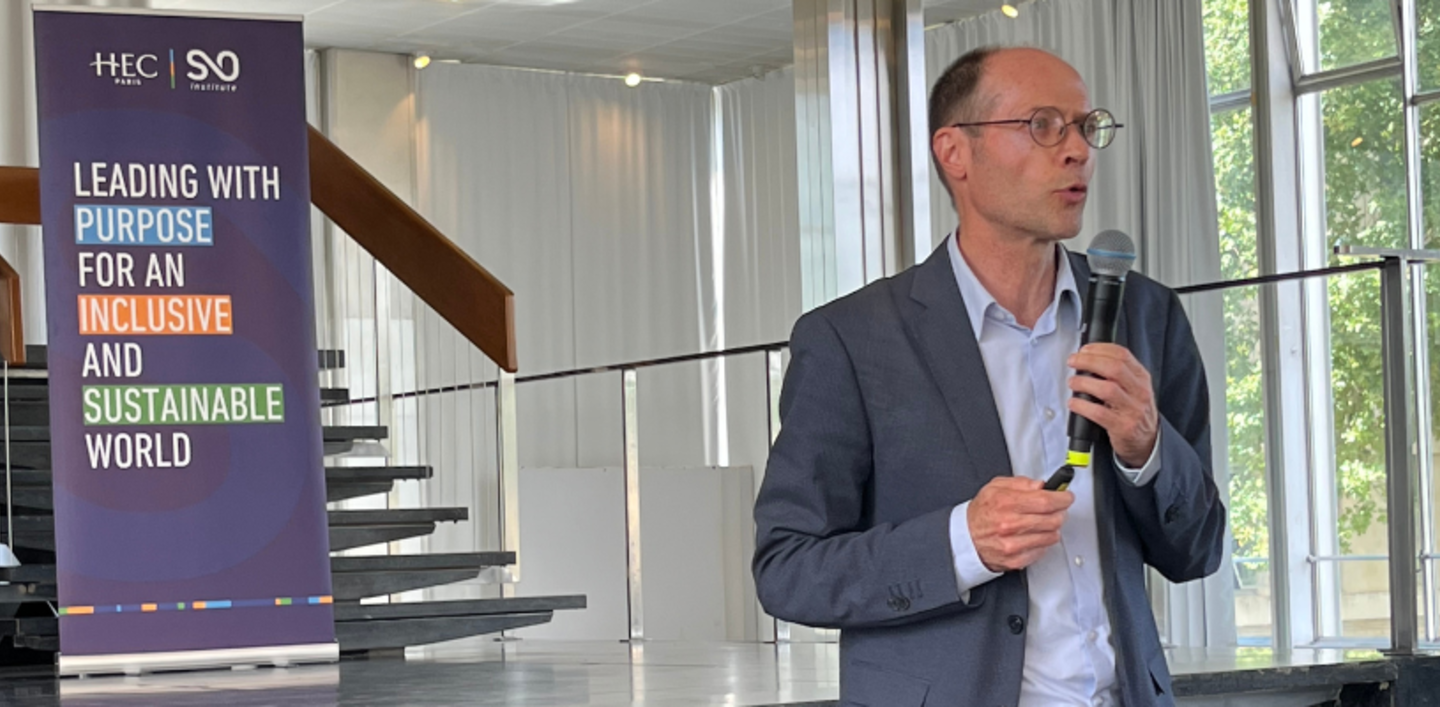

Why are the wealthiest countries also those reporting unprecedented levels of depression and anxiety? At first glance, the paradox is striking. Yet for Olivier De Schutter, United Nations Special Rapporteur on extreme poverty and human rights, it is now well supported by research.
At his opening lecture on the HEC Paris campus in August 2025, he delivered a powerful diagnosis: an economy built on competition, an obsession with growth, and a rigid meritocracy exhausts elites, deepens inequalities, and erodes trust—both between individuals and toward institutions. In doing so, it undermines mental health, social cohesion, and democracy itself. Reducing inequalities, restoring a sense of collective purpose, and rebuilding trust have become systemic imperatives.
- Today’s economic model generates anxiety, burnout, and isolation among elites worn down by meritocratic pressure—even as average wealth rises.
- The richest countries—often the most unequal—also display the lowest levels of interpersonal and institutional trust.
- Inequality fuels declining mental health and social fragmentation, weakening democratic resilience.
- Extreme meritocracy legitimizes “winners” and stigmatizes “losers,” undermining solidarity.
Depression Rates Rising with GDP
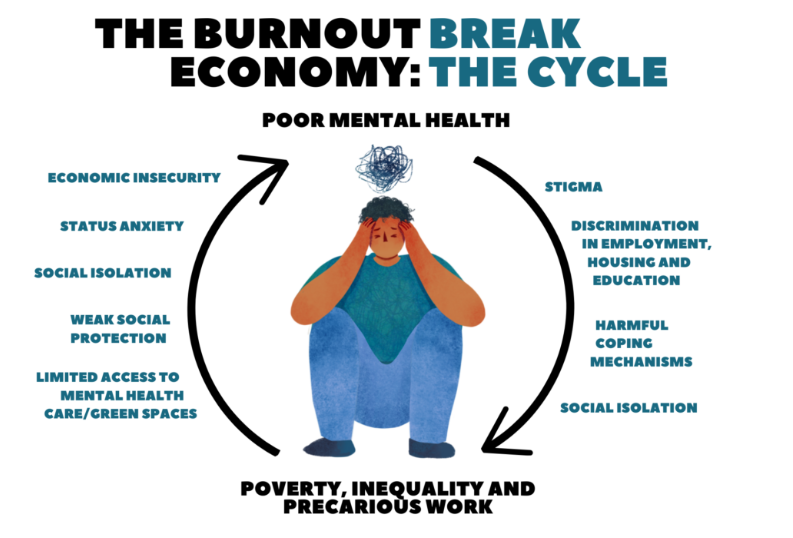
In his mandate as UN Special Rapporteur on extreme poverty and human rights, De Schutter speaks of a “burnout economy” to describe societies where anxiety and depressive disorders increase even as average incomes grow.
A study led by researchers from Harvard and MIT, which he references, shows that among wealthy countries, higher GDP per capita correlates with higher prevalence of depression and anxiety.
These forms of suffering are not merely “individual pathologies.” They reflect adverse social determinants: economic insecurity, precarious work, intense educational and professional competition, and relational isolation. In his 2024 report to the UN General Assembly on poverty and mental health, De Schutter calls on governments to move beyond a purely biomedical approach and address these social determinants—living conditions, social protection systems, workplace status, and the quality of community ties.
Inequality, Mental Health and Eroding Cohesion
To explain the paradox of richer yet sicker societies, De Schutter points to rising inequality in developed countries. In The Spirit Level: Why Equality is Better for Everyone, Richard Wilkinson and Kate Pickett demonstrate that more unequal countries (such as the United Kingdom, Portugal, and the United States) experience higher levels of health problems, violence, and social mistrust.
They also show that rising national wealth does not necessarily improve a country’s capacity to address societal challenges such as violence or declining institutional trust.
The mechanisms are well documented. In more unequal societies, individuals are more likely to feel judged, looked down upon, or socially downgraded—fueling anxiety and depression. Social capital—the density of support networks, civic engagement, and trust in neighbors and institutions—is weaker. As Robert Putnam documented in Bowling Alone, fewer neighborly invitations, lower civic participation, and more time captured by work and screens all weaken everyday social cohesion.
Deaths of Despair and the Sense of Uselessness
Beyond mental health disorders, inequality and insecurity contribute to what Anne Case and Angus Deaton famously called “deaths of despair.” Observing the unprecedented decline in life expectancy among certain groups in the United States—particularly white men without a college degree—they documented rising deaths linked to alcohol, opioids, and suicide. These trends are tied to the disappearance of “good jobs” and a growing sense of economic redundancy.
De Schutter builds on this analysis to show how globalized value chains, automation, and a digital economy intolerant of imperfection fuel feelings of social uselessness among those without the right degrees or networks. He suggests that some minority communities, despite facing discrimination, may be better protected by mutual aid networks—whereas socially downgraded majority groups may have lost their collective anchors.
Counterproductive Growth, Meritocracy and Distrust
For De Schutter, these social pathologies are not accidental; they are the product of an economic model in which growth has turned against its promise of progress. Drawing on Fred Hirsch (The Social Limits to Growth) and Ivan Illich, he argues that as wealth increases, a growing share of goods becomes “positional”—desirable mainly because they allow individuals to rank above others. This fuels competitive comparison rather than well-being.
This dynamic is reinforced by radicalized meritocracy, criticized by Michael Young (The Rise of the Meritocracy), Michael Sandel (The Tyranny of Merit), and Daniel Markovits (The Meritocracy Trap). The more society presents itself as purely meritocratic, the more “losers” internalize failure as personal fault—and the more “winners” see themselves as fully deserving. The result is mutual distrust and social humiliation. De Schutter identifies this as a major source of burnout, including among “winners” trapped in highly paid elite careers that resemble a Weberian “iron cage.”
Economist Herman Daly illustrated this with two curves: wealth increases environmental impacts (we burn our natural capital), while the marginal utility of consumption declines. At a certain point, negative effects outweigh benefits—this is the counterproductivity of growth.
Making Trust a Political Compass
How can we break this spiral, in which inequality drives mental health deterioration and social fragmentation, which in turn weaken democracy? De Schutter calls for reorienting public policy around three levers closely tied to trust: reducing inequality, guaranteeing basic economic security, and strengthening the quality of social relationships.
Economically, he advocates for a welfare state less dependent on growth, capable of financing social protection through more progressive taxation on wealth, pollution, and certain rents—rather than primarily on labor. This would secure life trajectories without requiring endless GDP expansion.
Democratically, he emphasizes the value of diverse life paths and perspectives—including in elite institutions and corporations—arguing that decisions improve when social experiences are varied and independence of thought is protected, as Émile Servan-Schreiber suggests in Supercollectif.
De Schutter proposes concrete pathways:
- Break with the “growth → taxation → redistribution” trilogy by exploring alternative financing mechanisms (wealth taxes, ecological taxation).
- Value diverse life trajectories by multiplying pathways into decision-making roles, as has been done for gender parity.
- Rebuild social capital through local engagement, community-based policies, and reterritorialization.
- Redefine value criteria by restoring recognition to essential professions and measuring their real social impact.
These are levers for building a more inclusive, supportive society—one more resilient in the face of future crises.
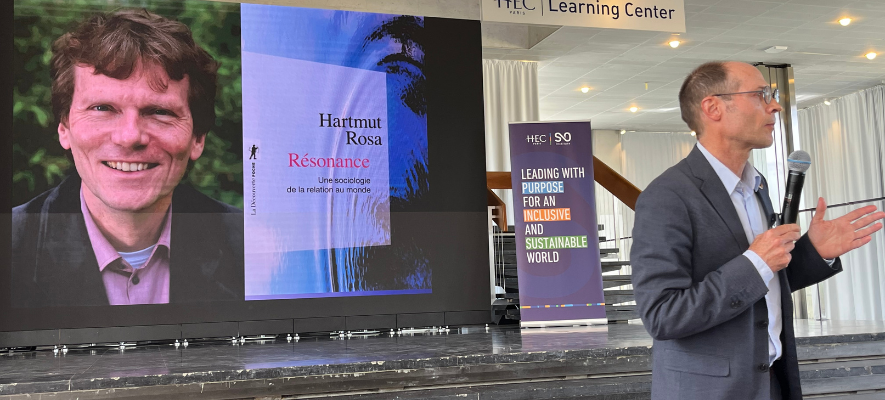
Finally, De Schutter calls for a shift in our collective imagination, drawing on Hartmut Rosa’s concept of “resonance”: making the quality of our relationship to the world and to others—our capacity to be moved, to learn, to feel enthusiasm—an explicit objective, rather than reducing success to accumulation and ranking.
Citing Cornelius Castoriadis, De Schutter calls for a profound institutional reorganization that restores the economy to its proper role as a means rather than the ultimate end. A society, we are told, is judged by its GDP. But what if we judged it by its level of trust?
This intangible yet vital asset erodes in unequal, meritocratic, productivist economies. For future leaders trained at HEC Paris and beyond, this reality demands a reversal of perspective: to see success not as individual performance, but as the ability to foster trust—and to be worthy of it. That is how true leadership, and lasting social cohesion, are built.
Translated by LLM
 Find out more


 Geopolitics & Public Affairs