

 Sustainability & Society

A City, Four Sheep, and the Beginning of a Bond
That morning in Les Mureaux, the scene seemed improbable.
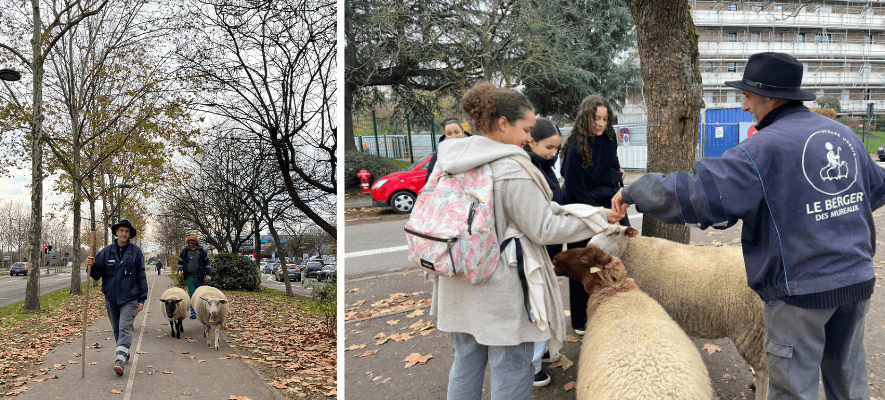
Between high-rise buildings, a school, and a supermarket, four sheep slowly made their way forward. Their names: Love. Grace. Faith. Joy. As they passed, conversations stopped, phones were lowered, and smiles appeared. A child called out “Love!” from the schoolyard. Passersby approached one another and began to talk. A connection was forming.
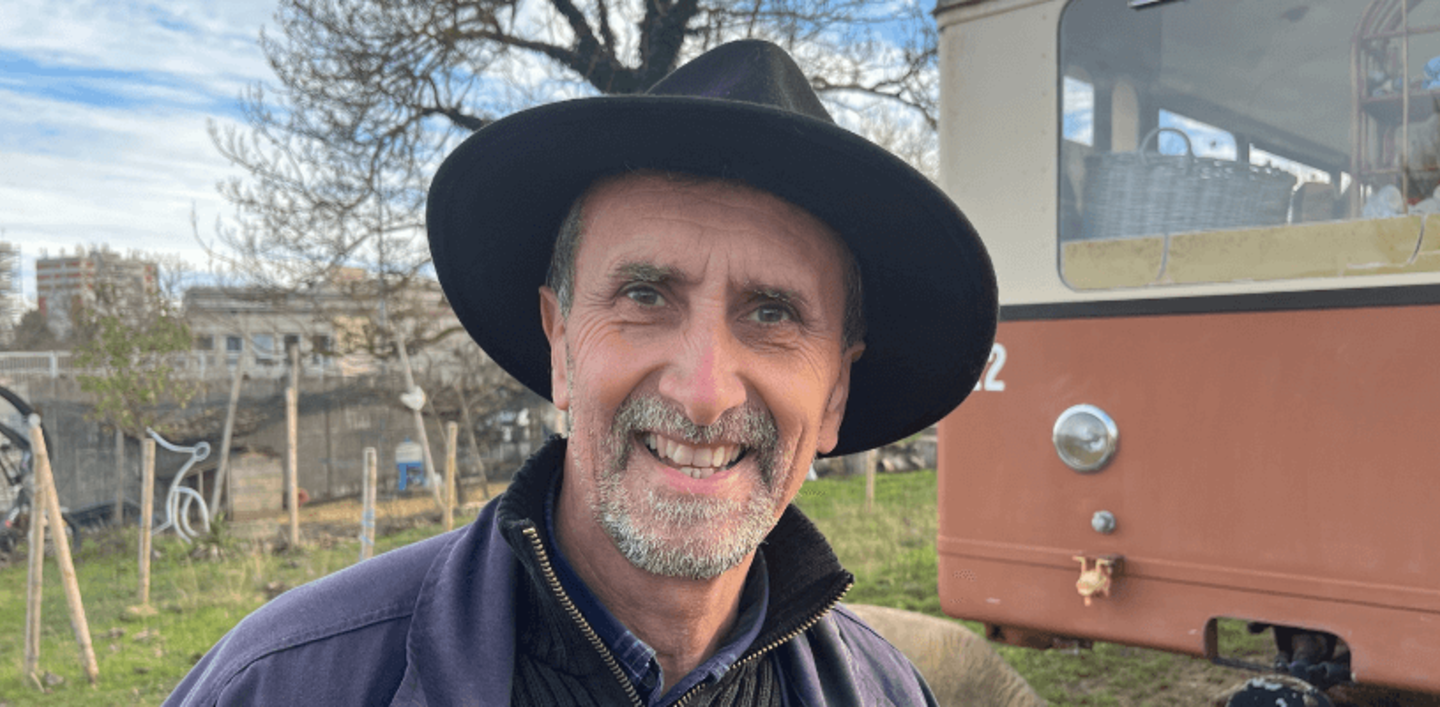
Walking beside them, unhurried, was Jean-Marc Semoulin—urban shepherd, nonprofit leader, and president of the Territorial Economic Cooperation Cluster (PTCE) Vivre Les Mureaux. For him, social cohesion is neither a slogan nor a program. It is a lived experience, repeated every day in public space. “We’re not here to practice eco-grazing. We’re here to meet people, to weave connections.” The sentence captures his philosophy: trust begins with presence.
A Driving Force: Revealing Young People’s Potential
Nothing predestined Jean-Marc Semoulin to become a leading figure in territorial social innovation.
Holding a vocational diploma in market gardening, he began his career as a mathematics teacher in an agricultural high school—a paradox he readily admits, describing himself as “bad at math.” Assigned to classes considered difficult, he discovered what would become his guiding thread:
“Basically, they wore out one math teacher a year and wanted to try an experiment with someone who didn’t like math to see if it would go better. I lasted 11 years. I think that’s what gave me a passion for inclusion: going out and finding the potential in young people who were struggling and feeling unwell, and helping reveal what they had inside.
From Humanitarian Emergency to Territorial Urgency
In 1991, war broke out in the former Yugoslavia. The relentless images of conflict on television deeply affected him and changed the course of his life. He was 21. As with the war in Ukraine today, unfolding just a few hundred kilometers from our borders, he could not look away.
In June 1993, he left alone in a truck filled with clothes, non-perishable food, and hygiene products, heading for Croatia. That initial act gave birth to the nonprofit organization La Gerbe.
For 32 years, a humanitarian convoy has departed every two months—now every three weeks. Each year, 43,000 people benefit from these initiatives, particularly in Ukraine. Yet he soon realized that the mechanisms of exclusion he was fighting abroad also existed in France.
La Gerbe evolved into a work-integration organization. Today, it employs 40 people in integration programs and enables around 30 individuals per year to secure long-term employment. A solid result—but insufficient in the face of a broader reality.
When Transforming a City Becomes a Systemic Challenge
While La Gerbe was helping 30 people per year back into employment, Jean-Marc observed that in Les Mureaux, twice or even three times as many were losing their jobs over the same period. “That realization was a shock.” He began to look at the city differently—as if it were a person with its own symptoms: poor self-image, lack of networks, feelings of abandonment, and stigmatizing external perceptions.
He reached out to major industrial and financial groups located in Les Mureaux: “When we asked companies, for example, ‘What is your connection to the city?’ they answered: ‘We have no employees living in Les Mureaux, no local clients, no local suppliers—no contact with the territory.’ In a human body, we would call that cancer or a foreign body.”
If a city is like a person, then it can be accompanied. Listened to. Cared for.
The creation of the Territorial Economic Cooperation Cluster, PTCE Vivre Les Mureaux, marked a turning point. This inclusive citizen-led initiative aims to make Les Mureaux a pilot city for full employment, initially leveraging experiential tourism.
Projects multiplied—sometimes successfully, always optimistically. But new obstacles gradually emerged: structural, financial, institutional.
Public Funding for Nonprofits: “The Largest Silent Wave of Job Cuts Ever Seen”
“Last year, over the course of three days, I felt as though I were living through the story of Job, with bad news piling up.” He describes the episode as encapsulating all the system’s vulnerabilities: €250,000 in subsidies went unpaid, despite funding having been announced as secured and actions already carried out. On top of that, €110,000 in regional funding has been pending for two years. How can an organization survive under such conditions?
Jean-Marc denounces what he sees as a short-term, accounting-driven vision of public policy, which evaluates projects based on the funds disbursed, never on the costs avoided. “Out of 40 people who moved off welfare benefits and into salaried jobs with us, we save the community €300,000 a year. It gives us €80,000. And yet we’re told that we’re the ones who are expensive.”
In this context, trust becomes fragile. Especially since, according to Jean-Marc, 90,000 nonprofit jobs are currently disappearing in France, in what he describes as “the largest silent wave of job cuts ever seen.”
When Residents and Businesses Reinvest in Their Territory
Jean-Marc is not the kind of person to give up easily. He channels all his energy into driving deep, structural change. Residents are beginning to reclaim their city. But the transformation does not stop there. Local businesses are also joining the momentum.
He starts from a simple observation: a company that has no ties to the territory where it operates cannot truly thrive. Conversely, when it becomes locally anchored, the entire ecosystem gains resilience. Some of the initiatives launched by the PTCE have become autonomous and sustainable local assets in their own right.
In an institutional context where public funding is shrinking and long-term viability requires maximum agility, Jean-Marc and his team have made a bold choice: to shift their posture in order to multiply their impact — moving from the role of central operator to that of architect of what is possible.
A New Third Place Inspired by Living Systems
It is in this spirit that JONAS emerged—the PTCE’s future third place.
Designed as a catalyst for ecological and social transition, JONAS will host between 70 and 150 people in a shared space for work, cooperation, and experimentation. Its economic model breaks from conventional logic.
Inspired by living systems, JONAS is built around 50 “root partners”—companies and organizations that finance the space for two to three years, independently of its commercial activity, and may use it under structured rules.
In return, the venue’s activities (catering, events, coworking) allocate 20% of their profits to a territorial fund dedicated to financing other local projects. Investment becomes what it should always be: a mutual act of trust anchored in the long term.
 Pour aller plus loin

Lucid, Demanding, Political Trust
For Jean-Marc Semoulin, trust is a demanding stance. It is tested by unstable funding, the fragility of the nonprofit sector, and eroding public commitments.
He knows how difficult it is to ask people in integration programs, entrepreneurs, or residents to keep believing when rules constantly change. Yet for that very reason, trust becomes a political act.
To trust is to accept interdependence.“It means prioritizing local anchoring over the search for immediate gains.” It means building sustainable economic relationships in which partners know one another—and can no longer ignore one another.
Ultimately, Jean-Marc asks a simple, almost uncomfortable question: “What am I doing for my territory?” His message is clear: no one should be a spectator of their territory. Everyone can act. One gesture at a time. One act of belief at a time. “If you don’t live what you say, what you say will not bring life.”
In Les Mureaux, Jean-Marc Semoulin is launching projects and opening a path—slow, fragile, but profoundly human. A path where social cohesion is cultivated like a living garden, and where trust becomes, once again, a common good.
© Laurianne Thoury - HEC Paris
Connection with HEC Paris
As part of the Grande École Engagement Track at HEC Paris, Jean-Marc Semoulin speaks to first-year students during the session “Meeting with Inspiring Leaders.” He shares his journey and his commitment to local development.
Master’s students from the CEMS program at HEC Paris, accompanied by their professors Bénédicte Faivre-Tavignot and Matteo Winkler, have also had several opportunities to spend a day in Les Mureaux as part of a course on social innovation. There, they discovered a territory that does not simply replicate existing models, but invents its own rules — with rigor and boldness.


 Geopolitics & Public Affairs