

 Sustainability & Society

Have you ever seen, rising from a crowd of protesters, a sign demanding the resignation of a leader or calling for wage increases? Chances are you have. Have you ever seen a placard declaring, “We demand more social capital”? Probably not.
A Nameless Desire: Social Capital at the Heart of Collective Movements
And yet, behind many demonstrations and popular movements lies a sense of lack — and a desire to feel connected to others.
In France, the gilets jaunes (Yellow Vests) movement drew its strength from shared anger, but also from moments of conviviality. In their demands — initially triggered by rising fuel prices — the protesters highlighted mobility needs in rural and peri-urban areas: the need to travel to work, to connect, to gather, to feel included in a relational network, but also in a region, a country, a collective decision-making body.
From Patronage to Privilege: Misunderstandings Around Social Capital
Such a summary would be risky. In France, where the Yellow Vests emerged, the expression “social capital” remains a semantic niche.
In the business world, it refers to a company’s share capital. In sociology — particularly among scholars influenced by Pierre Bourdieu — it denotes “the aggregate of the actual or potential resources linked to possession of a durable network of more or less institutionalized relationships of mutual acquaintance and recognition” (Bourdieu, le Capital Social, 1980).
This highly abstract definition may lead us to equate social capital with “connections” — or the ability to leverage them. The shortcut is somewhat simplistic. Still, social capital is indeed a decisive factor in acquiring other forms of capital — cultural, economic, professional — and therefore can become a lever of inequality.
These associations alone are enough to exclude the term “social capital” from the list of publicly embraced demands, especially within popular movements.
From the Bowling Club to Democracy: Putnam’s Lesson
Other perspectives, however, make the concept more appealing. In the United States, where the term is more common, social capital resonates with collective interest, as in Robert Putnam’s definition: “features of social organization, such as networks, norms, and trust, that facilitate coordination and cooperation for mutual benefit” (Putnam, Making Democracy Work, 1993).
The definition remains abstract, but the places where social capital is created are concrete. For Putnam, joining a bowling league helps build a bulwark against loneliness and contributes to the smooth and effective functioning of democracy. It is a dynamic essential to both personal and collective balance — and, as Putnam himself notes, often simply “fun”.
“Bonding” or “Bridging”: Two Faces of Social Capital
In reality, however, the magical formula for creating social capital does not always work.
Putnam’s virtuous cycle can falter. A bowling club may be a space of open sociability — or an opportunity to form an exclusive and closed network.
Academic research shows that certain forms of social capital can produce harmful effects: normative pressure, clientelism, even corruption. It therefore invites a more nuanced analysis.
Scholars distinguish between bonding social capital, which connects us to people similar to ourselves, and bridging social capital, rooted in relationships with people from different backgrounds. The latter form appears to generate the most substantial and well-documented positive effects.
 Find out more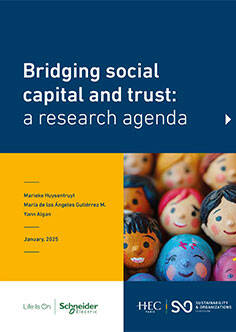
Who Creates Social Capital? Invisible Actors and Missing Recognition
Despite its limitations, academic research broadly teaches us that happy, resilient, and cohesive societies are rich in social capital. According to the United Nations World Happiness Report, an individual’s social network — “social support” — is the strongest predictor of happiness.
But such wealth cannot be decreed. Encouraging connections between people — especially those from different backgrounds — requires time, energy, and action. And therefore, agents.
Who creates social capital? There is indeed an Institute for Social Capital in Australia. But most often, social capital is generated by actors who do not think in those terms: businesses, sports organizations, trade unions, places of worship, book clubs.
In the United States, the Boys and Girls Clubs of America (BGCA) welcome four million children and adolescents into their extracurricular programs. In their annual report, the organization celebrates creating spaces for encounters, friendships, resources, opportunities, and mentorship. In short, they create social capital — yet, like the vast majority of associations, they rarely use the term.
Should we encourage them to do so?

Why Valuing Social Capital Could Change the Game
Most organizations have limited resources to demonstrate the added value of their actions. They prioritize efforts according to stakeholder expectations.
But which client or funder asks them to account for the social capital they create?
The question is not absurd. Particularly in the world of social innovation, many funders hope their resources will foster connections, solidarity, and resilience. Many volunteers — and employees — want to commit to organizations that openly and genuinely promote the creation of social bonds.
Democratic states would benefit from administrations that act as real vectors of trust. Associations could gain recognition if public authorities considered social capital when allocating funding. The collective gain could be immense.
Measuring Social Capital
Measuring social capital poses a major challenge: how can we robustly assess complex dynamics without reducing them to artificial indicators or generating counterproductive comparisons?
Beyond measurement, the concept itself raises questions. Its undeniable richness lies in its ability to capture, in a brief expression, a complex dynamic linking personal networks to broader social cohesion, civic engagement to individual social skills, mental health to collective well-being.
Yet tensions remain. For organizations, agreeing to evaluate their work through the lens of social capital risks ideological instrumentalization. Reporting on activities under the banner of “generated capital” may raise fears that relational wealth could be reduced to a mere driver of economic growth or cost avoidance. Others may fear appearing naïve for highlighting the social value they create, even as they operate under strict performance criteria.
A Common Banner to Align Collective Action
If the term “social capital” were able to gather sufficient consensus — or if a credible alternative emerged — it could serve as a common banner to highlight the converging effects of an infinite diversity of initiatives: a mosaic of pieces of every shape and color, subtly interdependent.
Under such a banner would fall initiatives that develop one or more components of social capital in a virtuous cycle.
At the individual level:
- Strengthening psychosocial skills
- Expanding relational networks
- Increasing self-confidence
Enhancing civic and societal engagement
At the collective level:
- Reinforcing pro-social norms
- Densifying relational networks
- Strengthening social cohesion
- Revitalizing civic and democratic life
Making this visible — through evaluation and shared learning — would support actors and initiatives, fostering mutual enrichment. It would also shape narratives, nurture aspirations, and provide new foundations for public decision-making.
Emerging Evidence of a Possible Turning Point
The ambition may seem vast and the path complex — yet it may be shorter than it appears.
A 2024 study based on the 200 awardees of “La France s’engage” found that 80% of organizations publishing information about their social impact mentioned elements related to social capital — often impacts linked to psychosocial skills, trust, and social bonds.
These results were not limited to organizations focused on social integration. Ecological and cultural associations also reported such impacts, highlighting the transversal role of social capital.
More broadly, many social entrepreneurs (Qualitative Survey in France, Perspectives of Social Entrepreneurs, 2025) aspire, in order to regain momentum and better demonstrate their social utility, to “count what counts.”
Voices are calling for this shift. In the United Kingdom, Andy Haldane advocates a “social connection revolution” and tangible evaluation methods.
International institutions are increasingly integrating this dimension. The OECD does so through its Better Life Index; the World Bank through its Social Capital index.
Will we one day see states, local authorities, investors, and foundations assess organizations based on the social capital they preserve or create? Will popular movements demand more connection, more trust — or more social capital? Will the level of social capital in a city, neighborhood, or company one day become a criterion before relocating or changing jobs?
The research agenda can help bring that future closer.
*Translated by LLM


 Geopolitics & Public Affairs