
Transdev: Giving Top Executives Time to Think Ten Years Ahead
From 2022 to 2026, Transdev and HEC Paris trained 101 of the group's top executives, in four cohorts, through a custom program built around the company's 2030 strategy. The program was designed for leaders who were already running significant businesses - and who, for the most part, did not spend time together. Its ambition: give them time to look ten years ahead, and the conditions to act as one group across 19 countries.
Transdev operates public transportation in 19 countries, under hundreds of contracts with transport authorities. Its model is B2G2C: public authorities sign the contracts, and passengers judge the service. A structurally complex position for the private-sector operator, signing contracts with one party and answering to another.
“Great leaders see further, execute better, and bring people with them. The ability to combine strategic vision, operational excellence and human leadership is what transforms ambition into lasting value, for organizations and for society." - Andrea Masini, Professor of Operations Management, HEC Paris, and academic director of the program.
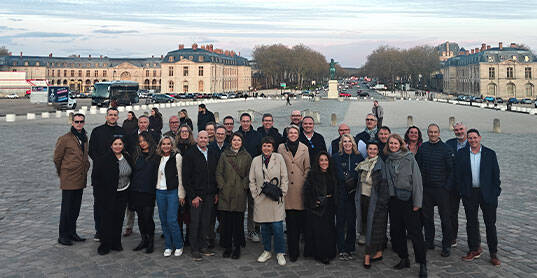
Transdev 's cohort 4 at Versailles Chateau
Trans'Lead TopEx at a glance
- Client: Transdev, public transportation operator in 19 countries
- Participants: 101 top executives (country CEOs and group functional leaders) in four cohorts of 22 to 30
- Format: two residential modules per cohort, the first at HEC Paris, the second in a Transdev market (Los Angeles, Stockholm, Rabat, Munich)
- Anchored in: MOVING YOU, Transdev's strategic plan for 2030
- Satisfaction: 4.65/5 on average across all modules
- Four chapters of impact: looking ten years ahead; leading across personalities, cultures and negotiating tables; applying AI to Transdev's own operations; building a "One Transdev" network
Why Transdev needed a program for its top executives
In 2021, three shifts were changing public transportation:
- The imperative energy transition toward net-zero mobility
- Evolving demographic needs across international markets
- The disruptive rise of data and artificial intelligence
Inside the group, a question had taken shape: what kind of development program do you build for 90 top executives spread across 9 countries? For François-Xavier Chirol, Transdev Group Learning Director, two priorities stood out:
- Acquiring future-proof skills, particularly in leadership for a business changing faster than the day-to-day allows. "We’re in a very operational business, very much in the present", recalls François-Xavier Chirol. "We judged it was necessary to give this population a specific time to step back, not only to answer today’s questions, but to prepare the company for tomorrow’s.”
- Breaking down silos. Transdev's decentralized model is an operational strength: it lets country CEOs and business leaders run their markets with real autonomy. The group wanted them to spend time together, and feel part of one company, while preserving the autonomy that makes each market work.
Co-Designing Trans’Lead TopEx with HEC Paris
Transdev built the Trans’Lead TopEx program around MOVING YOU, its strategic plan for 2030, which targets operational excellence, a high-performance culture, customer-centricity, a balanced client portfolio, and recognition as an employer of choice.
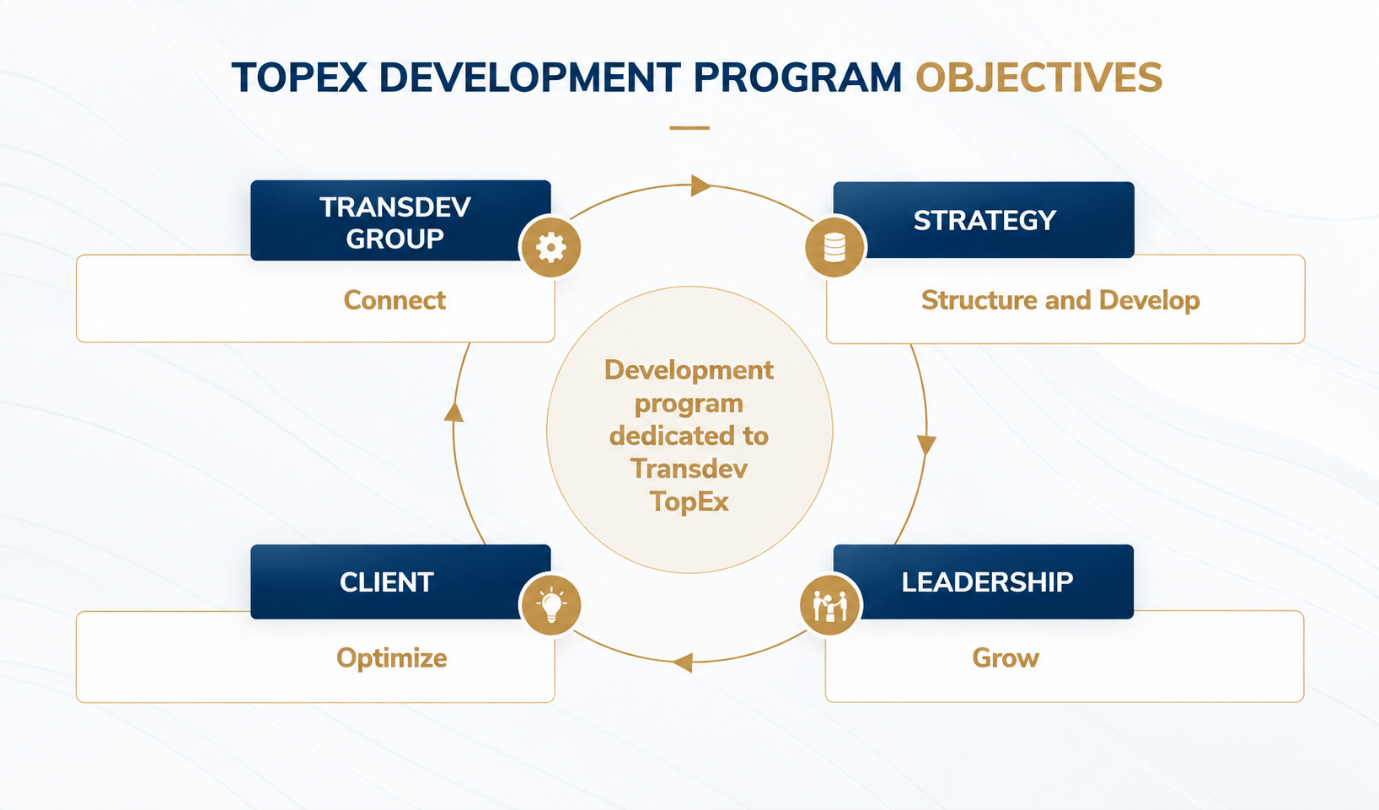
Transdev’s leadership and HEC academic team then spent several months designing the program together. It rests on four pillars/business imperatives:
- Strategic Group Leaders (operational excellence, high-performance culture) : understand the megatrends reshaping mobility, analyze competition, and rethink business models on real Transdev cases.
- Client-Minded Leaders (customer-centricity, balanced portfolio): see a contract from the transport authority’s side, anticipate its needs, and negotiate accordingly
- Inspiring Leaders (employer of choice by 2030): engage teams, attract top talent, and play an active part in talent management and succession planning
- “One Transdev” Connectors (a pillar led by Transdev itself): learn the full range of the group’s activities and share practices across countries and functions. Building a leadership community was part of the program's design.
This premise never changed. The forces shaping the world are shifting, leaders need to see them, and companies need new business models to keep pace. That calls for leaders who understand technology and data, who know how to build and sell a strong product, and who can guide their teams through major organizational change.
How the program worked
Each cohort of 22 to 30 executives followed two residential modules. The first, “Strategic Leadership”, took place on the HEC Paris campus. The second, “Innovation in Action & Make Strategy Happen”, was held in one of Transdev's markets: Los Angeles, Stockholm, Rabat and Munich, often with visits to local Transdev operations.
Teaching combined “Learning by Doing” and “Serious Fun” with Transdev's own strategic questions, so that every framework was tested on the business the participants run. Participants worked in small teams, which for Group CSR Beatrice Jung was “a wonderful way to grasp the concepts, get to know each other, and own those concepts on a very operational basis. And it was fun”. As participant Magnus Wikström states, the experience serves as a “tailored micro-MBA for Transdev managers.”
Three threads ran through the program:
1. Thinking ten years ahead, leading across cultures
Transdev CEO Thierry Mallet opened the first module. Andrea Masini’s sessions on megatrends shaping mobility, and on service innovation at the intersection of energy and sustainable mobility set out to challenge an assumption many executives shared, that their industry was stable.
Masini chose a deliberately ‘uncomfortable’ exercise, the “pre-mortem”. Leaders projected themselves ten years ahead into a worst-case scenario.
Participants then applied HEC’s Odyssey 3.14 methodology, guided by Hélène Musikas. This approach breaks a business model down into three dimensions: value proposition, value architecture, and economic equation. By mapping value curves and identifying core strategic assets, they gained concrete tools to assess current operations, spot new sources of revenue, and work toward anti-fragile business models, which gain from market volatility.
"Thinking outside the daily business. Thinking about the future in 10 years and not about the next 10 days." (Cohort 4 participant)
Nick Promponas has worked in public transit since 1985 and has been a senior vice president since 2002. He joined the program to update his skill set. He did not wait for the second module. After the session on reimagining the business in March 2026, "we had a day-and-a-half session with my team, along with our business development team, to begin working on maturing our transit management business and moving it into the future".
"You learn a lot of things through experience, failures, and successes. This program brings the latest business practices, which force us to start thinking differently about how we approach the work." — Nick Promponas, Senior Vice President, Transdev North America
Anja Kuehler, General Counsel at Transdev and 19 years with the group, valued the outside view the personality questionnaires gave her. "I know who I am, but it's good to have more objective feedback on myself. I don't have to change, just know who I am and what I can work on".
Beatrice Jung, Group CSR Director, describes the same effect: "I don't think I feel different, but I feel definitely stronger."
“When it came to leadership and intercultural sessions, you could feel the spark in the room. The sheer charisma of the professors made a world of difference.” — Anne-Sophie Belloc, Group Talent Director, Transdev
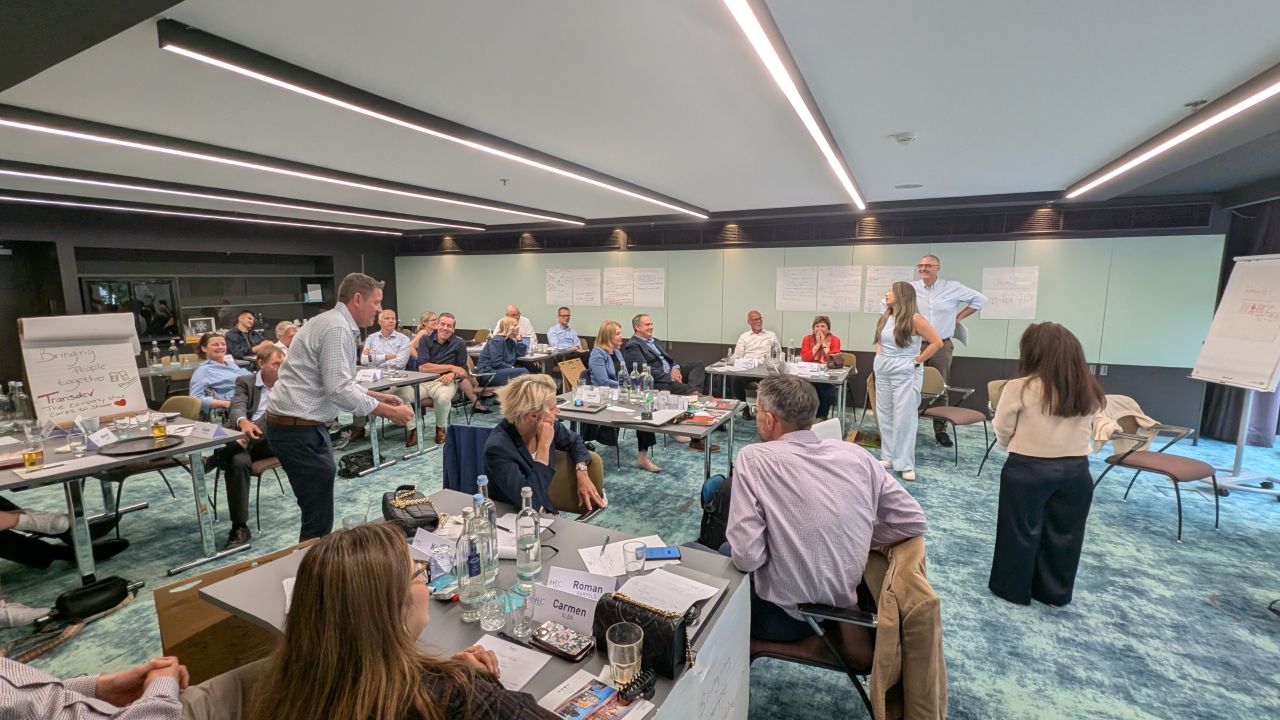
Transdev's cohort 4 in Munich
2. AI applied to Transdev’s own operations
Participants in the second cohort asked for “concrete examples on AI in our transportation environment”. By the fourth cohort, the AI session led by HEC Paris Associate Professor Vincent Fraitot had become a full day, co-designed with Transdev’s internal experts. After a grounding in the core concepts (machine learning, deep learning, large language models, generative AI), participants worked on business cases drawn from current Transdev reality.
For Anne-Sophie Belloc, the AI session was a big hit with the cohort. Anja Kuehler sees AI mattering "very much" in legal work. The difficulty is finding the time to explore it, so she has decided to make that time for her team.
"I'm the one within my team providing the time to work with AI, to test it and to see what the best outcomes are." – Anja Kuehler, General Counsel, Transdev
3. Between authority and passenger: clients, negotiations, change
The second module opened on the client's side of the table. In the latest edition, HEC Paris Associate Professor of Marketing Peter Fischer devoted a day to B2G2C marketing. A transport authority does not buy alone: elected officials, citizens, investors and interest groups all weigh on its decisions.
HEC Paris Associate Professor of Management and Human Resources Mathis Schulte then led two days on negotiation and change. The multi-stakeholder reality of B2G2C contracts shaped the negotiation work: participants practiced through role-plays in small teams and examined their own cultural biases in public tenders and contracts with authorities.
The day on organizational change combined a case exercise on different perspectives on change with a crisis simulation, in which teams made tough leadership decisions as events unfolded. Across cohorts, participants took back frameworks from force-field analysis to adaptive leadership. One Cohort 4 participant's action point fits in four words: "More time on the balcony", the adaptive leadership image for stepping back to see the whole system. Anja Kuehler will bring one principle back to her team in Germany: "Leave space to discuss and to disagree, in order to come to common ground."
Results and Human Impact
4.65/5 | 101 | 8 |
Global Satisfaction Rate | Participants | Days per cohort |
The latest cohort gave the program its highest scores: 4.79/5 for the first module and 4.67/5 for the second. Four cohorts later, the impact shows in four areas.
Direct Cross-Border Synergies: Participants use TopEx network in a more structured and systematic way to resolve operational challenges across countries. François-Xavier Chirol regularly receives spontaneous feedback from participants telling him:
“I needed contacts in another country, and the fact that we had done the program together helped enormously. We got into collaboration much faster, not just because I knew their name, but because we had already worked together.”
Immediate Workplace Application: Participants bring the tools back to their teams. Functional heads plan to apply them to their own departments.
“To actually do the same thing within the management team and have a discussion after that, to understand each other better and also to see how we can combine our different skills in different challenging situations to perform even better.” — Magnus Wikström, CEO, Transdev Sverige AB
Talent Acquisition: The program's behavioural frameworks have reached recruitment. In three of the four cohorts, participants listed personality assessments or situational judgment tests in hiring among the practices they intend to adopt, alongside technical evaluations.
Belonging & Engagement: Participants describe a stronger bond with the group and its leadership.
"It's not only that you're making friends. It's like you're really connecting to the DNA of the leadership of the company, and it makes you feel like a better part of this company when you come home." — Beatrice Jung, CSR Director, Transdev
Continuing the “One Transdev” Momentum
Trans’Lead TopEx has built a sustainable leadership development framework at Transdev, embedding an active, cross-border network across Transdev’s global operations.
Participants say they now reach out across countries to compare operational solutions and share insights on tenders. “You don’t develop the ability to collaborate sitting behind a screen,” concludes François-Xavier Chirol.
“The real impact is the connection. That link now exists.” — François-Xavier Chirol, Transdev Group Learning Director
The program gave participants the keys. Anne-Sophie Belloc is clear about who holds them now: "It is up to them to make it happen!"
Build a custom program for your leaders
To help your executives sharpen their strategic vision, work across organizational silos, and address the challenges of your industry, contact the HEC Paris Custom Programs Team.