
When Research Studies the Act of Mentoring: Inside CDL Paris Climate’s New Season
A research program embedded in the CDL‑Paris Climate’s accelerator transforms mentor-startup exchanges into data - and feeds the lessons back into pedagogy and venture support.
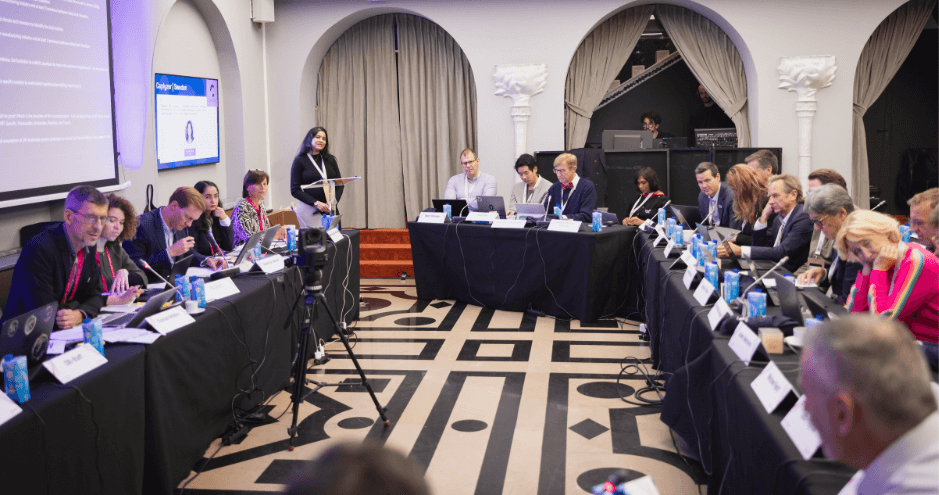
Thomas Åstebro leads debate in opening CDL Climate session © Edouard_Monfrais-Albertini
Key points
- HEC’s academics turn CDL‑Paris Climate into a field lab - capturing mentors’ beliefs and using AI on recorded transcripts to study how advice is formed.
- Early findings already shape practice and teaching, thanks to MBA students.
- Session #2 (Dec 10, online) will scale the research while founders pursue eight‑week objectives.
When the Creative Destruction Lab (CDL) began operating in Paris in 2020, the idea seemed straightforward: bring world‑class mentors together with science‑based startups to refine the three most important sprint-style objectives en route to their next major inflection point. Five years on, the approach is familiar in Europe’s climate‑tech ecosystem. What’s new is that researchers are now studying, almost in real time, how those interactions actually work - what is said, what changes, and why.
CDL‑Paris Climate’s second session for 2025-2026 is slated to run online on Wednesday, December 10, with mentors, ventures and MBA observers logging in for a full day of reviews and objective‑setting. This comes as HEC Paris underscores a growing emphasis on evidence‑based entrepreneurship. At the heart of that effort are Thomas Åstebro, professor of entrepreneurship and executive director of HEC’s ION Management Science Lab, and Carlos Serrano, associate professor of economics and entrepreneurship and ION’s scientific director. During the opening session, both scholars described a research agenda that treats a startup accelerator not only as a training ground but also as a field laboratory.
“At the ION Management Science Lab, we’re working on ways to scale up mentorship-including with AI,” Serrano explained. “We ask mentors about their beliefs regarding a startup before they meet the founders and after they do, and we’re recording small‑group meetings to see how those beliefs evolve through conversation.”
Studying Belief Formation - then Redesigning the Room
Serrano’s project has two linked strands. First, his team surveys mentors before and after the short, tightly structured interactions CDL engineers between founders and two or three mentors. The aim is to measure whether mentors’ priors about a venture converge or diverge once they have access to the same information and direct dialogue with founders and fellow mentors. Second, the researchers are recording and transcribing those meetings (after securing consent from mentors and ventures) and using natural‑language methods to categorize the topics discussed. The dataset, Serrano noted, already covers a large set of meetings and is expanding to “virtually all” sessions as consents accumulate.
Early descriptive results surprised the team. In a typical 15–18 minute meeting, about half of the time is spent with the entrepreneur talking and answering questions. Of the remaining time, one mentor tends to lead, even when two or three mentors are present. When CDL formally assigns a role - an “objective‑setter” or “objective‑critique” - the resulting conversation appears more centralized; when no one is assigned a task, the exchanges are more dynamic and multi‑voiced. The pattern is strong enough that Serrano’s group now proposes experiments that co‑design the seating plan - that is, who meets whom - to test how the identity and expertise of a designated lead influences which topics dominate (financing vs. marketing, for example).
“Without telling people what to discuss, we can influence the discussion by who we put at the table,” Serrano said. “That insight can travel back to CDL pedagogy immediately.”
Thomas Åstebro’s complementary project focuses on how and why mentors update their valuation and risk beliefs. He frames the work against the background of Robert Aumann’s famous “agreement theorem,” which says that, under certain conditions, Bayesian agents exposed to common information cannot agree to disagree. CDL may be a counter‑case: as mentors gather more information, their beliefs sometimes diverge, not converge-a finding the lab wants to document rigorously. (For a broader industry perspective on how startups and researchers can collaborate to speed innovation, see ScaleX’s synthesis on university–startup partnerships.)
“We’re recording what people say in the sessions - mentors and founders - and using AI to measure the amount and type of information provided,” Åstebro said. “Then we see whether that content actually drives the belief updates we capture in our surveys.” He added that, over five years, the questions mentors ask have become more precise, and CDL staff now provide more granular information in advance - an example of organizational learning the lab hopes to quantify.
The ION team is also launching a longitudinal study to track what happens to founders and employees after CDL. It recognized that a venture that doesn’t scale may still seed valuable careers and technologies in other firms. That broader human‑capital payoff, Åstebro argues, may rival the direct acceleration effects that make the program famous.
Feeding Research Straight Back into Practice - and Teaching
One of CDL’s distinguishing features in Paris is the proximity between the program and HEC classrooms. MBA students staffed each table as recorders and annotators, helping ION validate its topic‑classification models while gaining a window into how mentors structure tough choices around IP, markets and team composition.
“The MBA students see the theory in class and then watch it implemented in action,” Åstebro said. “They take away not only how to do this, but why you do it one way and not another.”
Marketing professor Peter Fischer described the loop in very concrete terms: a live debate among mentors about whether to patent or keep trade secrets in a deep‑tech context “goes straight back to the classroom,” including guest input from legal experts on when disclosure risk outweighs defensive benefits. Meanwhile, students embedded with ventures are expected to help founders hit the three objectives set at each session.
Strategy professor Hélène Musikas, who has advised CDL‑Paris Climate from its inception, sees two recurring hurdles in climate tech that the research could help address: designing workable business models for brilliant lab ideas, and scaling hardware from pilot to plant. “Everybody has a fantastic idea in the lab,” she said. “But there are so many stages before it becomes industrial.”
Those comments mirror the accelerator’s own design. CDL structures five sessions of intense, mentor‑driven objective setting; it’s non‑profit, charges no fees and takes no equity - a point HEC highlights as part of its alliance with the global CDL network.
Inside the Room: Ventures, Mentors and the “No‑nonsense” Method
The cohort itself spans the climate‑tech map: cement decarbonization and alternative binders, electrochemical processes for fuels and materials, carbon removal, green hydrogen, bio‑based materials, and industrial process AI. Founders say the real‑time feedback is bracing-but actionable.
“Cement is responsible for 8% of global CO₂ emissions,” said Erin Bobicki, co‑founder and CEO of Cura Climate, which is advancing an electrochemical process aimed at ordinary Portland cement while leveraging existing infrastructure. “The only solution that’s available today at scale is point‑source carbon capture, but our industry partners say it can triple or quadruple costs. We’re pushing for a route that’s both lower‑carbon and lower‑cost.” Her priorities for the December session are blunt: secure a lead investor, convert customer interviews into offtake‑style MOUs, and lock down pilot validation partners.
For Sébastien Fiedorow of Aerleum, which aims to produce synthetic fuels and chemicals from captured CO₂ via a one‑step process, the bottleneck is graduating from lab‑scale to industrial conditions. The CDL milestones he set for the next session? Identify 3-5 chemical‑industry prospects for letters of intent while the company proves multi‑kilogram‑per‑day output.
And Rutvika Acharya of Caplyzer pitches a twist on water electrolysis: producing one gas at a time to avoid explosive mixing and reduce reliance on expensive membranes. “I don’t want any roses,” she said of mentor feedback. “(In these sessions) they’ve made it clear, direct and helpful.” Asked to sum up CDL in a word, she didn’t hesitate: “A door‑opener.”
Mentors tend to agree on the method, if not always on the verdict. Renaud Visage, general partner at Slate Venture Capital and a longtime CDL mentor, calls the process “challenging,” but argues that concentrated eight‑week sprints create “an accelerated way of making measured progress” across financing, customers and team. The hard part in climate tech, he adds, is that “before there was appetite for green premiums; today economic viability prevails.”
The Climate Brief - and why Research Matters this Year
The Climate stream in Paris recruits technical founders across energy, materials, carbon removal, circularity and bio‑solutions. This year’s thesis emphasizes energy accessibility (including storage and alternative fuels), CO₂ removal, bio‑based materials to replace petrochemicals (PFAS and packaging among them), and biotech for drought‑resilient agriculture - four areas that climate mentors see as both urgent and commercially tractable. “Programs like CDL are a way to bridge science and commercialization, so that lab breakthroughs don’t just end up in papers,” said Maryam Khademian, who co-leads the climate stream.
Paris has also launched a Carbon Removal focus alongside its Climate stream, with a dedicated session to support startups working on sequestration at scale. It’s a sign of how urgently the ecosystem is treating engineered carbon sinks.
In parallel, HEC’s Deep Tech Center - which hosts CDL‑Paris - frames its mission in three parts: support founders, enrich education, and generate research that can improve selection and mentoring methods. “We’ve now supported 400+ startups across 20 cohorts,” said the center’s director Aymeric Penven, noting growing synergies across climate, AI, space, next‑gen computing and carbon‑removal tracks.
What the Lab is Already Changing
There are already lessons from ION’s fieldwork that are making their way into session design:
- Shorter interactions with more interlocutors may generate more information than longer meetings with fewer people - a hypothesis Thomas Åstebro and his team is testing by comparing last year’s interview week (short/many) with this year’s (longer/fewer). Whatever the final result, the evidence will inform how the CDL and any accelerator structure future interviews.
- Task assignment matters. If the designated lead is a VC, funding topics get disproportionate airtime; if the lead is a marketer, go‑to‑market issues dominate. That’s an opportunity, Carlos Serrano suggests, to engineer diversity of perspective across meetings for the same venture by rotating assigned expertise.
- Student roles can be more than observational. By placing an MBA at every table to record and rate topic salience, ION both scales data collection and creates experiential learning aligned with HEC’s curriculum.
The Broader Context-and what to Watch in Session Two
CDL’s Climate stream is part of a global network (Paris, Vancouver, Oxford and others) that applies the same objective: setting discipline to deep‑tech ventures. It relies on volunteer mentors who bring operator, investor and scientific experience. It is a rare accelerator model sustained by philanthropy and institutional partners, a structure HEC has leaned into since joining the network. At present, it’s become a fertile testing ground for the school’s research academics.
As this cohort heads into the December 10 session, expect three threads to converge:
- Sharper questions. Mentors report that five years of iteration have made the program’s prompts more precise. In turn, founders face tighter eight‑week goals.
- Student integration. HEC MBAs are not just shadowing; they’re generating labeled data that validates the lab’s AI models-and then bringing those insights back to courses on strategy, marketing and entrepreneurial finance.
Ongoing research by Serrano and Åstebro on beliefs, based on recordings and a survey.
This newsroom reported on CDL‑Paris Climate last season as the first in‑person gathering after a long run of virtual meetings, emphasizing the strengthening “complicity” among founders, mentors, investors and students. This year the same communities are adding a third strand – research - that promises to make the conversations themselves more productive. If Åstebro and Serrano are right, what gets learned in December will not only help set better objectives for January. It will also help any organization - from accelerators to corporate venture units - design better spaces for exchange.
Reporting for this article is based on interviews and transcripts from the opening session of the CDL‑Paris 2025–26 cohort, including conversations with Professors Thomas Åstebro and Carlos Serrano, HEC faculty advisers, mentors, founders and MBA participants.

Participants at the inaugural CDL Climate session © Edouard_Monfrais-Albertini