
Scaling Biotech: Insights from the Field on Turning Science into Impact
Biotechnology holds the promise to transform sectors ranging from healthcare to data storage. Yet few areas of innovation face barriers as structural, costly, and time-intensive. To explore what it takes to turn scientific discovery into market-ready solutions, the HEC Paris Innovation & Entrepreneurship Institute convened researchers, founders, industry leaders, and students for a new edition of Doers to Doers – Biotech Scaling, held at Station F in partnership with Creative Destruction Lab (CDL-Paris), Capgemini Invent, and Biomemory.
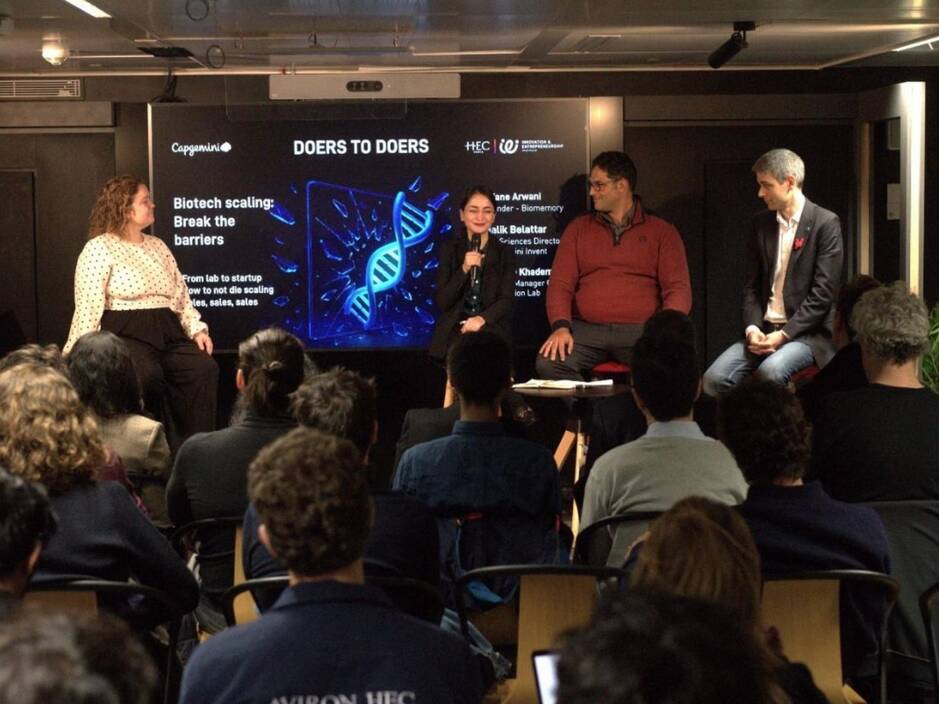
Behind the enthusiasm surrounding biotech lies a persistent paradox: the potential for societal impact is immense, but the journey from the laboratory to the market is uniquely complex. The event examined this gap, not as an abstract challenge, but as a lived reality for founders navigating what is often called the “valley of death.”
Key Findings
- Scientific excellence alone is insufficient for biotech success. Translation into the market depends on regulatory strategy, industrial capabilities, and access to specialized infrastructure—factors often overlooked in early-stage research.
- The timelines of biology create a structural misalignment with traditional funding models. Ventures benefit most from patient investors, early non-dilutive grants, and financial partners who understand that biological processes cannot be accelerated to fit conventional return horizons.
- Industrialization is a strategic inflection point, not a technical continuation. Successful scale-up occurs when companies stop “scaling science” and instead design reproducible, compliant, and market-aligned processes.
- Partnerships play a decisive role in market adoption. Well-structured collaborations with corporates can accelerate validation and access to customers—but require careful governance to avoid dependency.
- Biotech innovation is expanding beyond traditional domains. New applications—such as DNA-based data storage—illustrate how the sector is increasingly intertwined with digital infrastructure, sustainability, and manufacturing.
- Ecosystems matter. Market adoption emerges not only from scientific talent but from a network of collaborators capable of bridging science, industry, and regulation.
A Sector Defined by Long Horizons and Structural Constraints
“Biotech is inherently a risky space to invest time, money, and energy in,” noted Maryam Khademian, Climate Stream Lead at CDL-Paris, and biotechnologist by training. Drawing on years of data from deep-tech ventures, she highlighted a structural mismatch between scientific timelines and market expectations. Longer validation cycles, high capital requirements, regulatory uncertainty, and limited access to specialized infrastructure collectively widen the chasm that early-stage biotech companies must cross.
Yet, across ventures that managed to progress, three patterns consistently emerged:
- patient investors, who understand biological timelines;
- non-dilutive funding, which de-risks early technical milestones; and
- strategic partnerships, which can accelerate development when thoughtfully designed.
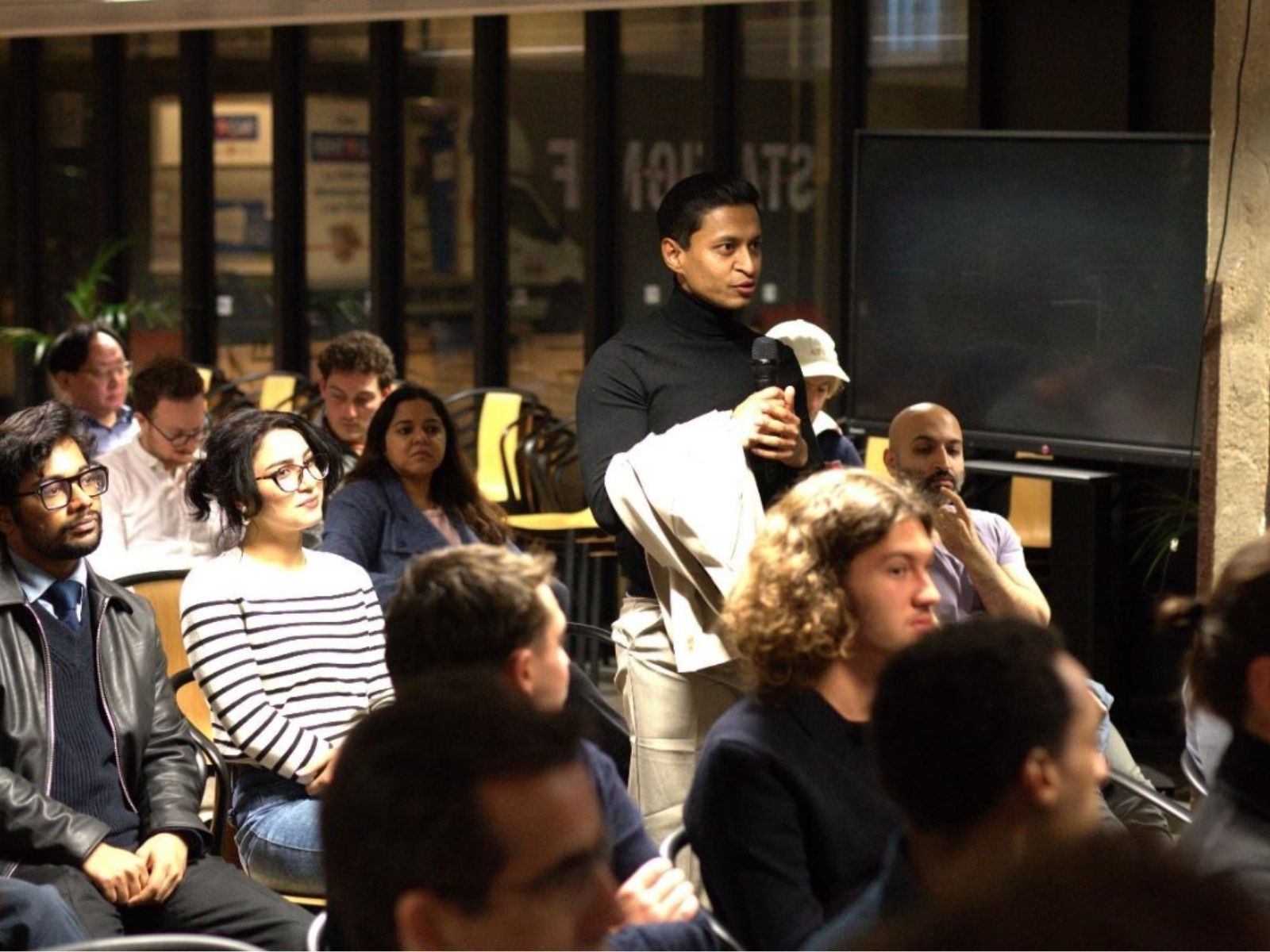
These trends echoed the concerns raised by the audience. Questions such as “How do I convert my PhD research into a viable company?”, “How can early clinical risk be mitigated?”, and “What does a realistic path to market adoption look like?” illustrated the breadth of uncertainty founders face when translating scientific insight into economic and societal value.
From Scientific Breakthrough to Scalable Process
If the scientific challenge is substantial, the industrial challenge is equally defining. Malik Belattar, Director of Life Sciences & Smart Manufacturing at Capgemini Invent, emphasized a fundamental principle: scaling is not the continuation of research, it is the beginning of commercialization.
“We do not scale science for its own sake,” he noted. “We scale processes when we know we can sell what comes out.”
This shift requires three elements:
a clear market need,
a robust and realistic proof of concept,
and a secure pathway to industrialization.
Malik Belattar outlined a progression in which agility, modular technologies, and externalized competencies become essential. Compliance, too, must be integrated from the outset rather than added downstream. Scaling in biotech is less a linear growth trajectory than a multidimensional transition, from lab exploration to industrial discipline.
Innovating Beyond Traditional Boundaries
The discussion also underscored how biotech innovation increasingly extends beyond its conventional domains. Biomemory, whose CEO Erfane Arwani participated in the dialogue, exemplifies this evolution. By encoding digital data into synthetic DNA, the company challenges assumptions about storage, sustainability, and the material limits of data infrastructure.
Arwani’s contribution provided both inspiration and realism. While the technology offers radical potential, the company’s journey also illustrates the structural constraints founders still confront: slow regulatory pathways, limited funding suited to long-term research, and uneven access to high-quality lab spaces. His frank assessment resonated with participants seeking to understand the realities behind emerging breakthroughs.
Beyond the Science: Building Ecosystems That Enable Adoption
Participants repeatedly returned to a central insight: biotech does not fail because the science is incomplete. It fails when teams cannot translate that science into a deployable, competitive, and compliant product. This translation requires far more than technical expertise.
Across the conversation, one theme emerged with clarity: ecosystems matter. Founders need collaborators who complement scientific talent with industrial, regulatory, and commercial capabilities. Investors need frameworks that align with biological timelines. Students and early-career scientists need pathways to engage with venture building, not only research.
“You are not alone. Build your ecosystem with real skilled collaborators — partners, investors, suppliers, customers — before adding AI magic.”
- Malik Belattar, Director of Life Sciences & Smart Manufacturing at Capgemini Invent
For many attendees, including HEC Paris MBA and EMBA participants, the event offered a rare opportunity to understand how commercialization, manufacturing, and regulation intersect with scientific discovery. Several emphasized that this intersection is precisely where they hope to build their careers.
Why This Matters
As biotechnology expands into domains such as health, climate, and data, the challenges of scaling have become a central managerial concern. The Doers to Doers – Biotech Edition showed that scientific innovation must be matched with patient capital, adaptive regulation, industrial capabilities, and cross-sector collaboration to translate breakthroughs into real-world applications.
The discussions highlighted a field shaped by structural constraints but also by significant opportunity. Participants stressed the need to reconcile scientific ambition with practical considerations—manufacturing, compliance, and market readiness. The questions raised during the session point to broader systemic issues that will continue to influence how biotech advances in the years ahead.
About Doers to Doers
Unlike traditional conferences or theoretical masterclasses, Doers to Doers is characterized by direct and interactive exchanges with experts and other entrepreneurs who have already overcome similar challenges.
This peer-to-peer learning allows participants to ask specific questions and receive answers based on real-life experiences, without the usual academic or commercial filters.
About Incubateur HEC Paris
The Incubateur HEC Paris is a bespoke, customizable, and participatory startup support program. It leverages all the resources of the HEC ecosystem to assist talented entrepreneurs. Located at the heart of Station F, the largest startup campus in the world, the program aims to enable entrepreneurs to achieve in 3 months what they would typically reach on their own in 1 year.
About the HEC Paris Innovation & Entrepreneurship Institute
The institute supports entrepreneurs from all walks of life. Through our Incubation & Acceleration, Deeptech, and Social Entrepreneurship centers, we help students with innovative ideas, budding startups or unicorns on the rise, accelerating SMEs, large transforming companies, and social or environmental entrepreneurs to develop effectively and with impact. Here, the entire entrepreneurial ecosystem of HEC Paris converges to allow you to Make it Happen, Make it Big.