
IPCC Taps French-based Scientist to Steer “Industry” Chapter of Assessment Report
With COP30 due to open in Belém, Brazil on November 10, the IPCC is moving into the operational phase of its Seventh Assessment Report (AR7). Among the newly named authors is HEC Paris’ Fernando J. Díaz López. The Executive Director of the Climate & Earth Center within the Sustainability & Organizations (S&O) Institute has been appointed as a Lead Author for Chapter 10: Industry in Working Group III on mitigation. He hopes to drive change in fundamental decarbonization sector.
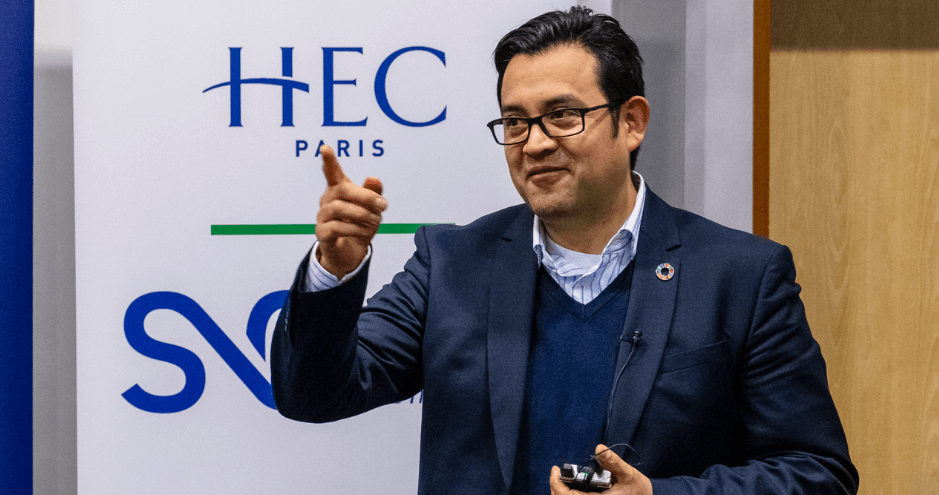
Fernando J. Díaz López
Key takeaways
- HEC scientist Fernando J. Díaz López has been appointed Lead Author for the “Industry” chapter of the IPCC’s Seventh Assessment Report (AR7).
- His selection comes as the IPCC finalizes a diverse cohort of 660+ experts for AR7 (2025–2029), the UN’s flagship climate science assessment.
- Chapter 10 focuses on industry decarbonization as the GIEC analyzes pathways to reduce emissions.
- AR7 will inform the 2028 Global Stocktake under the Paris Agreement, a key moment for raising national ambition.
- Díaz López brings HEC expertise in decarbonization, circularity and eco-innovation to a process grounded in scientific rigor and integrity.
Díaz López' appointment comes as AR7’s author teams are finalized and prepare for their first coordination meeting in Paris outskirts on December 1-5, positioning the industrial sector and its decarbonization pathways at the center of climate policy debates heading into COP30. Díaz López joins an international team charged with assessing the latest science on mitigating climate change.
COP30, a Turning Point?
The academic’s resumé reveals an expertise on industrial decarbonization, circularity and eco-innovation. At present, he will use this experience to inform governments and negotiators. The IPCC hopes the three Working Group reports will appear in 2028, with the cycle concluding in 2029. In the near term, author teams will convene to set scope, division of labor, and cross-chapter linkages. A first Lead Author meeting for parts of the program is slated for early December in Paris, keeping momentum immediately after COP30.
COP30 could be the most consequential UN climate summit since the Paris Agreement’s adoption, as countries are due to table the next generation of national climate plans (NDCs) in line with the 1.5°C goal. What the IPCC synthesizes on industry (covering heavy manufacturing, materials, process innovation and demand-side shifts) will feed directly into debates over feasibility, costs and co-benefits. In short, AR7’s industry analysis lands just as governments recalibrate ambition and financing frameworks.
European Engagement
There is also a European regulatory clock ticking that gives the appointment added relevance. The EU’s Carbon Border Adjustment Mechanism (CBAM) completes its transitional reporting phase at the end of 2025 before the full regime begins in 2026, in tandem with a phased reduction of free allowances under the Emissions Trading System for CBAM-covered sectors. For energy-intensive industries (ranging from steel and cement to aluminum), the policy shift raises the stakes for credible pathways on process emissions, electrification and circularity. These topics are squarely addressed in the Intergovernmental Panel on Climate Change's mitigation assessment.
Recent industry signals underscore the urgency. In October, the Global Cement and Concrete Association released a policy paper urging performance-based standards to accelerate low-carbon cement adoption, reflecting how standards and procurement rules are becoming levers for rapid diffusion of cleaner processes. Meanwhile, energy-system outlooks from the IEA highlight shifting demand and investment patterns that will shape industrial decarbonization economics, particularly electricity demand growth and capital allocation trends. Together, these developments frame the evidence base that AR7 authors are likely to scrutinize over the coming months.
Rigorous Selection Process
Díaz López’s appointment follows the IPCC’s completion of its author selection for AR7, bringing together hundreds of experts from over 100 countries as Coordinating Lead Authors, Lead Authors and Review Editors. The AR7 cycle will run between 2025–2029, culminating in a Synthesis Report that integrates the three Working Group contributions.
Díaz López’s research and practice span industrial decarbonization, circularity and eco-innovation. At the S&O Climate & Earth Center, this thought leader (in eco-innovation and circularity for industrial decarbonization and climate resilience) leads work that connects cutting-edge evidence with real-world transformation. It also encourages organizations and leaders to align strategy, innovation, and operations with planetary boundaries.
Reflecting on this new role in the environment debate, Díaz López noted that “the AR7 cycle (2025–2029) will not only advance our understanding of climate mitigation pathways, it will also provide critical scientific input into the second Global Stocktake (GST) under the Paris Agreement in 2028, a moment when countries must demonstrate progress and raise their climate ambitions.” He added: “I’m deeply honored to join this collective effort and look forward to working with colleagues worldwide at this pivotal time for climate action, with the strictest ethical and scientific integrity.”
Díaz López’s selection also underscores his standing in the field. Alongside academic publications and policy work on eco-innovation and circular economy, he has contributed to international initiatives linking science, strategy and entrepreneurship such as the United Nations Global Program on Eco-Innovation and Resource Efficiency. This portfolio, rooted in rigorous analysis and system-level thinking, aligns closely with the IPCC’s remit for independent, policy-relevant assessment.
IPCC’s Broad Mandate
The academic’s selection follows the IPCC’s August announcement concluding the AR7 author line-up across all three Working Groups. The Panel emphasizes geographic balance and disciplinary breadth in its teams, reflecting a drive to capture technology, policy and market dynamics across regions. For the industry chapter, that means integrating literature on breakthrough technologies (e.g., hydrogen-based steel, process heat electrification, CCUS/CCU), circular economy models, demand-reduction strategies and enabling policy architectures. Author teams will also coordinate with other chapters on systems integration, finance and just transition.
HEC Paris’ Climate & Earth Center will track AR7 milestones and contribute research to public debate as the cycle advances. The immediate calendar is dense: COP30 negotiations on finance and sectoral transitions will set near-term expectations for heavy industry, while December’s author meetings begin the technical work of drafting and cross-review of scientific evidence. Subsequent expert and government reviews will iterate the text, with Working Group reports slated from mid-2028 and a final Synthesis Report planned for 2029. For business leaders and policymakers, the through-line is clear: industrial transformation is moving from pilot projects to system-level redesign, under intensifying policy scrutiny and tightening timelines.