
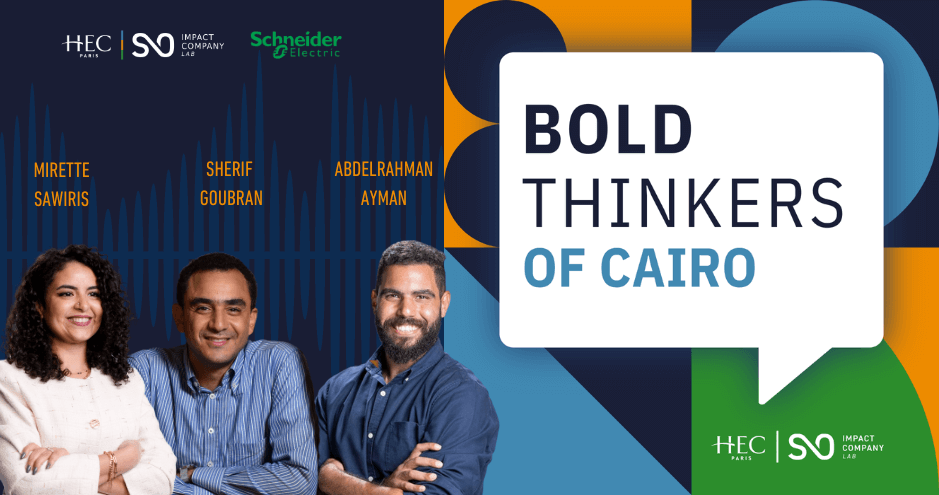
[PODCAST] – BOLD THINKERS Episode 4 – Cairo: Inside a Mega City Reinventing Itself
This 4st episode of Bold Thinkers, the HEC Paris Impact Company Lab explores Cairo — Africa’s largest metropolis and one of the world’s fastest-growing mega cities. The episode highlights three major opportunities shaping the city’s future: its unique urban resilience, its vibrant innovation ecosystem driven by a young population, and its strategic leap in renewable energy and digital infrastructure.
A Mega City Built on Adaptation
Cairo is a city defined by layers — historical, cultural, and urban — that have enabled it to evolve continuously over thousands of years. Its geography around the Nile has shaped not only its physical expansion but also its ability to absorb shocks and reorganize itself.
Listeners will learn how informal mobility, housing, and service systems play a central role in keeping this 20-million-person city functioning every day, revealing a resilience that is both social and economic.
A Young and Vibrant Innovation Ecosystem
With one of the world’s youngest populations and more than 107 million inhabitants nationally, Egypt is home to a dynamic entrepreneurial scene. The episode explores how Cairo’s startups are tackling large-scale challenges — from digital finance and mobility to education and social inclusion — and why the city is emerging as a regional engine of creativity and problem-solving.
Energy Transition and Digital Leap
Cairo’s future is also shaped by major investments in renewable energy and cloud infrastructure. From large-scale solar parks to ambitious national targets for green energy, Egypt is redefining its energy landscape while simultaneously accelerating data-center development. This dual transition is setting the foundation for a more sustainable, tech-enabled economy capable of supporting millions of new users and innovators.
The Voices Behind the Episode
Host Fatou Ndiaye is joined by three key contributors offering complementary perspectives:
- Mirette Sawiris, Vice President of Business Development and Strategy for Egypt, the Levant and Northeast Africa at Schneider Electric, leading sustainability-driven energy innovation across the region.
- Sherif Goubran, Assistant Professor of Sustainable Design at the American University in Cairo, specializing in transforming the built environment toward systemic sustainability.
- Abdelrahman Ayman, Co-founder and COO of Educatly, a global higher-education platform empowering millions of learners across Cairo, Nairobi, Lagos and Dubai.
“Cairo is not a market that is finished — it is a market in motion. Understanding its complexity, creativity, and resilience is essential for anyone who wants to be part of shaping the next chapter of sustainable urban development.”
LISTEN and SUBSCRIBE on Spotify, Deezer or Apple Podcast
Transcript
Welcome to BOLD Thinkers.
I am Fatou Ndiaye, and in this episode, we take you to the heart of yet another mega city, which will inevitably be part of all future, Cairo.
Today, in late 2025, Cairo is the biggest city on the African continent. It sprawls over 3,000 square kilometers and is the home to over 20 million people. By 2050, this mega-city's population is projected to reach 38 million, which will make it one of the biggest mega-cities in the world. Cairo pulses with energy, culture, and ambition. This is a city which craddled empires and civilizations, yet which never stops reinventing itself.
It is a city that demands attention, and one that will, without a doubt, shape the next chapter of global business, culture, and progress. You're listening to BOLD Thinkers, a podcast series dedicated to the voices from the places where critical sustainability issues are most pressing.
The objective of this podcast is to bring these voices to the forefront of the thinking, the planning, and the action of today's leaders. Today, we are going to explore Cairo through different perspectives shared with us by three expert speakers. The business perspective will be brought to us by Mirette Sawiris.
Mirette is Schneider Electrics Vice President of Business Development and Strategy for Egypt, the Levant, and Northeast Africa. She drives sustainability-focused innovation, leading a initiatives that bring smarter, greener energy solutions to the region. Passionate about empowering communities and concretely shaping a more sustainable future, Mirette brings both strategic vision and a deep personal commitment to all that she does. The academic point of view will be provided by Sherif Gubran. Professor Gubran is a leading interdisciplinary scholar, driving the transition of the built environment from incremental efficiency to transformational sustainability. He serves as an Assistant Professor of sustainable design at the American University of Cairo. And last but not least, we will hear from Abdelrahman Ayman. Abdelrahman is the co founder and COO of Educately, a global higher education platform serving millions of users across Cairo, Nairobi, Lagos, and Dubai. It has held numerous other leadership roles at organizations spanning from Rise Up to META, focused on youth employability and on translating youth entrepreneurship into inclusive and disruptive economic growth.
In order to understand Cairo today and its potential for tomorrow, we first need to look beneath the surface, because Cairo is a city of layers, a city built on thousands of years of human presence.
Most neighborhoods contain centuries and centuries of accumulated systems and relationships. You feel it in its streets, in its people, in its rhythm. From the Pharaonic settlements along the Nile, through Greco-Roman and Bezantine eras, to the Fatimid, Ayyubid, Ottoman, and modern periods, each era fundamentally really reshape the city, enriching its culture, reimagining its institutions, and transforming its social fabric. This constant layering is what gives Cairo its depths and complexity. But history can be deceiving. The world tends to view Cairo just through its monuments, the pyramids, the legend, the chronicle carved in stone.
Remarkable, yes, but ultimately, they reflect only the most visible layer of a much more intricate reality, one that holds significant opportunities for the future. Mirette Schneider Electrics, Vice President of Business Development and Strategy for Egypt, the Levant, and Northeast Africa, builds on this.
Mirette Sawiris
This is, yes, one of the biggest misconceptions that we are facing. Yes, the city carries some of the world's oldest history, but it has been always more than that. Cairo is a living engine of ideas for over a thousand of years.
Fatou Ndiaye
Abdel Khahman, co-founder and COO of Educately, a global higher education platform serving millions of users across Cairo, Nairobi, Lagos, and Dubai passionately develops on this.
Abdelrahman Ayman
I think that when you look at ancient Egyptian history, heritage that spans more than 7,000 years, I think it is a very nicely intertwined historical, let's call it orchestra or symphony of continuous innovation that has spanned millennia to this point in time, leading all the way up to marvels that everyone in the world would come and want to see and being crowned as a couple of weeks ago with the recent inauguration of the Grand Egyptian Museum. I think when we're going to look at those roots and seeds of innovation in different sciences, in different industries, we would be able to see big landmarks in architecture, for example, mathematics, physics. You can see that in how the pyramids were built in alignment with specific star constellations. You can see that at the temples where the sun would only shine on the face of the king statue twice per year when he was born and when he was crown king. These are incredible things that I think until today defy the natural laws of science the way that we know it.
Fatou Ndiaye
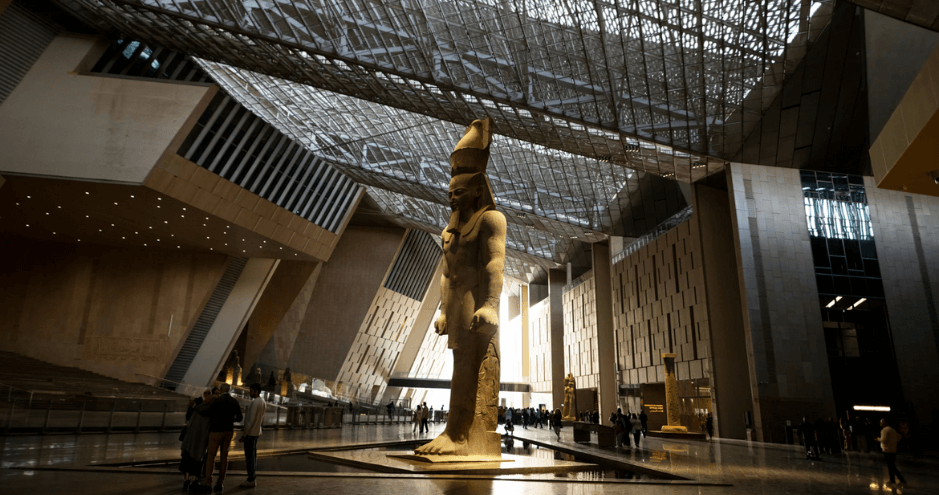
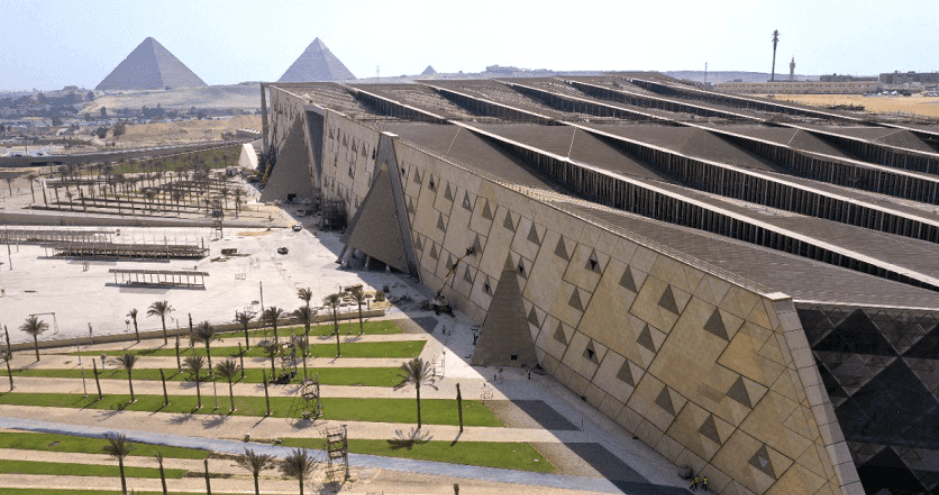
And very recently, Cairo unveiled the Grand Egyptian Museum, also known as GEM, the largest archeological museum on Earth. It doesn't just house history, it reframes it. It's an architectural experience, a cultural statement, and a technological leap forward, a place where ancient innovation meets modern imagination. The gem redefines how a nation tells its story. It's Egypt saying to the world, our past is extraordinary, but our future is even more daring.
Abdelrahman Ayman
It shows, and I think speaks to the testament of where Cairo and where Egypt is today. Yes, a lot of time you hear Egyptians talking about their history, their heritage, and being proud and bragging about the past. But I think the gem is a step in a different direction, which is a moment where Egyptians recognize their past with humility and pride, yet are becoming and stepping into the future with certainty, with tools, with a plan for the first time in a very long period of time.
Fatou Ndiaye
Cairos' past is woven into his present. For global business leaders, this history matters because it demonstrates a proven capacity to absorb shocks, to reorganize systems, and to sustain economic activity under pressure. Exactly the attributes that drives long-term market resilience. Cairo is a mega city defined by contrasting districts, and the green corridor of the Nile cutting through an otherwise arid landscape. This mix creates a dynamic, polycentric megacity where different areas, densities, and economic zones coexist, overlap, and constantly evolve. Sherry, an assistant professor of sustainable design at the American University of Cairo, explains.
Sherif Gubran
Cairo, in terms of geography or in terms of geographic placement, really sits at that intersection point where the Nile breaks into the two branches going to the Mediterranean. If we look at the topography of the area, it's mostly flat, with the exception of a few hills and a small Mount, Mokattam. It becomes really that vast landscape of expansion in a sense or another. While, of course, the historic portions of Cairo, even into the 19th century, downtown Cairo, was always focused on the banks of the River Nile and closer to the water for commercial and economic and social reasons as a time focused on agriculture and trade on waters and so on. Once we moved into an era of faster, easier mobility on land, that expansion started to move away from the river banks into the vast deserts that surround the of the city.
Fatou Ndiaye
As Sherif explains, it is this open flat terrain combined with the flow of the Nile that has allowed Cairo to grow not just along the river, but outward, east and west, into the desert. The physical shape of the city is being redefined.
Sherif Gubran
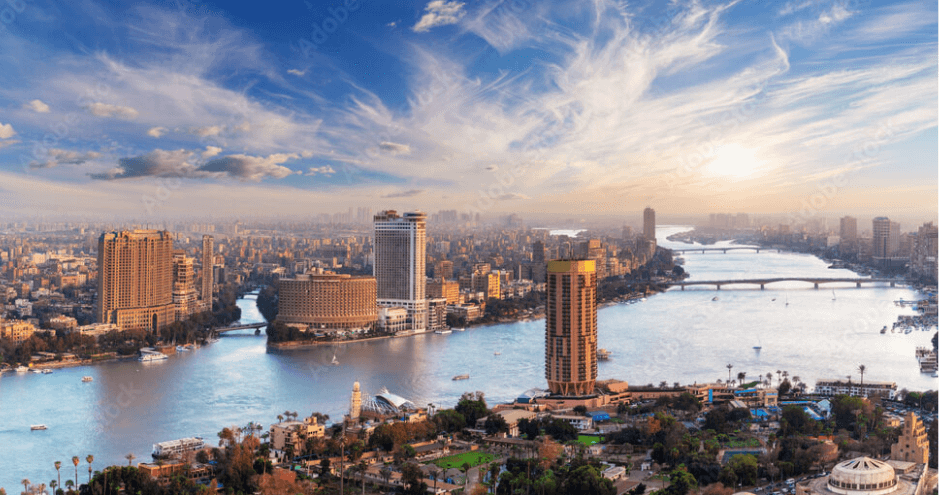
That gives you perspective also onto how important the Nile River is, and it flowing as a vein of life through Egypt all the way from the north to the south creates, let's say, the primary focal point of dissemination of everything, culture, society, people, populace, and innovation. When you look at Cairo, Cairo is a mega, mega city that is wrapped around the Nile, east, west, north, to south. The Nile spans all different corners, almost of Cairo.
Fatou Ndiaye
This expansion is not accidental. It's deeply strategic. Cairo's geography gives it both a dense historic core and vast space to scale.
Sherif Gubran
West Cairo more towards where you would see the pyramids, the Sphings, et cetera. That's one direction of expansion. Then East more towards where we would see the Red Sea and that big plateau of land between the Nile River and the Red Sea. That's where the new capital is also. But the key point here is because of how important the Nile is, think of the physicality itself. One of the biggest innovation projects that Egypt is seeing, I would say in the past decade and heading into the next decade, is expansion of the Nile itself. Taking the Nile to the east and taking the Nile to the west, creating these man-made or person-made artificial reservoirs that are pouring out of the Nile into the desert because Egyptians are attached to the Nile, not only due to scarcity of water or because Egypt has a more rough desert in nature. No, it's also cultural. It's because civilisation is nurtured and rooted because of the Nile. As a concept, respect of cycles of life and death, is all rooted in that perfect balance because of the Nile.
Fatou Ndiaye
The Nile is much more than a river. It's Cairo's heartbeat, a cultural and economic spine. Abdel Rahman reminds us that the city's growth, its the very soul, has always been anchored in that water. Cairo is no longer a passive beneficiary of the Nile. It is extending engineered water systems into the desert, turning the river into a strategic asset for future growth and ambitions. However, the long term ecological sustainability of this expansion remains a critical challenge. As Sharif tells us, Cairo's very different neighborhoods operate in a a mutually reinforcing ecosystem, each providing the workforce, services, and cultural knowledge the others depend on, creating a city that continuously learns from and sustains itself.
Abdelrahman Ayman
I think for me, every person that ever asks me about Cairo, I always respond with this notion of that multi-layered city. The idea that the city is not just what you see. It's what you see has so many layers that exist. So understanding that reality of Cairo as being these areas that are continuously being developed in you. You see as well a very social and cultural acceptance of that newness in a sense. That expansion, as it continues, grows the city, but it grows it as well in situations where each of these locations have been developed in specific times and contexts with specific economic, social, cultural, and political, even, understanding or realities, leading to each of these neighborhoods, if we think of them this way, as being unique in their style, unique in their logic of urban development from tightly-knit locations at the core to more urban-spralled car-centric locations at the edges, but also a variety in the planning designing models. But what makes all that very interesting is that while they have very different physical appearances, all these locations continue to work together to build as what we know as Cairo.
Fatou Ndiaye
Mirette zooms out and gives us a broader perspective on Cairo's unique hub positioning.
Mirette Sawiris
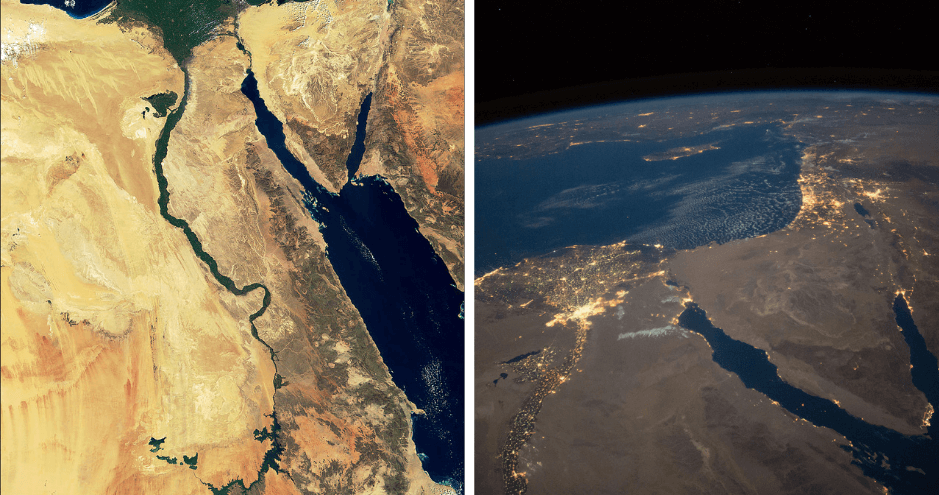
Cairo has its own strategic location. Actually, we can say that it is one of the strategic spots in the region. Why is that? Because it stands on the Nile Valley right before the ribbon fans out into the delta. This is one spot. The city is also positioned at the crossroads between Cairo, the Middle East, and the Mediterranean world, which shaped its role as a cultural and economic gateway. So basically for Cairo, on the right-hand side, this is the desert desert, but as well it's the road to Sinai and Asia and the Red Sea as well. And for the left, it is again the beautiful desert, but it is a road as well to Libya and so on. And only two hours or three hours away, you can easily reach the Mediterranean Sea. So it has a very interesting and strategic location.
Fatou Ndiaye
Cairo's geography underlies major economic and geopolitical infrastructure. For example, Egypt's Suez Canal economic zone has become a global logistics and industrial hub. Furthermore, Cairo also sits at the heart of regional energy diplomacy. The East Mediterranean Gas Forum headquarters in Cairo aligns major energy producers and consumers from across the region. This gives Egypt, and by extension, Cairo, strategic influence over gas markets, policy, and investment. For global business leaders, these aren't just abstract advantages. They are real levers, from supply chain resilience to future energy markets.
Opportunity #1: Cairo's Unique Resilience
Cairo's unique opportunity lies in its remarkable resilience, its proven ability to adapt, evolve, and continually reinvent itself. A quality leaders and investors should recognize. It is a uniquely diverse and dynamic urban system responsive to change and disruption.
Sherif Gubran
I think that dimension of adaptation is something that is, I wouldn't say unique, but very prominent in how we look at the city of Cairo as a whole. For example, you see that as the city expands, sometimes faster than the ability of the transport networks to accommodate, the city develops its own solutions with microbuses and tuk-tuk and mobility, now tech mobility solutions that allow that city to continue to operate, even in some cases without necessarily being fully formal. And again, the here really becomes a way for people to manage their own local issues. And in the process, it also provides a social safety net for the residents.
Fatou Ndiaye
Informality in Cairo functions as a parallel system. With rapid population growth and sustained housing demand, the city adapts continuously. Structures are expanded, new units appear, and neighborhoods reorganize faster than formal plans can be implemented.
Sherif Gubran
These informal settlements and the differences that they have, but again, that situation of randomness and the situation that they emerge out of need and adaptation and a need for resilient solutions for housing and so on. Of course, now we're in the process of rethinking what these ‘Ashwa’iyya yet could mean in terms of improving the conditions, because of course, that's an important dimension that these random urban settlements create with a lack of infrastructure, lack of safety in some cases in terms of the construction quality and so on. But it's also very important that we understand that these informal locations result in very real and formal social and cultural systems that are generally very tightly-knit societies that are very resilient and always adaptable to external risks because of the conditions that they live in a situation where they don't have formal land tenure and so on. That concept of resilience and adaptation really spills over into how we can understand the city of Cairo as a system, as an economic, social, but urban system as well. These formal areas on the surface seem to be equipped with infrastructure. They have their streets and it's governed in a formal way, but they lack a lot of services, including workforce, including services, including a lot of things that can only be sustained and maintained by people who live in less formal areas, sometimes in their neighborhood locations or in other locations.
For example, if we think of that dimension, we can start to imagine you're working in a formal area like downtown, for example, in a bank or something like that. Right across the street, you could start to see a vendor, a small stall or so on that sells tea or sandwiches, you name it. And of course, that small vendor is part of a very large informal economy, what we call an informal sector of the city. Again, maybe jumping back to the or the Zabbalin area or the waste collector's area. Again, we can go back and trace their history into the migration of that location and the start of the collection of the waste that's being generated. Initially, how it started is that, and I think in many cases until today, you see that these are informal waste collectors. How it started out is that they started to see that there is value in the waste or the refuse of wealthy districts. People living in areas like Zamalek, Maadi, Heliopolis, Masr Al-Gadida, and so on, they consume large quantities of food, products, and so on that generates what we can of as valuable waste in a sense.
So this is how it started, that the group “El Zabalín”, which is considered more as a family, very closely knit, started to collect this waste from wealthier districts, a waste that's valuable in terms of its contents.
Today, the government, the city, the governorates, Cairo, Giza, and so on, have in place some formal systems. However, these waste collectors still exist and still collect, and in many cases as well, you start to see practically what it means. You walk in areas like Zamalek and Maadi and so on, and there is significantly less waste maybe on the streets, especially plastic waste and metal waste, these cans for drinks and so on. I think you earlier mentioned that they reach recycling levels that are much, much higher than other locations in Europe or so on. I think some estimates even estimate that they recycle up to 80% of the waste. So you find that, on the other hand, in a very formal system, that process is not as direct in a sense, meaning that the waste collector who's employed by the government doesn't necessarily have a personal incentive to collect that waste, as opposed to the waste collector in the Zabalín, or Mancheid Nasser, who sees that waste product, whether plastic, paper, glass, or otherwise, as a direct source of income.
That means a city of 20 million plus people. So there is a lot of refuse that happens. But by the time it gets to these mega waste, treatment facilities. In many cases, the waste that comes in is missing all the valuable waste. It's missing the plastic, it's missing the glass, it's missing the paper and carton and so on and so forth, because in the process, it has been already fully taken up by the informal sector in a sense or another.
Fatou Ndiaye
Together, all these informal systems fill critical gaps in public services while generating a economic value. For business leaders, Cairo's resilience is a competitive asset. The city's adaptive systems, from housing to transfer to waste, are leaving innovation. Models that blend informal agility with sustainable impact.
Opportunity #2: the vibrant innovation ecosystem
Before we go any further, I want our global listeners to pause for a moment and set aside whatever assumptions they may have about Cairo, because what you're about to hear is not the story of a developing city catching up. It's the story of a mega city with scale, sophistication, and a deep innovation culture that many global leaders still underestimate. The mega city of Cairo is a market of more than 20 million people, Embedded in a country of over 107 million, with one of the youngest population on Earth. That alone should capture your attention. Cairo's business landscape is far more sophisticated and diverse than outsiders often assume. It is an ecosystem where long-standing commercial hubs, fast-scaling startups, and sector-leading enterprises operate side by side. This dense mix of talent, industries, and entrepreneurial energy has created one of the region's most vibrant innovation environments, capable of generating solutions for market far beyond Egypt.
AbdelRahman, helps us better understand this.
Abdelrahman Ayman
That is a beautiful reinterpretation of a historical downtown Cairo being reinterpreted into a hub or a beating heart for Egypt as it leaps into the future with its entrepreneurs and with its startups, where you can see innovative startups across different sectors all the way, attempting to solve unmet needs and problems in Egyptian people's lives. I think it is a vibrant ecosystem because there is a lot of problems to be solved. You can clearly see that in how Egyptians describe themselves and how people living in Cairo describe themselves as inherently hustlers problem solvers, shippers that are capable of creation.
Fatou Ndiaye
Cairo's innovation story isn't a recent spark. It's a long-running pattern of people building, organizing, and reinventing. And for global leaders, that consistency matters. Cities that generate creativity across generations tend to sustain it. Abdel Rahman further develops.
Abdelrahman Ayman
The beauty One of these problems that entrepreneurs and startups in Egypt are attempting to solve is that they are agnostic when it comes to wealth, social status, etc. Just like the Nile, it's undividing. It's attempting to solve your commoner in Cairo's problems, regardless of how wealthy they are, regardless of how much money they have. We see a lot of innovation in sectors like fintech, for example, where your typical Egyptian now would have apps that can help with everything from creating a bank account to payouts to insurance services to being able to transfer money, looking at remittances or receiving money from their family that lives abroad, to managing their wealth, regardless of how small or big they are or it is, to being able to get a nano loan or a microloan, to do something that as simple as purchase some goods to go sell them on the open market or on the free market. Startups innovating in social security and tackling problems that are as complex and as invasive as sexual harassment. You would see social platforms and apps that enable sexual harassment reporting. To be able to tackle that in a crowd format, in a societal format, not making it everyone's problem, not one specific part of of government's problem or saying there's this NGO trying to solve it.
Fatou Ndiaye
It's extraordinary how broad this ecosystem already is. These are solutions built at scale by young entrepreneurs solving problems for tens of millions of people. And that's what many global leaders miss. Cairo is a young, fast-moving, problem-solving economy where innovation is driven by necessity diversity, creativity, and shared demographic momentum.
Abdelrahman Ayman
Cairo inherently is a young population. So being able to step into the realms of startup entrepreneurship and trying to problem-solve our own problems with our own solutions, I think is something that also speaks to that historical hustle culture that I was talking about, that historical innovation culture that I was talking about. It's inherent. The market is there. You're talking about one of the biggest e-commerce markets in the region. It's a retail market that's estimated around $150 billion. That's a lot of money growing continuously. I think that there is bandwidth, that there is momentum, and the needs are infinite with a lot of different problems that are possible to solve.
Fatou Ndiaye
In summary, Cairo is an emerging global challenger. Not a top-tier global hub yet, but a rapidly rising market with scale, talent, and problem-solving energy that increasingly attracts international investors and partners.
Opportunity #3: powerhouse of renewable energy
When we talk about Cairo's future, the opportunity is not just in scale. It is in how the city leverages its natural and human resources to drive inclusive sustainable growth. Energy and technology are not separate investments. They are the backbone of social and economic transformation. Clean power can lift communities, while digital infrastructure can create jobs, enable entrepreneurship, and connect millions of young Egyptians to opportunity.
Mirette Sawiris
That's why the demand for access to energy is actually a mandate It is not optional anymore. Accordingly, the government put this as one of its top priorities for 2030 vision or strategy, focusing on the renewable energy alone, the country is aiming to increase the share for its electricity mix to 42% by 2030, with an updated goal to reach 60% by 2040. And because Because of our strategic and unique position, again, as a country and as a city, we have all these natural resources that can help make this come true. And with the collaboration between the government and the private sector, we can now have or we can now see actually lots of projects, mainly focusing on the renewable energy and the green hydrogen. Be it the sea, be it the wind, be it the sun. So this is all in all when it comes to the access to energy.
Fatou Ndiaye
As we hear from Mirette, Cario’s scale is staggering. This demographic weight doesn't just create demand, it creates urgency. You can feel that urgency in Egypt's national strategy.
Mirette Sawiris
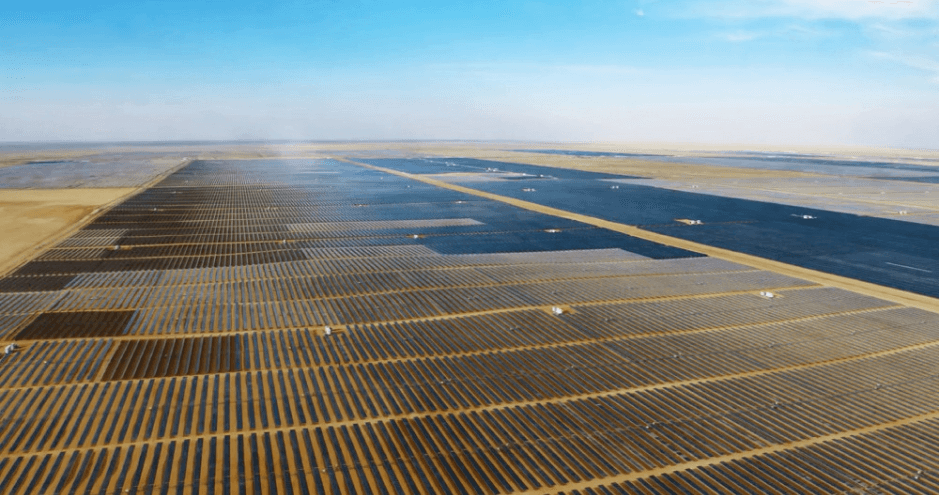
Speaking of renewable energy, in Egypt, we have one of the largest solar parks in the world, which is Benban Solar Park. Benban is located south, which is Upper Egypt, as we mentioned before, and it has a very large scale solar park. It has a total capacity of 1. 8 gigawatts and is composed of 41 individual plants. This actually is providing electricity and access to energy for more than 5 million people. Bimban It is not only one of the largest solar park, but it has its own impact on the community. Thanks to Bimban, it provided more than 10K jobs, and it had its own impact on the infrastructure and the social part.
Fatou Ndiaye
When we talk about sustainable development, this is what it looks like. Clean energy infrastructure that lifts communities while powering a mega city.
Abdelrahman Ayman
I don't want to follow the cliché pattern or call to action of these big branded words of, Invest in Egypt. Egypt today is what Bitcoin was 15 years ago. No, I don't think so. But it is the lay of the land. It is a fact. My call to action is, explore, learn, push your paradigms, look beyond your orthodox typical usual suspect plays when it comes to investment. Egypt currently is making a massive strategic leap in tertiary technologies like cloud and data farm infrastructure. Wouldn't that be relevant for foreign investors? Wouldn't you want to come and invest in being part of not an already built not a fully functioning infrastructure, but being part of the creation of the next leap for an economy that is highly rated, that has been incredibly performing in a time of extreme uncertainty. Being a part of that, being a part of bringing the next layer of technology infrastructure, being part of tackling the next 10 million users in demand, being part of solving the next set of problems that come while more and
Fatou Ndiaye
But the story doesn't stop with renewable energy, because as both Miret and Abdelrahman emphasized, Cairo' future will be powered by more than sunlight and wind. It will be also powered by data. Cairos' booming startup ecosystem depends on something less visible but absolutely essential, modern cloud computing and data farm infrastructure. And this is where Egypt is now making one of its most strategic pivots. In 2025, Egypt is building high-scale cloud and data center infrastructure, positioning the country as a North African tech hub whose impact will span across Africa, the Middle East, and Europe. Global leaders and investors have the opportunity to go beyond capital, to collaborate, innovate, and leave a tangible mark on a city whose future will inevitably shape our shared global future.
Our journey through Cairo comes to a close. I hope that the insights and perspectives shared by our guests have allowed you to learn about how the mega city of Cairo is leading the way on so many fronts. This is not a finished market. It's a market in motion. A market where the next 10 million customers, the next 10 million transaction, the next 10 million data-driven solutions are already emerging.
The real opportunity for global investors, innovators, and partners is to be part of shaping that next chapter, not once it's complete, but while it's being built.
No one is equipped to address the new world challenges being faced in Cairo. Neither the best CEOs in the world, nor the world best academics, nor the best scientists. But what we've learned from Abdelrahman, Mirette and Sherif, is that the solutions may lie in understanding the challenges through new lenses.
Thank you for joining us on this journey through Cairo. For more information on the HEC Paris Impact Company Lab, or if you are interested in collaborating with us on learning, testing, and scaling impact solutions in the mega cities of the global south, please visit us online or contact us at impactcompanylab@hec.fr
Thank you.