
How to Build Better Financial Habits – Masterclass With Professor Anastasia Buyalskaya
Participate
In this RESKILL Masterclass, Professor Anastasia Buyalskaya explores why good financial intentions so rarely translate into lasting habits, and why certain bad money behaviors are so difficult to break.
Drawing on behavioral science and decision neuroscience, this session sheds light on the hidden mechanisms shaping our everyday financial decisions, from spending to investing, in an environment increasingly designed for speed and ease.
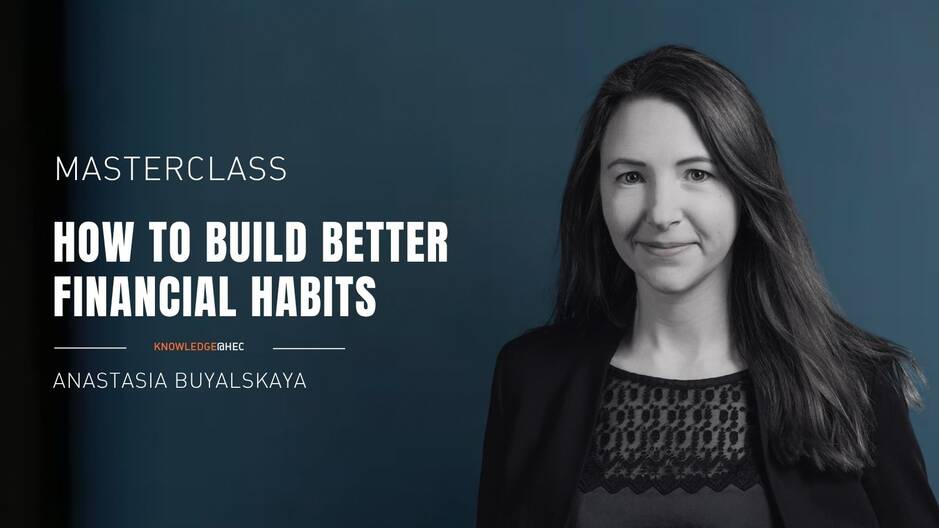
Don’t miss this opportunity to learn from a leading expert in behavioral science and financial decision-making. Whether you are managing your personal finances, leading teams, or navigating complex financial environments, this masterclass will offer practical tools to help you build better habits over time.
Who Should Attend This Masterclass?
Finance Professionals & Investors – Understand how cognitive biases and habits influence investment decisions and long-term performance.
Managers & Executives – Learn how financial behaviors impact strategic decisions, budgeting, and organizational outcomes.
Professionals in Career Transition – Develop better personal financial habits to navigate uncertainty and long-term planning.
Anyone Interested in Behavioral Science – Discover how habits shape everyday financial choices and how to change them effectively.
What You Will Learn
- Why so much of our financial behavior is habitual
- How to identify a habit and understand how it works
- How long it really takes to build new habits
- Which financial habits are worth building—and how to make them stick
- Why bad financial habits are so difficult to break
- Practical ways to automate good behaviors and introduce friction to harmful ones
Speaker Bio
Anastasia Buyalskaya is Assistant Professor of Marketing at HEC Paris and a behavioral scientist specializing in decision-making and financial behavior.
Her research focuses on how cognitive biases and habits shape individual choices, particularly in financial contexts. She teaches in the HEC Executive Master in Finance (EMiF), where she explores cognitive biases in investment decision-making.
Anastasia holds a PhD in Social and Decision Neuroscience from Caltech and brings over ten years of experience applying behavioral science within the financial services industry.
About the Research
Anastasia Buyalskaya’s research has been published in leading academic journals including PNAS and Management Science. Her work examines how habits form and how contextual factor, rather than motivation alone, play a critical role in shaping behavior.
Her research highlights how modern financial environments, from frictionless payment systems to gamified investment platforms, can reinforce both good and bad habits.
Pre-Event Reading
Changing Your Habits Depends on Context, Not Just Motivation, What can machine learning teach us about habit formation? Evidence from exercise and hygiene