


 Innovation & Entrepreneurship

- Entrepreneurial ecosystems strongly shape startup behavior
- Startups adopt Lean Startup practices before launching
- Founders internalize shared buzzwords and norms early
- Incubators require MVPs and KPIs aligned with Lean philosophy
- Peer influence cements standard approaches to innovation
The Lean Startup Approach
When we think of startups, we think of fresh, ideas-led businesses that seek to break the mold in how they do things or in what they produce. But when it comes to their business practices and values, it seems that, rather than being pioneers of innovation, many startups adhere to very similar ways of doing things: following the Lean Startup philosophy
Early-stage startups are up against it. Figures from 2023 show that 9 out of 10 fail – with only 9% surviving ten years. Founders are taking part in a risky game but are they all playing by the same rules? Our research reveals that the people, structures, and systems surrounding startups amplify a philosophy known as the Lean Startup.
Lean Startup is an approach formalized by entrepreneur Eric Ries in his book, “The Lean Startup: How Today's Entrepreneurs Use Continuous Innovation to Create Radically Successful Businesses”, in which startups develop their business model iteratively, enabling them to rapidly decide whether to pivot or persevere. And it seems that the entrepreneurial ecosystem – comprising incubators, higher education institutions, non-governmental organizations, web agencies, service suppliers, mentors, investors, and customers – pushes the earliest-stage startups to internalize and adopt the Lean Startup philosophy.
Buzzwords Reveal a Deeper Logic
At first, we were interested in understanding how early-stage startups manage and steer their business. Which data do they use to make decisions? How do they set incentives for their staff; if any? How do they steer their organization forward? We soon realized that everyone we spoke to – no matter their business or market – was saying very similar things. And the phrases and vocabulary these startups were using – such as “minimum viable product” and “pivoting the business model” – are characteristic of the Lean Startup philosophy.
Essentially, this approach is against the traditional philosophy of developing and then executing a fully fleshed-out business plan at an early stage. As the boxer Mike Tyson once said, “Everybody has a plan until they get punched in the mouth.”
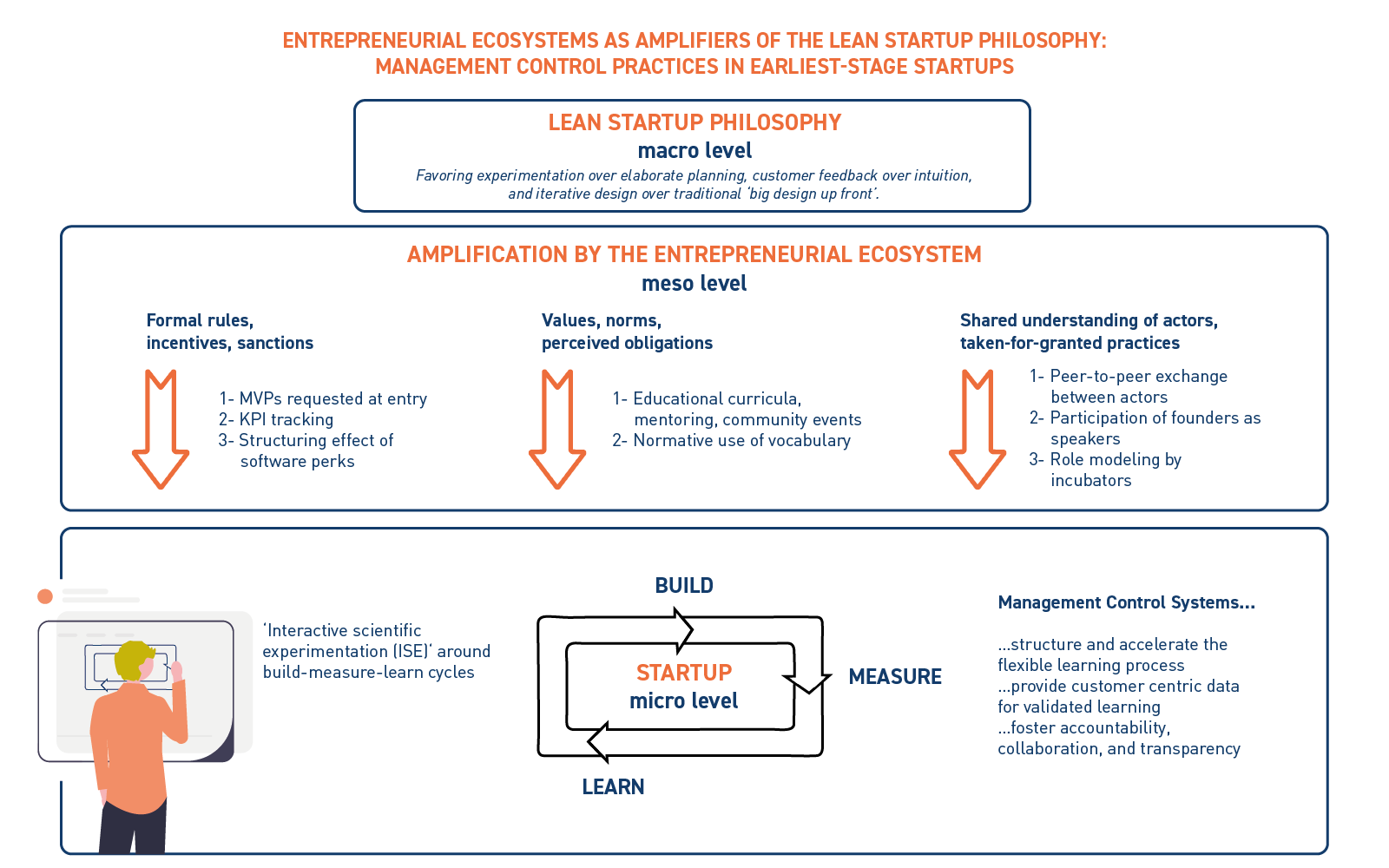
Originating in Silicon Valley in the late 2000s, the Lean Startup philosophy is characterized by an iterative, experimental nature – building something, measuring its success, and then learning from it – with the goal to create a business model that develops and sells products or services in as short a development cycle as possible. Rather than focusing on predefined business plans, this ‘build, measure, learn’ philosophy drives startups to develop management control systems that help them structure and accelerate a flexible learning process, to gather predominantly customer-centric data, and to foster accountability, collaboration, and transparency among their employees and in their decision-making.
The entrepreneurial ecosystems as amplifiers of the Lean Startup philosophy, explained by the researchers. The figure includes a definition of Lean Startup that is based on Blank (2013)
How Ecosystems Institutionalize a Single Approach
To contribute to the literature, we deliberately looked at startups in their earliest stage of development and for practical reasons, we did this across the Greater Paris area. Startups were, on average, two years old. To find out more about the managerial systems startups employ, our main approach was interviewing startups’ founder-managers and from there we went on to talk to actors in the ecosystem and Lean Startup thought leaders.
The startups we looked at structure their business along a ‘build, measure, learn’ cycle. This helps them rapidly gain insights into the success (or failure) of their business model. It also pushes them towards using customer-centric data rather than financial data. For a digital company, for example, this would translate to focusing on click rates to their website, retention time and using tools such as Google Analytics to understand more about the customer’s interaction with their website.
We also found the values of the Lean Startup philosophy to be integrated into the startups we studied. This translates into these companies aspiring to transparency and accountability for their actions and seeking to collaborate with others (in their incubators or the larger ecosystem) as much as possible.
The Power of Ecosystem Rules and Norms
We were eager to find out more about why the Lean Startup philosophy was so dominant. What factors shape startups’ inclination towards this approach?
We turned our attention to the entrepreneurial ecosystem, by which we mean everything that surrounds and influences startups – from incubators and investors to flexible and shared office space and other support facilities. While we already knew that the entrepreneurial ecosystem plays a key role in the development of startups, less is known about how they influence managerial practices. So, we investigated the Parisian ecosystem (e.g. the HEC incubator at Station F) and also triangulated our findings in ecosystems in Germany.
Three Mechanisms Behind Startup Conformity
We identified three main mechanisms that drive startups to follow the Lean Startup philosophy. Firstly, startups are driven to adhere to some basic rules, incentives, and sanctions if they want to participate in an ecosystem.
An example of a rule is that startups often need the support of incubators to grow. These specialized hubs help early-stage startups navigate some of the most challenging aspects of starting up. However, in their selection processes, incubators demand an MVP and require seeing some early success with customers (so-called traction), concepts that themselves are inspired by the Lean Startup philosophy.
For example, a startup working on a digital product would therefore need to go to an incubator with its initial website and proof that it has seen at least some traffic; positive feedback from existing customers; or a list of potential customers who signaled demand for the value proposition.
In this way, a startup has already started down the road of the Lean Startup philosophy. Incubators also offer free software and systems imprinted with other central tenets of the Lean Startup philosophy, such as tools to measure certain key performance indicators (KPIs), which make it difficult to escape such ideals.
The Conversation France (in French): "Pourquoi tant de start-up adoptent-elles la même philosophie de développement ?"
Adhering to the norm
Secondly, there are values, norms and perceived obligations that are communicated to startups at their earliest stages of development, sometimes even before a founder has created her company. Buzzwords that exemplify the Lean Startup approach, such as pivoting, agile development, MVPs, and KPIs, are everywhere, from education courses to popular business books, mentoring and networking events.
Very quickly therefore, the Lean Startup vocabulary becomes part of the everyday language of people entering the entrepreneurial ecosystem.
Thirdly and finally, there is a certain degree of shared understanding constantly being exchanged between players in the ecosystem. These are often taken-for-granted, influential practices such as peer-to-peer exchange or successful founders sharing their experience with early-stage startups.
Methodology
We interviewed more than 25 startup founders about their management control systems and 25 other actors in the startup ecosystem across the Greater Paris area. We also visited startups and incubators, observed pitches for funding and training sessions, attended conferences and trade fairs, and analyzed startups’ websites and social media activity. We triangulated our findings from Paris in the Munich and Berlin entrepreneurial ecosystems, where we made very similar observations.
Applications
The ‘build, measure, learn’ approach we have described can guide new startups (or any innovative idea within a corporate) in how to develop a scalable business model and be incubated (or funded) as quickly as possible. Meanwhile, this research reveals that what feels like rational, deliberate choices over how startups opt to structure and run their business are heavily shaped by external, institutionalized pressures. This research may help startup founders open their eyes to that, so they can more consciously tailor their practices to their unique business.
Sources
Based on an interview with Associate Professor Sebastian D. Becker of HEC School of Management and Associate Professor Christoph Endenich of ESSEC Business School on their paper “Entrepreneurial Ecosystems as Amplifiers of the Lean Startup Philosophy: Management Control Practices in Earliest-Stage Startups,” published in Contemporary Accounting Research, July 13, 2022. Sebastian Becker's research examines the diffusion, change, and implementation of accounting and control techniques in the private and public sectors.


 Strategy & Leadership