

 Innovation & Entrepreneurship

- Social cohesion weakens when shared spaces disappear: trust erodes as everyday encounters between different people become rarer.
- Tiers-lieux act as social infrastructures, fostering ties across social, cultural, and economic differences.
- By prioritizing place, time, and collective governance, place-based entrepreneurs contribute to rebuilding trust beyond digital or purely policy-driven solutions.
What happens when the places that once brought people together — the corner café, the town hall, the shared workshops — disappear? Social bonds erode. Polarization grows and trust fades. In response, a new kind of entrepreneur is emerging: one who sees place not just as a real estate asset, but as a social necessity. These ventures don’t aim to scale fast, but to stay long, creating spaces where strangers meet, society mends, and a new form of innovation arises.
Social cohesion doesn’t disappear — it loses its places
A closed café. An unused warehouse. A municipal building awaiting renovation. Social fragmentation rarely begins with open conflict; it begins quietly, when the spaces that once allowed people to cross paths gradually disappear.
The entrepreneurs featured in the Entrepreneuring from Places dossier do not start from abstract theories of trust. They begin with a building, a neighborhood, a concrete need. They observe that when encounters become rare, mistrust grows — not because people reject one another, but because they no longer share everyday experiences.
As Julien Delcey, director of the tier-lieu Sinny&Ooko, puts it:
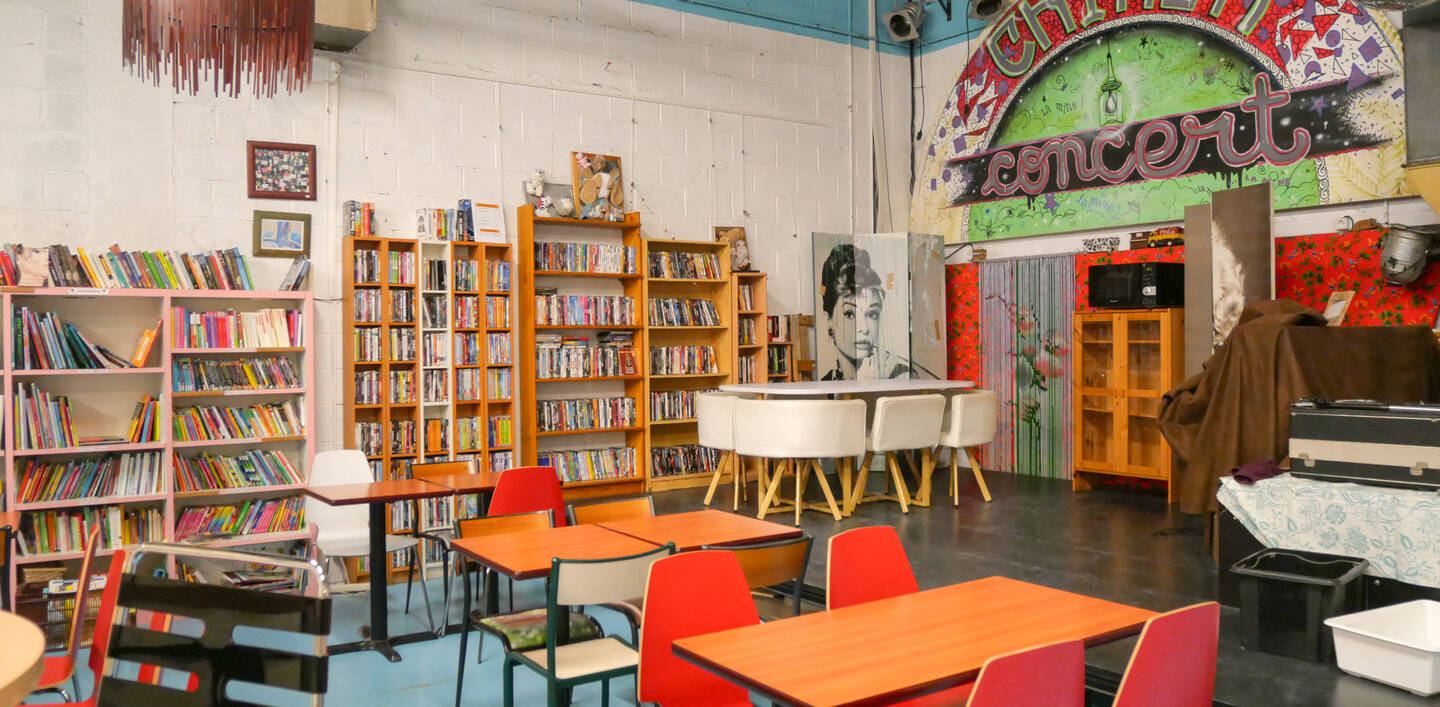
This “something” is difficult to quantify, yet easy to feel. A shared kitchen in a co-living house. A repair workshop inside a former factory. A neighborhood crèche inside a care facility. In each case, the place itself creates the conditions for encounter.
Trust, here, is not declared — it is practiced.
This is the case with Tom&Josette, which establishes its micro-crèches within senior living facilities, developing a pedagogical approach rooted in intergenerational relationships. By reactivating existing spaces as places of encounter between generations, the initiative embodies a model of place-based innovation serving social cohesion.
A different form of innovation
In dominant narratives, innovation is associated with speed, technology, and scalability. The projects highlighted in the dossier tell a different story. Their novelty does not lie in an algorithm, but in how they reorganize space, governance, and economic models to respond to social needs.
These initiatives are rooted in the Social and Solidarity Economy and take diverse forms — cooperatives, associations, social enterprises, hybrid structures supported by local authorities. What they share is a belief that restoring value to underused spaces can restore value to social life.
Emma France, Associate Director of HEC Paris Innovation & Entrepreneurship Institute and author of the dossier, describes the ambition clearly:
The point is not only to open places, but to weave them into an ecosystem — to create continuity, shared methods, and mutual support.
This is innovation by recomposition rather than disruption. It accepts constraints — physical, regulatory, financial — and works within them creatively.
From communities to bridges
Not all social ties have the same impact. Some reinforce existing circles; others connect people across differences. Tiers-lieux are particularly effective at creating these crossings — not by proclaiming inclusion as a slogan, but by organizing space in ways that make it possible.
This logic is central to La Maison de la Conversation, a tiers-lieu dedicated entirely to dialogue. Conceived as a space for social innovation and experimentation, it seeks to “rehabilitate conversation as a tool for living together, acting together, and emancipation.” Located at the heart of a diverse and socially unequal territory, the Maison anchors its work in eight priority urban neighborhoods, offering open meeting spaces, free and participatory programming, and a community committed to making the place a catalyst for inclusion and transition.
Open access, mixed uses, and low barriers to entry encourage encounters between people who might otherwise never meet: residents and newcomers, entrepreneurs and associations, young parents and retirees.
At La Mine, a tiers-lieu dedicated to ecological transition, circular economy and social innovation, founder Régis Pio summarizes the philosophy simply:
Solidarity here is not an abstract principle. It is embedded in how the space operates — through shared tools, collective activities, affordable access, and opportunities for participation. Over time, repeated interactions create familiarity. Familiarity reduces distance. Distance, when reduced, allows trust to emerge.
These micro-encounters accumulate. A shared meal. A workshop. A discussion. Slowly, a sense of belonging takes shape — not based on sameness, but on coexistence.
Time as a strategic variable
Place-based entrepreneurship unfolds at a different rhythm. Securing a building, navigating regulation, aligning partners, mobilizing financing — these steps often take years. Unlike digital startups, such projects cannot pivot overnight.
Yet this slower temporality is not a weakness; it is part of their strength. Trust itself requires time. The continuity of a place — remaining open, reliable, anchored — becomes a strategic asset.
Success is measured less by rapid scale than by durability. By remaining present in a neighborhood. By adapting without abandoning the initial mission.
Scaling impact without multiplying walls
One tiers-lieu alone cannot solve structural challenges such as loneliness, housing precarity, or civic disengagement. Many founders therefore focus not only on operating places, but on sharing practices.
They train other project leaders. They open-source governance models. They collaborate with municipalities. They diffuse methods.
The ambition is not simply to multiply walls, but to transmit ways of designing places that foster cooperation.
Rebuilding trust, the dossier suggests, is not primarily a matter of persuasion or communication. It is a matter of infrastructure — social infrastructure.
As societies grapple with fragmentation, a simple question emerges: where do we still meet people unlike ourselves?
If trust depends on repeated encounters across difference, then the future of social cohesion will not be built in theory — but in places deliberately designed to make those encounters possible.
Sources
This article draws on the report “Entrepreneuring from Places: When Innovation and Impact Push Back the Walls”, authored by Emma France, who leads cross‑functional projects for the HEC Paris Innovation & Entrepreneurship Institute to strengthen the impact of its programs within the school ecosystem. She has also been teaching impact entrepreneurship and social innovation since her doctoral studies at CNAM.


 Sustainability & Society
 Geopolitics & Public Affairs