
HEC Paris Welcomes Top-notch Academics to its Faculty
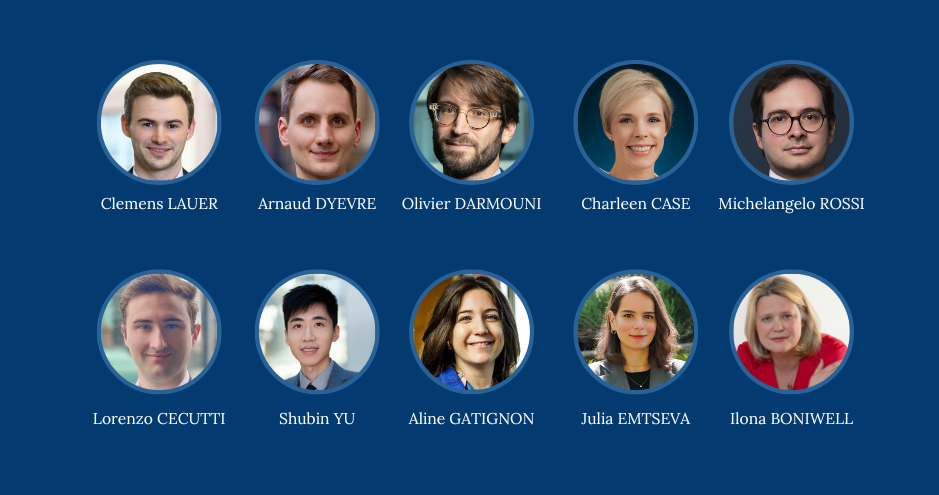
From AI-fueled interviews to the geopolitics of transitional law in conflict zones, this year’s incoming faculty spans the questions leaders can’t ignore.
Key takeaways
- Ten new scholars join across the Departments of Finance, Strategy, Marketing, Management, Accounting, Economics and Law.
- A strong tech thread around platform competition, GenAI in business, and the cognitive effects of digital tools.
- Sustainability & policy feature prominently: coal phaseouts, green finance limits, and the productivity stakes of public R&D.
- People & organizations: mentoring dynamics, positive leadership, and cross - sector partnerships in emerging markets.
- Global outlook: research informed by Europe, North America, and emerging markets; methods ranging from big - data econometrics to legal analysis and field work.
It was in the 18th century that French anatomist E.P. Bertin coined the phrase: “It is not what is poured into the student, but what is planted, that counts.” With the 10 latest research professors to join the HEC ranks, the plants could well feature debates about whether the Digital Markets Act changed how people find restaurants on their phones. There could be constructive exchanges on how state ownership helps or hinders the coal phase-out; a lunch-table discussion about how much AI should sit between managers and their customers; a workshop on getting junior voices to travel up the hierarchy without fear. The common thread? Our 2025/26 arrivals are obsessed with how ideas work outside the lab, when markets meet rules, when technology rewires judgment, and when purpose collides with incentives.
From Rules to Real Life: the Themes Shaping this Cohort
The 10 top-drawer academics hail from the four corners of the world with fresh ideas which we’ve divided into thematic and crossover topics:
1) When markets meet public purpose
Michelangelo Rossi looks at the plumbing of digital platforms, showing how choices in ranking, defaults, and self-preferencing shape what consumers actually see (and what rivals never get the chance to show). As a result, regulation isn’t a footnote to strategy anymore. It’s part of the competitive arena. Rossi’s work on mapping services under the DMA sits alongside Olivier Darmouni’s finance research on the energy transition: even oceans of private capital can be out-muscled by governments’ energy-security aims, especially where coal assets are concerned. Add Julia Emtseva’s analysis of transitional law in conflict zones and the privatization of public functions, and you have a clear message for boardrooms: in the real world, the state is not an externality, it’s a co-author.
2) Technology is changing how we think, decide, and disclose
Lorenzo Cecutti studies how devices and sensory cues change our felt effort and memory, suggesting tech often extends our abilities rather than numbing them. Shubin (Lance) Yu pushes that logic into practice: his GenAI tools turn interviews and qualitative research into something organizations can do at scale, without losing the human voice they’re trying to hear. And Clemens Lauer follows the downstream effect when data becomes visible: what happens to markets and firms when you publish flight-level CO₂ or segment disclosures with more granularity? Transparency becomes a mechanism that moves prices and behavior. In sum, if platforms are the stage, our three new academics show that technology is now the script supervisor.
3) People, power, and the craft of organizing
Big shifts only stick if people can talk about them honestly. Charleen R. Case looks at the psychology of status, leadership, and mentoring, probing how dominance and prestige motives shape whether teams tell leaders the truths they don’t want to hear. Ilona Boniwell, a pioneer of positive organizational psychology, translates decades of research into routines leaders can actually practice: resilience under uncertainty, meaning at work, and attention management. Meanwhile Aline Gatignon studies cross-sector partnerships in emerging markets, asking a deceptively simple question: how much diversity in partners is enough to scale impact without adding paralyzing complexity? The HEC Breakthroughs podcast recently invited her to discuss the uneasy partnerships between corporations and NGOs in times of crisis.
Together, these new arrivals give our students and executives a playbook for making strategy social, not just analytical.
4) Growth, science, and the long game
Amid the news-cycle churn, Arnaud Dyèvre reminds us that the biggest economic effects often arrive slowly. His work connects public R&D to long-run productivity growth, quantifying the spillovers that make today’s budget lines tomorrow’s living standards. The throughline to Olivier Darmouni’s climate-finance research is obvious: when the state shapes markets (through labs, rules, or ownership) the calculus of private investment changes. Understanding that reality is the difference between wishful thinking and workable policy.
What Our New Academics Bring to HEC Paris
The arrival of these 10 scholars deepens our knowledge on the interface between firms and institutions (where competitive advantage now so often lives). They also bring technology into the human domains of judgment, communication, and disclosure, allowing our community to have concrete tools rather than abstract slogans. Finally, they will be anchoring our teaching and outreach in problems that matter: from climate and competition to leadership and law-so that ideas don’t stay trapped in PDFs.
Arriving soon will be new electives and Exec-ed content on platform strategy under regulation, AI-mediated research, stakeholder partnerships, disclosure and ESG data quality, and well-being for performance. There will be research seminars where a legal scholar shares a stage with a finance economist and a marketing scientist. And expect the same thing our students always demand: that we translate complexity into action and impact.
To our ten new colleagues: welcome. We’re excited to build with you.