
Family-run businesses, the backbone of an economy with a human face
A look back at the Family Business Conference: 85% of French people see family businesses as a major asset, providing a means of handing down the family business and anchoring it in their local area.
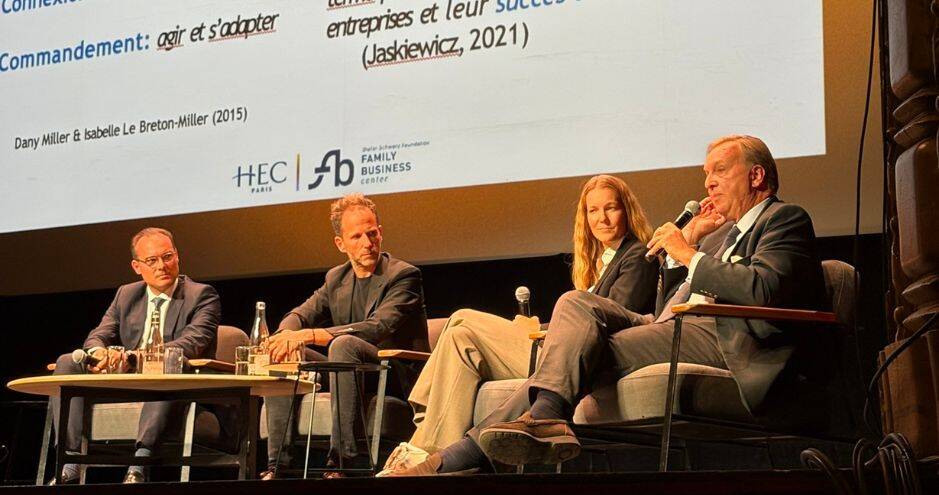
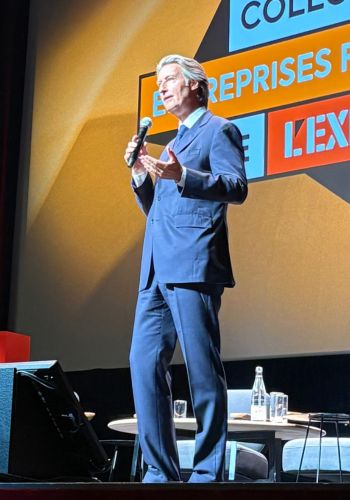
On September 24, 2025, the Théâtre Marigny hosted the first edition of the Family Business Conference, organized by L’Express. The Family Business Center at HEC Paris was the academic partner of this event, which brought together business leaders, experts, and decision-makers to explore the major challenges of family governance.
85% of French people view family businesses as “an asset”
On the occasion of the conference, L’Express, in partnership with Viavoice and HEC Paris, released an exclusive survey. The results confirm the strong position of family businesses in public opinion: 85% of French people believe that the presence of family businesses across the country is “an asset.” The values most strongly associated with these businesses are:
- the heritage of know-how (63%)
- intergenerational transmission (56%)
- prudence in management (21%)
73% of the general public and 69% of business leaders report greater trust in brands that originate from family businesses.
A unique relationship to time and place
Family businesses are particularly grounded in time and place.
In time: their time horizons are very different from those of institutional capitalism. Family businesses are built for the long run. Their return-on-investment is measured in decades, not quarters.
Jean-Charles Decaux (JCDecaux): “What should be preserved: values, long-term thinking, and frugality.”
Pauline Bucon-Duval (Groupe Duval): “Family businesses have the ability to think long-term. We are built for impact.”
In space: family ownership is often deeply rooted in local, national, and even continental territories. These roots often lead to the deliberate and courageous choice to stay in the regions and resist offshoring.
Laurent Burelle (OPMobility): “Could others do as well as we, the family-owned? Probably. But would decision-making centers remain in France? Certainly not.”
Alexandre Ricard (Pernod Ricard): “Today, the headquarters of Pernod Ricard is still in France because the reference shareholder is based in France.”
A model aligned with the great challenges of our time
This special relationship to time and place allows family businesses to remain distant from two of the major threats of our era: – short-termism – statelessness
They are more inclined to prioritize the creation of productive value over purely financial value, and to favor local roots and social bonds over disconnection and relocation. These are essential strengths in a time of major transformations—both climatic and cognitive—that require long-term investments and renewed social cohesion.
Renaud Dutreil (former minister): “Family capitalism is patriotic capitalism.”
The social glue of a resilient economy
Family businesses have the potential to be the cornerstone of the social contract, by championing an economy that is responsible, resilient, and human-centered—one that values long-term thinking and remains attentive to local communities and social ties.
Cécile de Lisle, Executive Director of the Family Business Center at HEC Paris: “The family business is one of the last bastions of a human-centered economy.”
HEC’s commitment: a dedicated center focused on transmission
Family businesses are thus part of the solution. As the #1 business school in Europe and a leader in entrepreneurship, HEC Paris is committed to promoting this model of “European-style capitalism”—especially the specific entrepreneurial act that is the transmission of a family business, a critical issue for the decade ahead.
This is the mission of the newly created Family Business Center, built around three pillars:
- Think: through world-class academic research on European family businesses and their economic and societal impact.
- Teach: as of this year, 100% of HEC students are offered a course on family businesses. The Center also provides open-access educational resources to foster knowledge sharing.
- Act: by encouraging and supporting next-generation family members to embrace the entrepreneurial journey of taking over their family business.
Patrick Martin: “700,000 jobs are impacted every year in France by family business successions.”