
Doctolib Founder Returns to HEC with Ambition and Fragile Architecture of AI Health
Stanislas Niox-Chateau brought to HEC Talks some bracing optimism about AI and access to care, while acknowledging the human and systemic constraints of European healthcare.
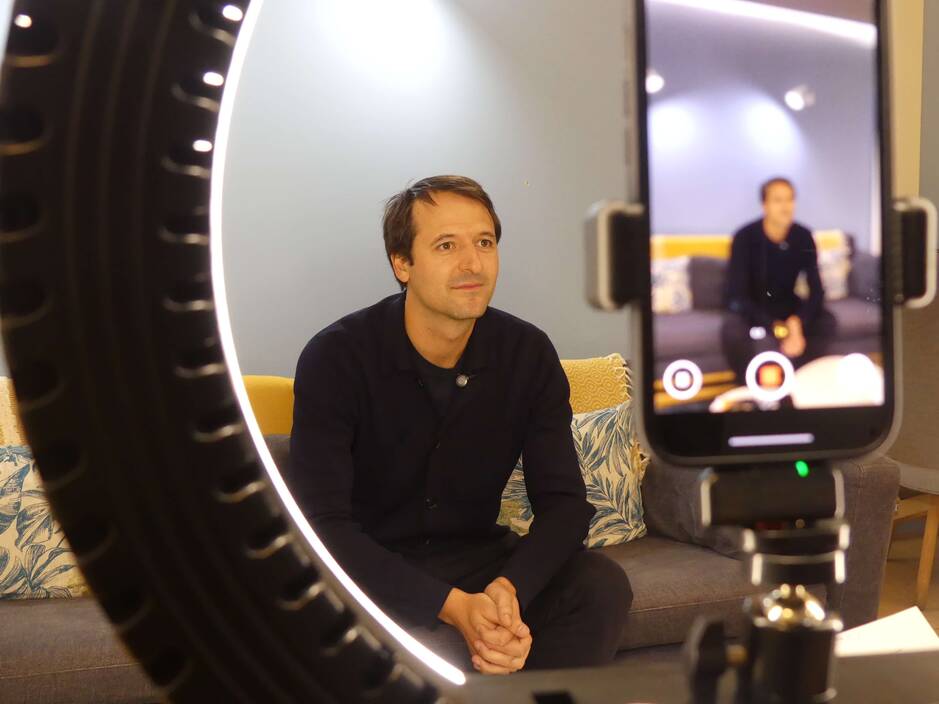
Photo ©Olivia Lopez, HEC Paris
Key Takeaways
- Stanislas Niox-Chateau framed Doctolib’s north star as “user, user, user,” arguing that purpose and economics align when you solve real problems for patients and professionals.
- Citing a global shortfall of 11 million health workers, he said technology must free clinicians’ time and empower patients.
- He called healthcare “Day one” of an AI revolution in clinical decision-making, yet insisted on “zero compromise” on data protection.
A First Return, 15 Years On
Stanislas Niox-Chateau return to campus on September 15, 2025, was his first since graduation,a symbolic homecoming for a founder who has come to personify French e-health. “It was [my] first time [back]… after 15 years,” he smiled in our interview, adding that his most vivid memories are of friendships forged here and the first steps of an entrepreneurial journey. HEC, the 38-year-old said, gave him a network and the habit of thinking differently, with an ambition to create social impact.
The school, he said, provided intellectual tools, networks, and a certain confidence in embracing risk. The campus itself, the rigor of the classes, the pressure, the exposure to business and technology, all contributed to the mindset that would later fuel Doctolib’s ascent. But, he insisted, no business school alone makes an entrepreneur; it was the long hours, the decisions under uncertainty, the setbacks. That energy, he maintained, is non-negotiable.
Such insights were part of the evening talk in the HEC Talks series (streamed for a broader audience) which promised a candid account of “innovation that benefits everyone.”
“User, User, User”: the Operating System
Pressed on the balance between purpose and performance, Niox-Chateau’s answer was reflexive: “It’s all about user, user, user,” a core message he repeated throughout the evening. For Doctolib, that means practitioners and patients, “working on things which matter,” with the business model following impact “every time”. After 13 years at Doctolib’s helm, he remains clear-eyed about the structural constraints: European states devote ever greater shares of GDP to health, yet the world is short 11 million health professionals and still delivers largely episodic, curative care.
In France (and more broadly in Europe) there are chronic shortages of health professionals. Rural or mountainous areas suffer from lack of specialists. Even with Doctolib, the platform’s own data show that delays for certain specialties (cardiology, dermatology, ophthalmology, etc.) remain very long: 30-40+ days in many departments.
Systemic Challenges Beyond Doctolib
The educational system further compounds the problem: high attrition, rigid pathways, regulatory barriers. For students who want to become general practitioners, for whom rural service is essential, there is often little support or incentive. The number of candidates is pruned heavily, sometimes for reasons that appear misaligned with population health needs.
Doctolib helps surface these disparities by revealing, via its data, which regions have long wait times. But it cannot (alone) solve the underlying shortage of trained professionals, the organizational inefficiencies of hospitals, or deep geographic and socio-economic inequality.
About Doctolib’s own scale, Niox-Chateau is concrete: “We have 2,800 people today. We will double that population[in] four [to] five years.” The ambition is animated by an almost old-fashioned hustle: from its first days in 2013, he went door-to-door to pitch physicians well into the company’s hypergrowth years. Astonishingly, he continued the practice until three years ago, three years after it had become a unicorn.
Day One for AI…So Long as Trust Holds
“We are at day one of our journey,” Niox-Chateau insisted in front of the hundreds of students and academics gathered in the campus’ Hall d’Honneur. He argued that clinicians are, at core, “data scientists” combining patient data and medical knowledge. This is precisely the space where AI can transform diagnostics and decisions. Yet he offered a counterweight: “zero compromise on data privacy [and] security,” guided by the spirit of the Hippocratic oath.
That stance faces a demanding public. In recent years, watchdog reporting and court skirmishes have scrutinized the platform’s encryption practices and cloud dependencies. A 2022 controversy focused on whether Doctolib fully protected user health data and metadata. The company also weathered a 2023 incident involving the erroneous deletion of several thousand consultation records. These episodes sharpen the stakes of Niox-Chateau’s “no compromise” claim.
The Human Question: Access vs. Contact
Is there a risk that scheduling efficiency flattens the doctor-patient relationship into transactions? Niox-Chateau hears the concern. His answer is to change the use of time, not its quantity: remove bureaucratic drag so that the human moment can resurface in the consultation. He ties this to AI as well by automating notes so that clinicians can look at patients, not screens. (He has made this case in other public forums, too.)
Still, the bottleneck is not only time but people. Studies leveraging Doctolib data show that median waiting times in France have been stubborn for years, with significant disparities by specialty and region. Niox-Chateau doesn’t deny the arithmetic; he reframes it. Technology, he argues, can help Europe stretch scarce clinical capacity while nudging care from episodic to continuous.
Europe, Fragmented by Design
Operating across France, Germany and Italy has forced Doctolib to relearn the same lesson in three accents: financing regimes differ, reimbursement rules diverge, patient journeys are not the same. What travels is modular technology; what must be rebuilt is the team and the brand. This, the father-of-three admits, is harder work here than in a continental-scale U.S. or Chinese market.
That fragmentation also shapes public policy debates. When France floated a “taxe lapin” (a €5 penalty for no-shows), Niox-Chateau opposed mandatory bank-card imprinting on access-to-care grounds, urging a solution shouldered by Assurance Maladie rather than platforms or secretariats. The stance is consistent with his emphasis on inclusion, even as platforms push for reliability.
Ironically, his own growth has been both spectacular – and financially fragile. This has nurtured another public point of discussion in recent years which Niox-Chateau shrugs off with a smile: “This year might be the first one in which we are not in the red.” Doctolib has been operating at a loss (as per recent public reports) though with increasing revenue, aiming for profitability in 2025. To maintain growth, the company must keep investing, hiring, entering new regulatory environments. That requires capital, which often comes with demands not always perfectly aligned with the “serve everyone” ideal.
The business leader also politely palms off the timing questions (including IPO chatter) and returns to a mantra he says he would have sent to his 2013 self: “Focus on the technology, focus on the user, focus on the team.”
Fragile Dependencies
Yet, Doctolib’s dependence on the Internet and AI is not bereft of risks. Technological systems always depend on infrastructure that is imperfect: servers, networks, data centers, rare metals, long supply chains. Several recent studies show that the global supply of rare earths (critical to many technologies) is concentrated, geopolitically risky, environmentally fraught.
A large-scale epidemic, war, or supply chain disruption could threaten the continuity of services. More concretely, data privacy scandals, or cyberattacks, though not crippling so far, loom as threats.
Myth-busting the Origin Story
It has often been reported that Niox-Chateau decided to abandon a his dream of professional tennis because of a back injury which forced him to pivot to entrepreneurship. He now tells it differently: he stopped because he lost the passion and wanted to build elsewhere. “I wanted to work in Africa,” he said with a smile. “It could have been anything, education, economy. It turned out to be health… but not in Africa!” That candor aligns with another admission: he knew “zero” about healthcare at the start and he had “zero” network. So he embedded himself for months inside hospitals to understand how professionals work and how patients access care. The result is an almost obsessive user focus that has become Doctolib’s cultural constant. A dedication which translates into days without end, as the company founder seeks new ways to make health services accessible for all.
And, as if work and family were not enough, Niox-Chateau has co-created a not-for-profit association allowing equal opportunities for children irrespective of their social origins. Indeed, since 2022, the Paris-born entrepreneur has joined forces with his partner Marine to found Okola. This is a fund dedicated to social projects, a family affair, he says, shared with his three (soon four) children.
After the Applause
If there was a single common thread to this HEC visit, it was energy without naivety. He reads “all the time” about AI; he insists technology must be at the service of humanity, not the reverse; he admits that pollution is an undeniable by-product of digital infrastructures and says the company invests to minimize it.
And for once, the heroic founder narrative felt less myth than method: door-to-door persistence; a taste for difficult markets; and a willingness to talk openly about the fragility of systems on which platforms depend. Servers, supply chains, policies, people. Those fragilities have already produced scrutiny: on data practices; on marketplace curation (remember the 2022 suspension of naturopath profiles under pressure from medical professionals); on potential overlaps with public digital health initiatives.
The audience at HEC was receptive. There were pointed questions about regulation, ethics, purpose: What about server downtimes? What about digital illiteracy or “illectronisme”? What about loss of trust when data leaks happen - even “metadata” leaks? And, finally, what about the human dimension: when a doctor sees patients back-to-back with no time to breathe - does Doctolib help or exacerbate that pressure?
Still, the students came to be inspired. There were nods to the audacity it takes to build something this large, this essential. All of which, Stanislas Niox-Chateau handled with candor and modesty. As the one-hour exchange wound down, he admonished his audience, both on campus and online: “Think big, build modular, and choose problems that matter”. The applause suggested the students heard both parts of the message: the courage and the caution. If Doctolib is still at “Day One,” as its cofounder put it, Day Two will depend on a promise kept: that speed never outruns trust, and that efficiency never crowds out the human moment it is meant to protect.